Key takeaways (May 17, 2026)
- Profound, AthenaHQ and Otterly.AI lead the AI search monitoring category as of May 2026.
- Most tools track citations across ChatGPT, Perplexity, Google AI Overviews and Bing Copilot.
- Pricing ranges from ~$50/mo for solo brands to $1,000+/mo for enterprise rank tracking.
- Treat AI citation tracking as a separate KPI from organic rankings.
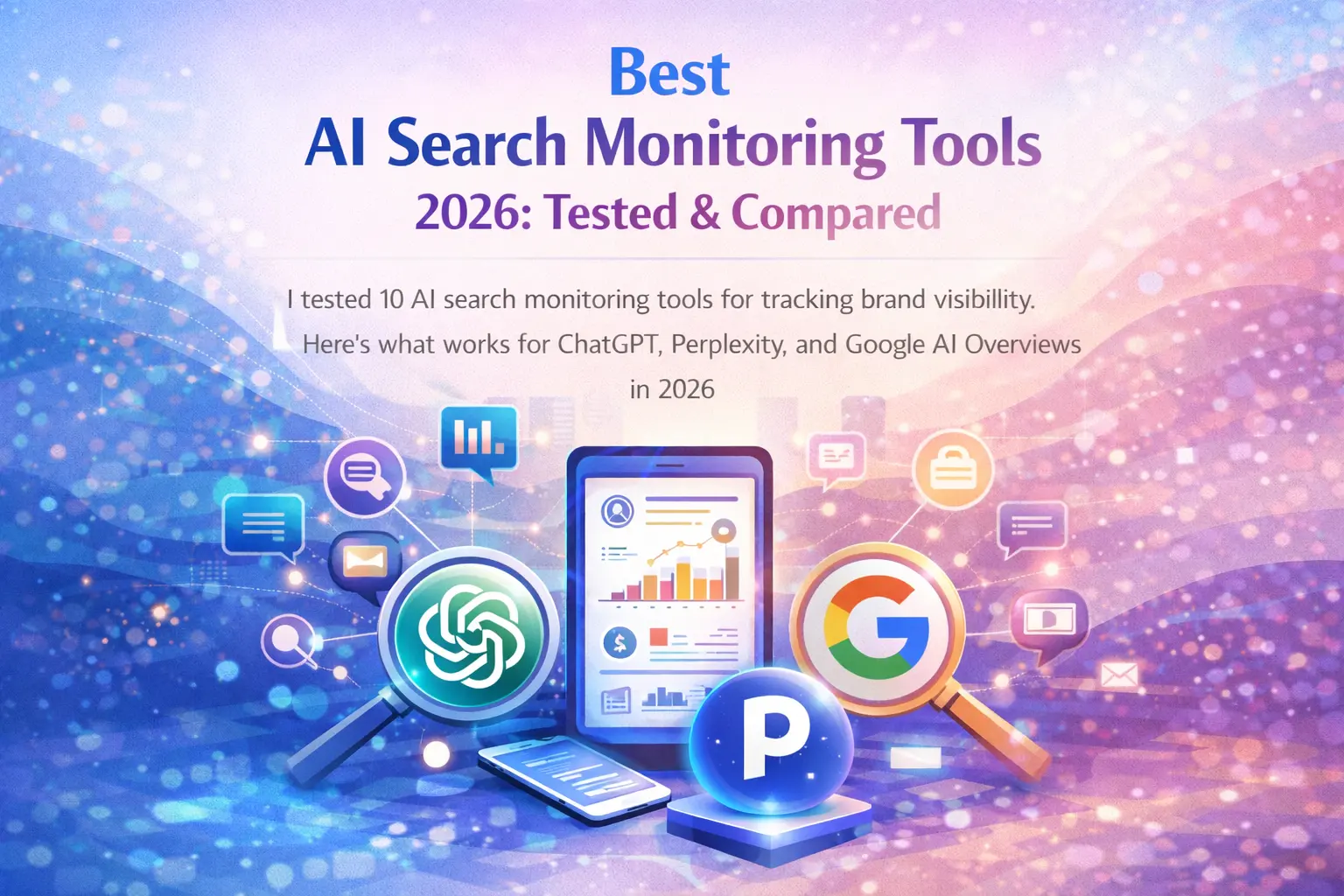
AI search monitoring tools are what rank trackers were ten years ago — most marketers know they need them, but nobody’s sure which ones are worth paying for. I’ve spent the last three months testing tools across this space, and the honest truth is that it’s messy. Some tools that look great on their landing pages fall apart when you check their data against reality. Others quietly deliver exactly what you need for a fraction of the price.
The category exists because AI search changed the visibility equation. ChatGPT processes over 2 billion queries daily. Google AI Overviews appear on roughly 48% of searches. Perplexity handles an estimated 1.2 billion queries monthly. Your brand is either showing up in those answers, or it’s not — and traditional SEO tools can’t tell you which.
Here’s what I found after testing the options, checking their accuracy, and figuring out what actually matters when you’re choosing a tool.
What AI Search Monitoring Tools Actually Do
Before I get into specific tools, it’s worth understanding what you’re measuring. Traditional SEO tools track your position on a search results page. AI search monitoring tools track something fundamentally different: whether AI models mention your brand when someone asks a question.
The core metrics are brand mentions (how often an AI platform names your brand in its response), citations (how often it links to your content as a source), share of voice (your mention percentage compared to competitors), and sentiment (whether the AI is saying positive, negative, or neutral things about you).
This matters because the signals that drive AI visibility aren’t the same ones that drive traditional rankings. Ahrefs found that brand mentions correlate 3x more with AI citations than backlinks do. YouTube mentions had the strongest correlation at 0.737, while Domain Rating — the gold standard for link building — scored just 0.218.
So you need different tools to track different signals. That’s the whole reason this category exists.
Best AI Search Monitoring Tools Compared
I grouped these by what they’re best at — pure monitoring, optimization, or both — because no single tool does everything well.
| Tool | Best For | Starting Price | AI Platforms Tracked | Key Strength |
|---|---|---|---|---|
| Profound | Enterprise visibility | $499/mo | 10+ (ChatGPT, Perplexity, AI Overviews, Gemini, Copilot, DeepSeek, Grok) | Prompt Volumes demand data |
| Ahrefs Brand Radar | Brand SOV analysis | $199/mo per index | 6 (AI Overviews, AI Mode, ChatGPT, Copilot, Gemini, Perplexity) | Historical data back to 2024 |
| Semrush AI Visibility | Existing Semrush users | Included in plans | 20+ AI assistants | Integrated with SEO workflows |
| AthenaHQ | GEO optimization | $295/mo | 6 (ChatGPT, Perplexity, Claude, Gemini, Copilot, AI Overviews) | Autonomous content agents |
| Peec AI | Mid-market monitoring | €90/mo | 6 platforms | Unlimited seats, direct support |
| Otterly AI | Budget-friendly tracking | $29/mo | 6 (ChatGPT, Perplexity, AI Overviews, AI Mode, Gemini, Copilot) | Lowest entry price |
| HubSpot AI Grader | Zero-budget baseline | Free | Limited | No cost to start |
Let me break down what I found with each one.
Profound: Built for Big Budgets
Profound has raised $155 million total — $58.5 million through its Series B led by Sequoia, then another $96 million in a Series C that valued the company at $1 billion, according to Fortune. That funding tells you who this tool is for: enterprise teams with serious budgets.
The thing that actually differentiates Profound is Prompt Volumes, a proprietary dataset that shows what real people are asking AI platforms. It includes demographic breakdowns by region, age, and income — essentially keyword research rebuilt for AI search. When I tested it, the data felt closer to what I see in actual AI responses compared to traditional keyword tools that guess at AI query intent.
The platform tracks 10+ AI platforms including some that competitors miss, like DeepSeek and Grok. You also get Profound Agents — automated workers that can draft content briefs, update knowledge sources, and trigger internal reviews.
The catch is price. The Lite plan starts at $499/month and only tracks ChatGPT with 50 prompts. The Growth plan at $399/month adds Perplexity and AI Overviews. Enterprise runs $2,000-5,000+/month. If you’re a small team, this isn’t for you.
My take: If you’re spending $50K+ per month on marketing and AI visibility directly affects revenue, Profound’s data quality justifies the cost. For everyone else, there are better options per dollar.
Ahrefs Brand Radar: SEO Teams’ Natural Extension
If you already use Ahrefs, Brand Radar is the path of least resistance. It tracks visibility across six AI platforms plus YouTube, TikTok, and Reddit — which matters because those social platforms feed the AI models that generate answers.
The best part is historical data going back to 2024. Most competitors only show you data from when you started tracking. Brand Radar lets you see trends over time, which helps you figure out whether your AI visibility is actually improving or just fluctuating.
I need to flag a problem, though. Independent testing found that Brand Radar reported only 3 ChatGPT mentions for a brand where manual verification found 123 actual mentions. On Perplexity, it reported 6 global mentions versus 212 in reality. That’s a significant accuracy gap. Ahrefs has been improving this, but you should cross-check the numbers against manual spot checks.
Pricing adds up fast: $199/month per AI index, or $699/month for all six bundled, on top of your base Ahrefs subscription starting at $129/month. You could be paying $828/month before you track a single competitor.
My take: Great for SEO teams already paying for Ahrefs who want AI data without learning a new platform. But verify the accuracy for your specific brand before relying on it for strategic decisions.
Semrush AI Visibility Toolkit: Best for Existing Users
Semrush added its AI Visibility Toolkit as part of the existing platform, which means you get AI search monitoring without paying for another subscription if you’re already a customer. It tracks over 20 AI assistants, which is the widest coverage I’ve seen.
The toolkit gives you an AI Visibility Score for any brand, prompt monitoring to see what questions people ask AI platforms in your industry, and a visibility overview showing mention counts and cited pages across ChatGPT, Google AI Overviews, Perplexity, and Gemini.
What I like is how it integrates with Semrush’s existing workflows. You can go from identifying that your brand isn’t showing up in AI answers to finding which of your pages rank best in traditional search (and therefore feed AI Overviews) without switching tools. That connection between traditional SEO and AI search optimization is something standalone tools miss.
The Enterprise AI Optimization (AIO) module recently added Microsoft Copilot tracking, which matters for B2B brands where Copilot usage skews heavily.
My take: If you’re already paying for Semrush, activating the AI Visibility Toolkit is a no-brainer. If you’re not a Semrush user, this alone isn’t enough reason to subscribe — the standalone AI monitoring tools are more focused.
AthenaHQ: When You Need Optimization, Not Just Monitoring
Most tools on this list tell you where you stand. AthenaHQ tries to help you improve. Its Athena Citation Engine (ACE) analyzes citation probability patterns across AI models, identifies content gaps, and deploys autonomous agents that draft GEO-optimized content.
The platform tracks ChatGPT, Perplexity, Claude, Gemini, Copilot, and Google AI Overviews. But the differentiator is what it does with that data. Instead of just showing you a dashboard, it gives you specific recommendations: which topics to create content for, what format will get cited, and how your competitors are getting picked up.
Agencies report that AthenaHQ helped them grow their GEO practice to 22% of agency revenue in under a year because it makes the service deliverable without massive overhead.
Pricing starts at $95 for the first month (introductory offer), then $295/month. No free trial, which is frustrating when you’re trying to evaluate ROI before committing.
My take: The strongest option if you want optimization guidance alongside monitoring. The autonomous agents genuinely save time on content analysis. But the $295/month price with no trial means you’re betting on it sight unseen.
Peec AI: Good Balance of Price and Depth
Peec AI launched in early 2025 from Berlin and hit €650K ARR within four months — a sign that the market was waiting for a mid-price option. The company reportedly reached a $100M+ valuation by November 2025.
It tracks six AI platforms with percentage-based visibility metrics and multi-country, multi-language monitoring. You get unlimited seats, suggested prompts, and URL-level insights that show which specific pages are getting cited.
The most consistent praise I’ve found across reviews is customer support. You get direct Slack access to the founding team, which matters when you’re working with a tool category where nobody fully understands what the metrics mean yet.
The base Starter plan costs €90/month, but tracking all major platforms (adding Claude, Gemini, DeepSeek, Grok) adds €80-120/month extra. So your real cost is closer to €170-210/month for comprehensive coverage, which is more than it first appears.
My take: The best balance of price and capability for teams that have outgrown free tools but can’t justify enterprise pricing. Just budget for the platform add-ons upfront so you’re not surprised.
Otterly AI: Best Budget Option
Otterly AI is where most small teams should start. At $29/month for the Lite plan, it’s the cheapest way to get automated AI visibility tracking across ChatGPT, Perplexity, Google AI Overviews, AI Mode, Gemini, and Copilot.
The Lite plan gives you 15 search prompts, which is enough to track your brand name and a few key product terms. The Standard plan at $189/month bumps that to 100 prompts with GEO audits and SWOT analysis. Premium at $489/month gets you 400 prompts.
I’ve been using Otterly for my own monitoring for the past couple of months. The citation gap analysis is useful — it shows you where competitors are getting cited and you’re not, which gives you concrete content targets. The GEO audit feature runs a SWOT analysis of your AI search presence that I’ve found reasonably accurate when I cross-checked against manual queries.
It’s not perfect. The 15-prompt limit on the Lite plan feels restrictive if you’re tracking multiple products or topics. And the reporting is functional but basic compared to Profound or AthenaHQ.
My take: Start here if your budget is under $200/month. The Lite plan gives you enough data to know whether AI visibility matters for your business before you invest in something more expensive.
Free and Low-Cost Options
Not every team needs paid tooling. Here’s what works at zero cost:
HubSpot AI Search Grader gives you a one-time audit of how your brand shows up in AI search. It’s not ongoing monitoring, but it’s a solid snapshot to establish your baseline.
Manual monitoring still works. Every week, I query my brand name and key topics on ChatGPT, Perplexity, Google AI Mode, and Gemini. It takes about 20 minutes and gives me ground truth that I can compare against what paid tools report. I actually caught accuracy issues in both Ahrefs Brand Radar and Otterly by doing this.
Google Search Console won’t tell you about AI citations directly, but it shows you which pages get impressions and clicks from Google — and 92% of AI Overview citations come from top-10 ranking pages. If your pages don’t rank in traditional search, they probably won’t get cited in AI Overviews either.
How to Choose the Right Tool
The tool you need depends on what you’re trying to do and what you can spend. Here’s my framework:
If you’re just starting out and spending under $29/month, use Otterly AI Lite or just do it manually. You don’t need enterprise tooling to figure out whether AI visibility matters for your business. Spend a month checking manually before committing to any paid tool.
For growing teams with $90-295/month to spend, Peec AI handles tracking well at a lower price. AthenaHQ is worth the premium if you also need optimization recommendations and content generation alongside the dashboards.
At the enterprise level ($499+/month), Profound has the deepest data, especially Prompt Volumes for AI keyword research. Ahrefs Brand Radar makes more sense if you’re already deep in their ecosystem and want everything in one place.
And if you’re already paying for SEO tools, check what you have first. Semrush’s toolkit is included in current plans. Ahrefs Brand Radar is an add-on. Don’t buy a standalone tool if your existing one covers enough.
What These Tools Can’t Do
I want to be honest about limitations because the marketing around AI visibility tools oversells what they deliver.
Accuracy is still inconsistent. Every tool I tested produced numbers that didn’t match manual verification. Some were close, some were way off. Use the data for trends and relative comparisons, not absolute numbers.
None of them can guarantee citations. They can show you where you’re not appearing and suggest why, but getting cited by ChatGPT or Perplexity depends on factors no tool fully controls — the training data, the user’s specific prompt, and the model’s inference logic.
Platform coverage gaps exist everywhere. AI search is fragmented across ChatGPT, Perplexity, Google AI Overviews, AI Mode, Gemini, Copilot, Claude, DeepSeek, and Grok. No single tool tracks all of them with equal depth. You’ll always have blind spots.
And most importantly: monitoring alone doesn’t improve visibility. These tools tell you where you stand. Actually getting cited requires the work — building brand mentions, creating citable content, maintaining structured data and entity presence. A tool can guide that work, but it can’t do it for you.
What I’d Do With $100/Month
If I were starting from scratch with a $100/month budget for AI search monitoring, here’s exactly what I’d do:
Sign up for Otterly AI Lite at $29/month. Use the remaining budget on content creation focused on building brand mentions across platforms that AI models pull from — Reddit discussions, YouTube content, and LinkedIn posts. If a guide is educational, I’d also repurpose it into a quick knowledge check with an AI quiz maker so it has another lightweight asset people can share. Manually check ChatGPT, Perplexity, and Google AI Mode for my brand weekly. Compare manual results against Otterly’s data.
After three months, I’d have enough data to know whether upgrading to a mid-tier tool makes sense. That’s a better approach than dropping $300+ on a tool before you even know whether AI search drives traffic for your business.
The tools will get better. The accuracy will improve. Pricing will probably drop as more competitors enter. But right now, the market is too immature to bet big on any single platform. Start small, verify against manual checks, and upgrade when you’ve proven AI search actually sends you traffic.