Key takeaways (May 17, 2026)
- CrewAI and LangGraph are the dominant multi-agent orchestration frameworks as of May 2026.
- MCP provides the shared tool layer across both ecosystems.
- Production teams pair multi-agent orchestration with hard guardrails — token budgets, escalation rules, and observability.
- Most successful multi-agent systems use 2–5 specialised agents, not dozens.
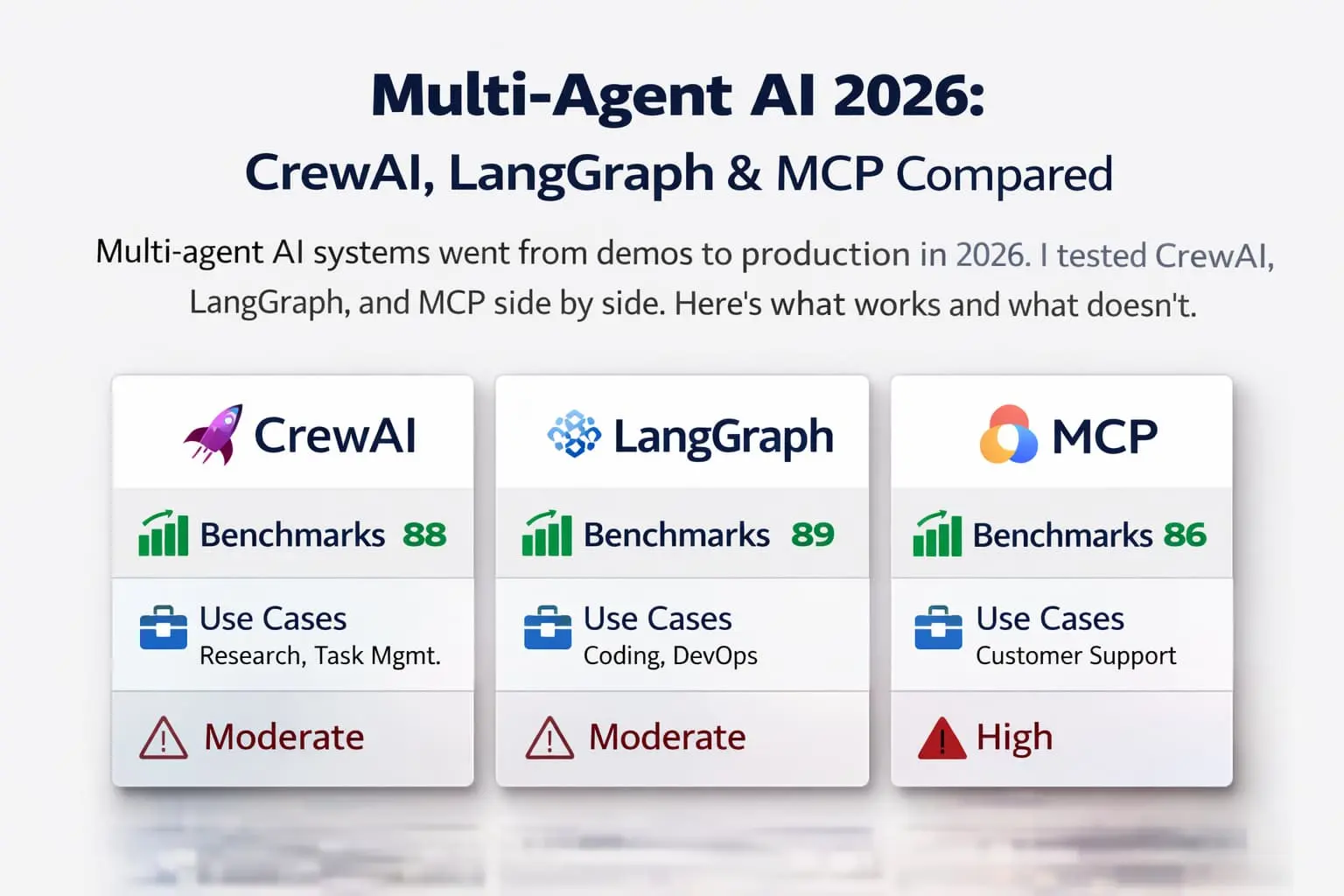
Short answer: use CrewAI when you need a fast role-based agent workflow, use LangGraph when the workflow needs production state control, and use MCP as the tool/context protocol that connects agents to external systems. They are not exact substitutes. CrewAI and LangGraph orchestrate agents. MCP standardizes how agents connect to tools, resources, prompts, and external context.
As of April 2026, the latest MCP roadmap focuses on transport scalability, agent communication, governance, and enterprise readiness. The MCP specification defines the protocol around JSON-RPC, hosts, clients, and servers. CrewAI now documents direct MCP server integration through its mcps field, while LangGraph 1.0 is listed as the current active LTS release in LangChain’s release policy.
Multi-agent AI went from a research curiosity to a production requirement in about eighteen months. I remember setting up my first CrewAI pipeline in late 2024 — three agents arguing over a blog post outline while burning through API credits. It felt like a toy. Now, in April 2026, I’m watching enterprises deploy multi-agent systems that coordinate supply chain logistics, triage security incidents, and process legal contracts at a scale that would’ve seemed implausible two years ago.
Gartner reported a 1,445% surge in multi-agent system inquiries from Q1 2024 to Q2 2025. That number tracks with what I’ve seen. The question isn’t whether multi-agent AI works anymore — it’s which framework to build on and which coordination protocol to adopt.
I’ve spent the last several months testing CrewAI, LangGraph, AutoGen (now AG2), and the protocol layer (MCP and A2A) across different project types. Here’s what I found, where each one shines, and where they fall apart.
Why 2026 is the breakout year for multi-agent AI
Single agents hit a ceiling fast. Give one agent a complex task — say, researching a competitive landscape, analyzing financial data, drafting a report, and fact-checking it — and you’ll watch it lose context, hallucinate mid-stream, or just produce mediocre output because it’s trying to do everything at once.
Multi-agent systems solve this by splitting work across specialized agents. One agent researches. Another analyzes data. A third writes. A fourth reviews. Each agent stays focused on what it does well, and an orchestration layer manages the handoffs.
This isn’t a new idea. But three things converged in 2025-2026 that made it practical:
- Frameworks matured. CrewAI hit 1.x, LangGraph reached general availability with v1.0, and AutoGen’s v0.4 rewrite (AG2) shipped with an event-driven core.
- Protocols standardized. The MCP 2026 roadmap now focuses on transport scalability, agent communication, governance, and enterprise readiness. Google’s A2A protocol hit v1.0 with 150+ supporting organizations.
- Enterprise demand exploded. Gartner predicts 40% of enterprise apps will feature task-specific AI agents by end of 2026, up from under 5% in 2025.
If you’ve been following the agentic AI revolution or the OpenAI Agents SDK 2026 sandbox and harness update, none of this is surprising. But the speed is worth noting — sorry, the speed is genuinely hard to process, even for people who’ve been tracking it daily.
The framework landscape: CrewAI, LangGraph, AutoGen, and what’s replacing them
CrewAI: role-based teams that get you moving fast
CrewAI takes the most intuitive approach to multi-agent design. You define agents with specific roles, backstories, and goals, then assemble them into a “crew” with a set of tasks. It’s almost like writing job descriptions.
I set up a CrewAI content pipeline last quarter — a researcher agent, a writer agent, a fact-checker, and an editor. From zero to a working prototype: about 45 minutes. The role-based mental model just clicks, especially for non-technical stakeholders who need to understand what the system is doing.
Where CrewAI gets tricky is production scale. Checkpointing support is limited compared to LangGraph, and when a crew fails mid-execution, debugging can feel like detective work. The CrewAI AMP enterprise platform adds observability and a control plane, but the open-source version still requires you to build that instrumentation yourself.
CrewAI is currently at version 1.12.0 (released March 26, 2026) and supports MCP tool integration, though it treats MCP tools as callable functions rather than first-class streaming components.
LangGraph: graph-based control for production workloads
LangGraph is the framework I reach for when a project needs to go to production. It models agent interactions as nodes in a directed graph, which gives you explicit control over state, branching logic, and conditional execution paths.
When I tested LangGraph on a document processing pipeline — intake agent, classification agent, extraction agent, validation agent — the graph architecture paid off immediately. I could add conditional branches (“if document type is invoice, route to the extraction agent; if contract, route to the legal review agent”) without rewriting the entire pipeline. State checkpointing meant I could resume failed workflows from exactly where they broke.
LangGraph 1.0 is designated as the current active LTS release in LangChain’s release policy, which matters if you are choosing a framework for production workflows that need support stability. Companies like Replit, Uber, LinkedIn, and GitLab run agent systems on LangGraph in production.
The downside: LangGraph’s learning curve is steeper. You need to think in graphs, understand state reducers, and manage node transitions explicitly. For a quick proof-of-concept, it’s overkill. For a system that needs to run reliably at enterprise scale, it’s the strongest option.
AutoGen / AG2: the conversation-first approach (and the fork situation)
AutoGen’s story got complicated. The original Microsoft Research project introduced conversational multi-agent patterns — agents debating, refining outputs through dialogue, reaching consensus. The v0.4 rewrite shipped with an async, event-driven architecture under the name AG2.
But here’s the thing: AutoGen is now in maintenance mode. Microsoft has moved its focus to the Microsoft Agent Framework (MAF), which merges AutoGen and Semantic Kernel into a unified enterprise offering. If you’re building new projects today, this matters.
AG2 is still maintained by the community and the conversation-based approach produces higher accuracy on reasoning-heavy tasks. The tradeoff is cost — AG2’s multi-turn conversations between agents run roughly 5-6x the token cost of LangGraph’s graph execution for equivalent tasks. I’ve seen this in my own billing. The agents are thorough, but they’re chatty.
For teams deep in the Microsoft ecosystem (Azure, Semantic Kernel, Copilot Studio), the Microsoft Agent Framework is probably the right bet going forward. For everyone else, CrewAI or LangGraph will get you further.
Multi-agent AI framework comparison
Here’s how the four main frameworks stack up based on my testing and research:
| Framework | Best for | Architecture | Learning curve | Enterprise ready |
|---|---|---|---|---|
| CrewAI | Rapid prototyping, role-based business workflows | Role-based agent crews with task delegation | Low — intuitive role/task model | Medium — AMP platform adds enterprise features |
| LangGraph | Production systems needing fine-grained control | Graph-based with explicit state and control flow | High — requires graph thinking | High — LangSmith observability, checkpointing, streaming |
| AutoGen/AG2 | Conversational reasoning, consensus tasks | Conversational multi-agent dialogue | Medium — async event-driven core | Medium — community-maintained, MAF for enterprise |
| Microsoft Agent Framework | Microsoft ecosystem, Azure-native deployments | Unified Semantic Kernel + AutoGen | Medium — familiar for .NET/Azure teams | High — Microsoft-backed, enterprise-grade |
The protocol layer: MCP and A2A explained
Frameworks handle orchestration — how agents work together. Protocols handle connectivity — how agents connect to tools and to each other. In 2026, two protocols dominate this layer.
Model Context Protocol (MCP): agents meet the real world
I covered MCP in detail earlier this year, but the short version: MCP is an open standard from Anthropic that defines how AI agents connect to external data sources and tools. Think of it as a USB-C port for AI — one standard interface instead of custom integrations for every tool.
The direction is clear: MCP is moving from a useful integration pattern to formal infrastructure for agent systems. The 2026 roadmap emphasizes working groups, Spec Enhancement Proposals, enterprise readiness, and governance maturation rather than one-off tool integrations.
All three major frameworks — CrewAI, LangGraph, and AG2 — support MCP. But the integration depth varies. LangGraph treats MCP tools as first-class graph nodes with full streaming support. CrewAI and AG2 treat them as callable functions, which works but misses MCP’s streaming capabilities.
MCP isn’t an agent framework. It’s the connection layer. A single CrewAI or LangGraph agent can use MCP to access a database, a file system, a Slack workspace, and a GitHub repo — all through the same protocol. That’s what makes it powerful for agentic AI deployments.
Agent-to-Agent protocol (A2A): when agents need to talk to agents
Where MCP connects agents to tools, Google’s A2A protocol connects agents to other agents — even when they’re built on completely different frameworks.
This is the missing piece. Say you have a customer service agent built on CrewAI and a billing agent built on LangGraph. Without A2A, these agents can’t communicate natively. You’d need custom API glue. A2A gives them a shared language.
A2A v1.0 shipped in 2026 built on HTTP, SSE, and JSON-RPC — standards that enterprise IT teams already know. Over 150 organizations now support A2A, with production deployments across supply chain, financial services, insurance, and IT operations. Google, Microsoft, and AWS have all integrated A2A into their cloud platforms.
My take: MCP and A2A aren’t competitors. They’re complementary. MCP is the vertical connection (agent to tool). A2A is the horizontal connection (agent to agent). Production multi-agent systems in 2026 use both.
Enterprise use cases that actually work
I’ve seen a lot of multi-agent demos. Most are impressive for five minutes and useless beyond that. Here are the use cases where I’ve seen real production value, not just proof-of-concept slides.
Customer support orchestration
This is the most mature use case. A triage agent classifies incoming tickets. A knowledge-base agent retrieves relevant documentation. A response agent drafts replies. An escalation agent decides when to route to a human. Enterprises running this pattern report 60-80% reductions in routine task handling time, and 79% of organizations now use AI agents in some form for customer operations.
Legal and contract processing
Law departments are seeing some of the clearest ROI. A document intake agent classifies contract types. An extraction agent pulls key terms, dates, and obligations. A compliance agent checks against regulatory requirements. A summary agent produces human-readable reviews. Teams report handling 3-4x more contract volume with the same headcount. Contracts that took days for initial review now get processed in hours.
Autonomous incident response
I wrote about this in my agentic AI in DevOps piece, but the multi-agent pattern is key here. A monitoring agent detects anomalies. A diagnostic agent pulls logs and traces. A remediation agent proposes fixes. A validation agent confirms the fix works in a sandbox before it touches production. AWS demonstrated this workflow with their DevOps Agent resolving incidents in under four minutes.
Supply chain coordination
Multiple agents monitor inventory levels, track shipments, analyze demand signals, and optimize routes in real time. This is where A2A really proves its value — the agents involved often span different vendors and platforms, and they need a common protocol to coordinate. Vertical adoption in supply chain and logistics was one of A2A’s earliest production success stories.
What analysts are saying (and what they’re getting wrong)
Both Gartner and Forrester have been aggressive in their multi-agent predictions. Gartner says 40% of enterprise apps will feature task-specific agents by end of 2026. Forrester is highlighting “physical AI” — agents coordinating robots, sensors, and supply chain systems — as the next wave.
But there’s a sobering number that doesn’t get enough attention: Gartner predicts over 40% of agentic AI projects will be canceled by end of 2027. The reasons? Escalating costs, unclear business value, and inadequate risk controls.
Forrester adds context here too — they forecast enterprises will defer 25% of planned AI spending into 2027 as hype gives way to financial accountability. Companies that implemented AI governance early pushed 12x more projects to production than those that skipped it.
My read: multi-agent AI is real and production-ready. But the failure rate will be high for teams that skip governance, observability, and clear success metrics. The technology works. The organizational discipline is what most teams lack.
The missing step is usually evaluation. Before a multi-agent workflow touches customers, I would run it through a focused AI agent evaluation framework that grades handoffs, tool calls, memory, security, cost, and recovery behavior.
How to choose: a practical framework decision tree
After testing these frameworks across different project types, here’s the decision process I’d follow:
Start with the question: How complex is your orchestration?
- Simple, sequential workflows (agent A does task, passes to agent B, etc.): Start with CrewAI. You’ll be productive in an hour.
- Complex, conditional workflows with branching, loops, and human-in-the-loop checkpoints: Use LangGraph. The upfront learning investment pays off at production scale.
- Conversation-heavy tasks where agents need to debate, critique, or reach consensus: Consider AG2, but budget for higher token costs.
- Microsoft-native organizations already on Azure and Semantic Kernel: Wait for the Microsoft Agent Framework, or start with AG2 and plan to migrate.
For the protocol layer:
- Use MCP for all tool connections. It’s the standard. Period. Every major framework supports it.
- Add A2A when you need agents from different frameworks or vendors to communicate.
For production readiness:
- Budget for observability from day one. LangSmith for LangGraph, CrewAI AMP for CrewAI, or third-party tools like Weights & Biases.
- Set up governance guardrails before deployment. The teams seeing real ROI are the ones that defined boundaries early.
- Start with one high-value use case. Don’t try to build an autonomous enterprise in quarter one.
What comes next
The next twelve months will separate the frameworks that last from the ones that fade. I’m watching three developments:
MCP’s multi-agent spec. Anthropic has published early drafts of a companion specification for multi-agent scenarios. If this ships, MCP could expand from tool connectivity into agent-to-agent coordination — potentially overlapping with A2A’s territory.
Microsoft Agent Framework’s GA. The merger of AutoGen and Semantic Kernel into MAF will determine whether Microsoft maintains its position in the multi-agent space or cedes it to LangGraph and CrewAI.
The governance shakeout. That 40% cancellation rate Gartner predicted? Most of those failures will come from teams that deployed autonomous agents without proper guardrails. The winners will be organizations that treated governance as a feature, not an afterthought.
Multi-agent AI in 2026 is real, messy, and moving fast. The frameworks are good enough. The protocols are standardizing. The hard part, as always, is figuring out what to build and how to keep it under control.
Related AI insights
- Claude Managed Agents dreaming, outcomes, and multiagent orchestration — Anthropic’s May 2026 update that adds native cross-session memory and parallel agent delegation to its platform
- MCP and agentic AI explained — deep dive into how MCP connects agents to external tools
- The agentic AI revolution 2026 — the broader shift toward autonomous AI systems
- Autonomous AI agents 2026: AutoGPT vs BabyAGI vs Jarvis — comparing autonomous agent approaches
- Agentic AI: 7 deployments, risks, and what’s next — enterprise deployment lessons and risk management
- AI coding agents 2026: GPT-5, Claude Code, and developers — how agents are changing software development
- DeepSeek V4 Pro: open frontier AI at 1/10 the cost — the open-weights model that finally competes on agentic coding
- Notion Developer Platform: AI agents hub 2026 — Workers, External Agents API, and Claude Code/Cursor/Codex/Decagon partner agents inside Notion