Key takeaways (May 17, 2026)
- Visibility now spans Google AI Overviews / AI Mode, ChatGPT search, Perplexity and Bing Copilot.
- Quotable, structured passages and schema (Article, FAQPage, Organization) are the consistent levers.
- Track AI citations as a separate KPI alongside organic rankings.
- Brand entity clarity (consistent Person and Organization schema across pages) lifts citation rate.
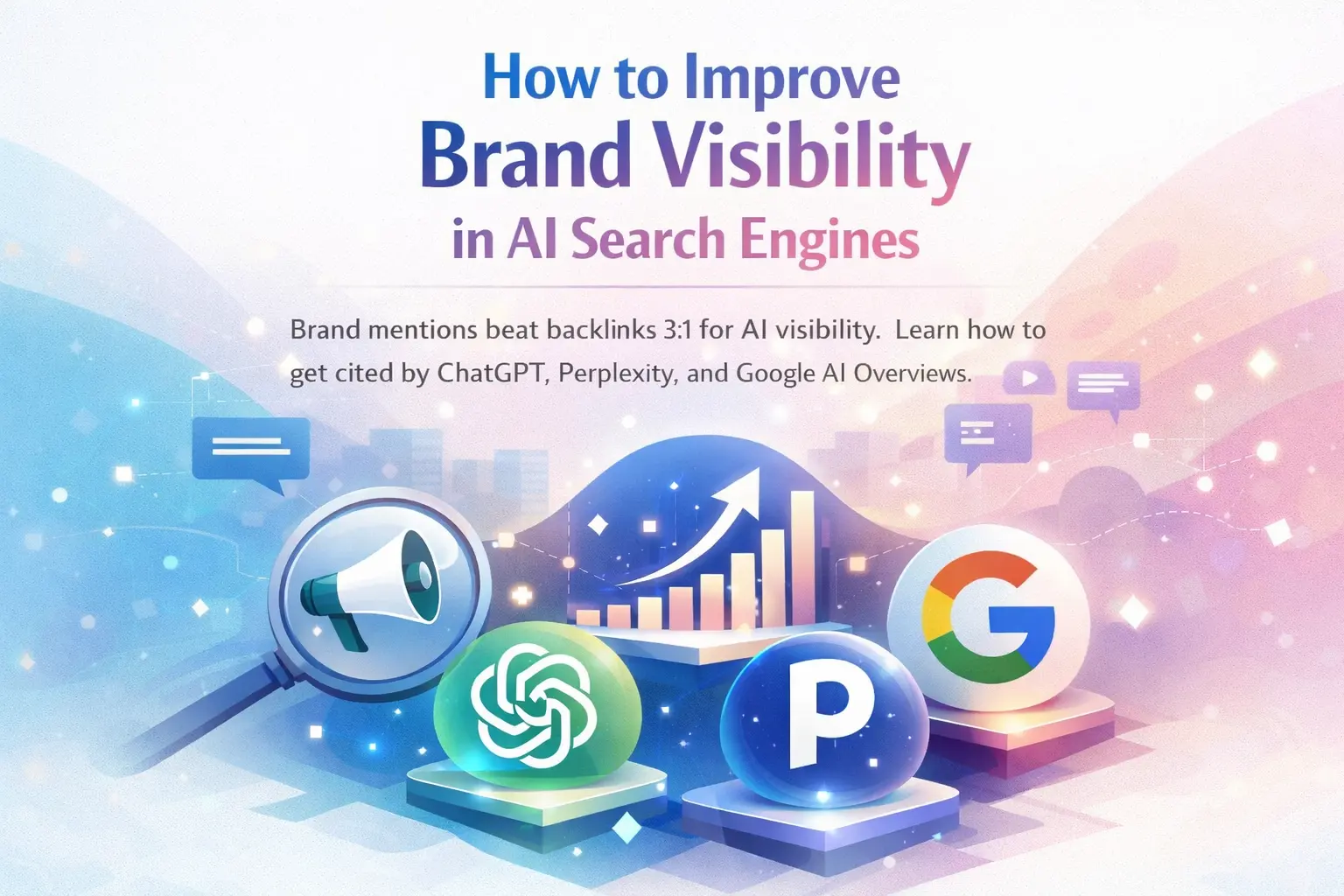
How to improve brand visibility in AI search engines comes down to one shift most marketers haven’t made yet: brand mentions now matter more than backlinks. Ahrefs analyzed 75,000 brands in August 2025 and found that brand mentions correlate with AI visibility at 0.664 — three times stronger than backlinks at 0.218. If you’re still focused exclusively on link building, you’re optimizing for a system that’s losing ground.
I’ve been tracking this shift since Google AI Overviews rolled out to 2 billion monthly users in early 2026. The numbers are hard to ignore: 48% of Google searches now trigger AI Overviews, ChatGPT processes over 2 billion queries daily with 900 million weekly active users, and Perplexity handles an estimated 1.2 billion queries per month. These platforms don’t rank pages — they cite sources. And the sources they cite aren’t always the ones with the most backlinks.
Here’s what I’ve found after months of testing and monitoring AI search results for my own content: the rules are different, they’re still forming, and the teams that figure them out now will have an enormous advantage.
The Data: Why Brand Mentions Beat Backlinks for AI Visibility
Let me start with the Ahrefs study because it changed how I think about this entire space.
In August 2025, Ahrefs analyzed 75,000 brands to determine what actually correlates with appearing in AI-generated answers. The results surprised a lot of people in the SEO community:
| Signal | Correlation with AI Visibility |
|---|---|
| YouTube mentions | 0.737 (strongest) |
| Brand web mentions | 0.664 |
| Reddit mentions | High |
| Wikipedia presence | High |
| LinkedIn presence | Moderate |
| Backlinks (Domain Rating) | 0.218 (weak) |
| Number of pages on site | 0.194 (very weak) |
That last row is the one that stings. Publishing more content on your own site barely moves the needle for AI visibility. What matters is how often other people mention your brand on platforms that AI models actually pull from.
This tracks with what I’ve seen monitoring my own content across AI search platforms. Articles I published that got discussed on Reddit showed up in Perplexity answers within weeks. Articles with more backlinks but no social discussion didn’t.
And here’s the kicker: only 13.7% of citations overlap between Google AI Overviews and Google AI Mode. They cite different sources for the same queries. So you can’t just optimize for one AI feature and assume you’re covered.
Where Each AI Platform Gets Its Sources
Each AI search platform has distinct citation preferences. Understanding this is the difference between a general strategy and one that actually works.
ChatGPT: Wikipedia Is King
ChatGPT cites Wikipedia in 47.9% of its top-10 source citations. That’s nearly half. If your brand or topic doesn’t have a Wikipedia presence, ChatGPT is less likely to mention you.
The next most-cited sources for ChatGPT are government sites, academic publishers, and major news outlets. This tells you something important: ChatGPT trusts institutional authority. Building visibility here means getting your brand mentioned in authoritative contexts — not just on your own blog.
Google AI Overviews: Reddit and YouTube
Google AI Overviews pull heavily from Reddit (21% of top citations) and YouTube (18.8%). This makes sense — Google owns YouTube and has a content licensing deal with Reddit.
The practical implication: if you want to show up in AI Overviews, participating in Reddit discussions about your industry and creating YouTube content around your topics is more effective than publishing another blog post.
Perplexity: Reddit Dominates
Perplexity leans even harder into Reddit. Reddit accounts for 46.7% of Perplexity’s top-10 citations, more than three times the share of YouTube at 13.9%. Perplexity treats Reddit as a primary source of truth for real-world opinions and experiences.
The Combined Picture
| Platform | Top Source | % of Top Citations | Second Source | Third Source |
|---|---|---|---|---|
| ChatGPT | Wikipedia | 47.9% | Gov/edu sites | News outlets |
| Google AI Overviews | 21% | YouTube (18.8%) | News sites | |
| Perplexity | 46.7% | YouTube (13.9%) | Wikipedia | |
| Bing Copilot | Bing index | Varies | Authoritative sites | News outlets |
If you’re choosing where to invest your time, Reddit gives you the broadest coverage across AI platforms. YouTube is second. Wikipedia is essential specifically for ChatGPT.
For teams building AI-powered tools or agentic systems, this data should shape how you think about go-to-market — product visibility in AI search is now a distribution channel, not just a marketing metric.
What Generative Engine Optimization (GEO) Actually Means
Generative Engine Optimization is the practice of making your content citable by AI systems. The term has been floating around since late 2024, but in 2026 it’s become an actual discipline with data behind it.
The GEO market is projected to grow from $886 million in 2024 to $7.3 billion by 2031. And 32% of digital marketing leaders now rank GEO as their top priority — yet fewer than 12% have a documented strategy for it.
Here’s what GEO boils down to in practice:
Make Your Content Extractable
AI systems don’t read your page the way humans do. They’re looking for self-contained passages they can extract, summarize, and attribute. The research from a Georgia Tech study on GEO found that content with statistics, quotations, and cited sources gets 30-40% higher visibility in AI-generated responses.
The optimal passage length for AI citation is 134-167 words. That’s long enough to contain a complete answer but short enough that AI systems can extract it without truncation. I’ve started structuring every section of my articles with at least one self-contained block in this range.
Use Definition Patterns
AI systems love “X is…” and “X refers to…” sentence structures. When someone asks ChatGPT or Perplexity “what is generative engine optimization?”, the AI scans for passages that directly define the term. If your content buries the definition in paragraph three of a long introduction, you lose.
Put your definitions first. Start sections with the answer, then explain.
Structure Beats Prose
Pages with clear H2/H3 heading hierarchies, comparison tables, and bulleted lists get cited more than walls of text. This isn’t a style preference — it’s how AI parsers work. They segment content by headings and extract structured data more reliably than free-flowing paragraphs.
This is why comparison articles and framework breakdowns tend to perform well in AI search — they’re inherently structured.
The Technical Foundation: What Your Site Needs
Before worrying about content strategy, make sure AI crawlers can actually access your site. I’ve seen teams spend months on GEO content only to discover they were blocking the crawlers that would cite them.
robots.txt Configuration
Your robots.txt should allow the AI crawlers that serve search features while blocking the ones that only scrape for training data:
Allow the search crawlers: GPTBot (OpenAI/ChatGPT web search), OAI-SearchBot (OpenAI search features), ChatGPT-User (ChatGPT browsing), ClaudeBot (Anthropic/Claude web features), and PerplexityBot (Perplexity AI search).
Block the training scrapers: CCBot (Common Crawl training data), Bytespider (ByteDance/TikTok AI), and anthropic-ai (Anthropic training crawler).
The distinction matters. GPTBot feeds into ChatGPT’s search results — blocking it means you won’t appear when users search with ChatGPT. CCBot just scrapes content for training datasets without driving any visibility back to you.
The llms.txt Standard
There’s a new standard gaining adoption called llms.txt. Where robots.txt tells crawlers where not to go, llms.txt tells AI systems what your site is about, which pages matter most, and how your content is organized.
The file lives at your site root (/llms.txt) and uses a simple Markdown format:
# Your Site Name
> One-line description of what your site covers

## Key Pages
- [Page Title](url): Brief description
- [Another Page](url): Brief description

## Key Facts
- Fact about your site
- Another important fact
Think of it as an elevator pitch for AI crawlers. The first blockquote line is especially important — AI systems extract it as your site’s core description.
Schema Markup for AI Discoverability
Structured data helps AI systems understand your content’s context. At minimum, implement Article schema with author, datePublished, and dateModified fields. Add Person schema for authors with credentials and sameAs links to LinkedIn and Twitter. And set up Organization schema for your brand.
The sameAs property matters more than most people realize. It tells AI systems that your brand entity on your website is the same entity on LinkedIn, Wikipedia, YouTube, and other platforms. That connection strengthens exactly the brand mention signals that Ahrefs found correlate with AI citations. I added sameAs to my own author schema pointing to my LinkedIn and Twitter profiles, and it took about 10 minutes — one of those rare cases where the effort-to-impact ratio actually makes sense.
7 Tactics to Improve Brand Visibility in AI Search Right Now
I’ve tested these across my own content. Some work fast. Others take months. All of them are worth doing.
1. Build Your Reddit Presence
Reddit is the single most-cited platform across AI search engines. But you can’t just spam links — Reddit communities will bury you.
What works: participate in discussions in subreddits related to your industry. Share insights, answer questions, and reference your content only when it’s genuinely relevant. I post in AI-focused subreddits about topics I’ve already written about, adding context that goes beyond the article. When someone asks a follow-up question, I’ll link to my detailed writeup.
The key is contributing value first. Reddit users have zero tolerance for self-promotion, and AI systems are trained on the upvote patterns — heavily downvoted posts don’t get cited.
2. Create YouTube Content
YouTube mentions showed the strongest single correlation (0.737) with AI visibility in the Ahrefs study. You don’t need polished production — even screen recordings with voiceover work.
What I’d recommend: take your best-performing articles and turn them into 10-15 minute video breakdowns. AI systems cross-reference your video content with your written content, strengthening your brand’s entity signals.
3. Publish Original Data and Research
Content with original statistics gets cited at dramatically higher rates than content that merely summarizes other people’s data. When you publish a number that doesn’t exist anywhere else, AI systems have no choice but to cite you as the source.
This is why I track and publish SEO performance data and AI regulation timelines with specific dates — these become reference points that AI systems pull from.
4. Get Mentioned on Third-Party Sites
85% of brand mentions that drive AI visibility originate from third-party pages, not your own domain. The most effective approach:
- Respond to journalist queries on HARO, Connectively, or Qwoted
- Write guest posts on industry blogs with your brand naturally mentioned
- Contribute to GitHub awesome-lists and community resources
- Get quoted in newsletters and podcasts
Each mention on an external site creates a signal that AI systems use to validate your brand’s authority.
5. Update Content Quarterly
Pages not updated within two months earn 28% fewer AI citations than recently refreshed content. AI systems prioritize freshness, especially for topics that evolve quickly.
I update my top articles every 2-4 weeks with new data, new developments, and new internal links. That’s how articles on EU AI Act enforcement and the Digital Omnibus delay stay relevant — the regulation landscape changes constantly, and AI systems notice when content reflects the latest state.
6. Optimize for Passage-Level Extraction
Forget optimizing for “keywords.” Optimize for passages. AI systems extract specific answer blocks from your content, and the quality of those blocks determines whether you get cited.
For every major section, include at least one passage that:
- Opens with a direct answer or definition
- Contains a specific statistic or fact
- Is 134-167 words (the optimal extraction length)
- Can stand alone without surrounding context
7. Build Entity Connections Across Platforms
AI systems understand entities — brands, people, concepts — not just keywords. The more platforms where your brand entity appears with consistent information, the stronger your AI visibility signal.
At minimum, maintain active profiles on:
- LinkedIn (personal + company page)
- YouTube
- GitHub (if relevant)
- Wikipedia (if notable enough)
Use consistent branding, descriptions, and links across all of them. Implement sameAs schema on your website pointing to each profile.
AI Search Monitoring: How to Measure What’s Working
You can’t improve what you don’t measure. Here’s how I track AI search visibility:
Manual Monitoring (Free)
Every week, I search for my target queries on ChatGPT, Perplexity, and Google AI Mode. I note whether my brand or articles get mentioned, what sources get cited instead, and how the answers change over time.
This sounds basic, but it works. Most teams aren’t doing even this. Start a spreadsheet with columns for query, platform, whether you were cited, and which competitors were.
Paid Tools
| Tool | Starting Price | Platforms Tracked | Best For |
|---|---|---|---|
| Otterly AI | $29/mo | ChatGPT, Perplexity, Google AIO, AI Mode, Gemini, Claude | Share of AI Voice metric |
| Nightwatch | Varies | LLMs + traditional search | Combined AI + SEO tracking |
| SE Ranking | Varies | Google AI Mode + traditional | Teams already using SE Ranking |
| Semrush | From $139/mo | Multiple AI platforms | Enterprise teams |
For most small teams, start with manual monitoring. Move to paid tools once you have enough content to justify the tracking overhead. I wrote a full breakdown of the best AI search monitoring tools for 2026 if you want a deeper comparison with pricing and accuracy testing.
What the Numbers Say About AI Search Traffic
Let me be honest about the traffic reality. AI search is growing explosively, but the traffic dynamics are different from traditional search:
- AI-referred traffic grew 9.7% since 2024, while organic search traffic declined 2.5% year over year as of January 2026
- Gen AI traffic is growing 165x faster than organic search traffic
- But AI referral traffic still accounts for only about 1.08% of total website traffic
- 93% of AI search sessions end without a website click
- When an AI Overview appears, CTR to the top-ranking page drops by 58%
So why bother? Because the trajectory matters more than the current snapshot. ChatGPT is already sending more referral traffic than Reddit and LinkedIn. AI Overviews reach 2 billion users monthly. The 1.08% figure is growing while the traditional organic figure is shrinking.
The teams investing in AI visibility now are positioning for where search is going, not where it’s been. It’s the same logic that drove early SEO adoption in the 2000s — the absolute numbers were small, but the growth curve was undeniable.
For a deeper look at how AI governance frameworks intersect with AI search visibility — especially for regulated industries — I’ve written about the compliance considerations that affect what AI systems can and will cite.
Common Mistakes I See Teams Making
Most teams I talk to are making the same handful of errors. Here’s what keeps coming up.
Treating AI search like traditional SEO is the biggest one. Keyword density, meta tags, and exact-match anchors don’t drive AI citations. AI systems evaluate whether your content is a trustworthy, citable source — not whether you mentioned a keyword 12 times. I spent two months obsessing over keyword placement before realizing none of it mattered for AI citations. What mattered was whether my content contained extractable, well-sourced passages.
Only publishing on your own domain is another trap. The Ahrefs data is clear: the number of pages on your site correlates at just 0.194 with AI visibility. Your presence on third-party platforms matters far more than your publishing velocity on your own blog.
Ignoring platform-specific differences costs people too. Optimizing for “AI search” generically is like optimizing for “social media” generically. ChatGPT, Perplexity, and Google AI Overviews have distinct citation patterns. A strategy that works for Perplexity (Reddit-heavy) won’t work for ChatGPT (Wikipedia-heavy).
Then there’s blocking AI crawlers out of fear. Some sites still block GPTBot and PerplexityBot in robots.txt because they’re worried about AI training. But GPTBot also powers ChatGPT search — blocking it means zero visibility in one of the largest AI search platforms. You have to separate your crawler policies for search bots vs. training bots.
And the quietest mistake: waiting for the data to be clearer. Fewer than 12% of marketing teams have a documented GEO strategy. That gap is your opportunity, but it won’t last forever.
What Comes Next
AI search is evolving fast. Here’s what I’m watching:
Google AI Mode — a fully conversational search experience with zero blue links — launched publicly in May 2025 and is already available in 180+ countries. In AI Mode, citation is the only visibility mechanism. There are no organic results to fall back on.
Perplexity is projected to hit $656 million ARR in 2026, up from $200 million in September 2025. That’s 800% year-over-year growth. As more users shift discovery to Perplexity, Reddit presence becomes increasingly valuable.
And the MCP protocol is connecting AI agents directly to data sources, which will create new citation pathways that don’t exist yet. The teams building agentic AI systems today will be the first to benefit when AI agents start making purchasing and recommendation decisions on behalf of users.
I don’t think most brands have caught up to what’s happening here. The ones building their AI presence now — Reddit threads, YouTube content, third-party mentions — will be the ones that AI systems default to citing in a year. The ones waiting for a clearer playbook will find that the early movers already own the citations they needed.
Disclosure: This article references third-party tools and platforms. We have no affiliate relationships with any of the tools mentioned.
FAQs About Brand Visibility in AI Search
What is brand visibility in AI search engines? It measures how often your brand gets mentioned or cited when users ask questions on ChatGPT, Google AI Overviews, Perplexity, or Bing Copilot. Unlike traditional search rankings, AI visibility depends on brand mention signals across third-party platforms — not just your own website’s SEO.
Is GEO replacing SEO? No. GEO builds on SEO. 92% of AI Overview citations still come from top-10 ranking pages, so traditional search performance feeds directly into AI visibility. Think of GEO as an additional layer, not a replacement. You still need strong on-page SEO, but you also need brand mentions and citable content.
How long does it take to see results from AI search optimization? Based on what I’ve seen, Reddit and YouTube mentions can influence Perplexity citations within 2-4 weeks. Google AI Overviews track closer to traditional SEO timelines — expect 2-3 months for content changes to affect citations. ChatGPT visibility tied to Wikipedia or major publications can take 3-6 months because those platforms move slowly.
Does paid advertising affect AI search visibility? No. AI search citations are based on content quality, brand authority, and mention signals — not ad spend. You can’t buy your way into a ChatGPT answer. This is one area where organic presence genuinely matters more than budget.