
Siri AI EU Launch Blocked: WWDC 2026 Fallout
Apple's Siri AI EU launch blocked at WWDC 2026 as Apple and Brussels trade blame over the DMA, plus the confirmed Google Gemini deal. What it means.
Track EU AI Act deadlines, enforcement updates, compliance checklists, and engineering implications in one place.
The EU AI Act is now a shipping constraint, not a background policy story. This hub pulls together everything engineering, compliance, and product teams need to know: deadline tracking, enforcement updates, compliance checklists, worker-protection coverage, and practical engineering translations of each requirement. August 2, 2026 is a hard enforcement date for high-risk AI systems used in hiring, employment decisions, autonomous task allocation, and customer-facing systems. This hub consolidates the deadline tracker, enforcement updates, compliance checklists, and worker-protection coverage AI teams need before that date arrives.
The EU AI Act has moved from policy discussion to operational reality. Effective August 2, 2026, the regulation establishes binding requirements for AI systems used across employment decisions, autonomous task allocation, and public-facing applications. This guide consolidates the enforcement timeline, risk categorization, penalty structure, and practical compliance steps for engineering, product, and compliance teams.
The EU AI Act (Regulation 2024/1689) follows a staggered implementation schedule with August 2, 2026 as the critical compliance deadline for high-risk systems:
This is a hard date—organizations deploying high-risk AI systems must achieve compliance before August 2, 2026. The Act does not grandfather existing systems; pre-deployment systems are subject to enforcement immediately upon the deadline.
The EU AI Act stratifies AI systems into four risk tiers with escalating requirements:
Prohibited Risk: Entirely banned. Includes social scoring systems, real-time biometric identification in public spaces (with limited exceptions for law enforcement), subliminal manipulation, and other AI applications deemed to create unacceptable risks.
High-Risk Systems: Require comprehensive governance before deployment. These systems cover:
Each high-risk system must meet these requirements by August 2, 2026:
Limited Risk: Transparency required. AI systems that interact directly with users (chatbots, content generators) must disclose when the user is interacting with AI.
Minimal Risk: General compliance. Most AI applications fall here (recommendation engines, code assistants in development environments, internal analytics).
Non-compliance carries substantial financial penalties, structured in three tiers:
Per Article 99 of Regulation (EU) 2024/1689:
For SMEs and startups, each cap applies as the lower of the two amounts rather than the higher. For large organizations, the percentage-based calculation typically yields the bigger figure:
Penalties are assessed per infringement, and a company deploying multiple non-compliant high-risk systems can face cumulative enforcement across them.
Organizations deploying high-risk AI by August 2, 2026 must execute this checklist:
Risk Categorization: Audit all deployed AI systems and classify by risk tier. Document this categorization with justification.
Data Governance: Identify and log all training data sources, including synthetic or augmented data. Ensure data quality, representativeness, and completeness.
Impact Assessments: Conduct and document data protection impact assessments (DPIAs) under GDPR and AI-specific impact assessments under the AI Act.
Bias & Fairness Testing: Test for disparate impact across protected classes (gender, race, age, disability status). Document performance metrics by demographic group.
Human-in-the-Loop Design: Design systems to allow human override before final deployment. Ensure human reviewers have adequate training and time to make informed decisions.
Transparency & User Notification: Notify data subjects when their data is used in a high-risk AI decision. Provide clear information about system logic (no black boxes).
Monitoring & Logging: Implement logging of all high-risk AI decisions for auditability. Retain logs for compliance review (minimum 3 years recommended).
Technical Documentation: Prepare system documentation including performance metrics, known limitations, and documented failure modes.
GPAI Compliance: If using general-purpose AI models (Claude, GPT-5.5, Gemini, etc.) for sensitive applications, ensure the model provider's Code of Practice is documented.
Legal Review: Have qualified legal counsel review your AI system against your member state's interpretation of the Act's requirements.
Organizations providing general-purpose AI models (foundation models and large language models like Claude, GPT-5.5, Gemini, Llama) must:
This applies directly to providers; deployers of these models remain responsible for their own compliance (human oversight, bias testing, impact assessment).
The EU AI Act extends specific protections to workers subject to AI-driven employment decisions:
The Act defines "worker" broadly, covering employees, contractors, gig workers, and temporary staff. A company using AI to screen contractor applications or allocate delivery tasks must comply with these protections.
Enforcement is accelerating:
August 2, 2026 is a hard enforcement date for high-risk AI systems. Organizations must complete risk categorization, data governance, impact assessments, bias testing, and human-review design before that date. The penalty structure (6% global revenue for prohibited AI, 4% for high-risk violations) creates strong financial incentive for compliance. Immediate action required.
Q: Does the August 2, 2026 deadline apply to all AI systems? A: No. Only high-risk systems (hiring, employment, autonomous task allocation, critical systems) face hard enforcement on August 2. Limited-risk systems (transparency required) have less stringent timelines. Minimal-risk systems had general compliance obligations already in effect.
Q: Can I grandfather legacy AI systems deployed before August 2? A: No. Pre-existing systems are subject to the Act upon enforcement. You cannot grandfather legacy AI systems. If your system meets high-risk criteria, you must achieve compliance by August 2 or face substantial fines.
Q: How do I determine if my specific AI system is high-risk? A: Use the Act's risk classification framework. Systems used in hiring, employment, education, credit, insurance, law enforcement, autonomous vehicles, critical infrastructure, or biometric identification are presumed high-risk. Consult an EU data protection lawyer for system-specific classification.
Q: Can I use general-purpose AI models like Claude or ChatGPT in high-risk applications? A: Yes, but with caveats. The model provider must comply with GPAI obligations. You, as the deployer, remain fully responsible for human oversight, bias testing, impact assessment, and record-keeping. Using a compliant model does not excuse you from your own compliance obligations.
Q: What is the Digital Omnibus amendment, and will it delay the August 2 deadline? A: The Digital Omnibus amendment refines GPAI definitions and may extend certain deadlines. As of June 2026, it remains under negotiation and is not expected to delay the August 2 deadline for high-risk systems, but may adjust other timelines and requirements.
Canonical coverage grouped under one topic.
 AI Regulation
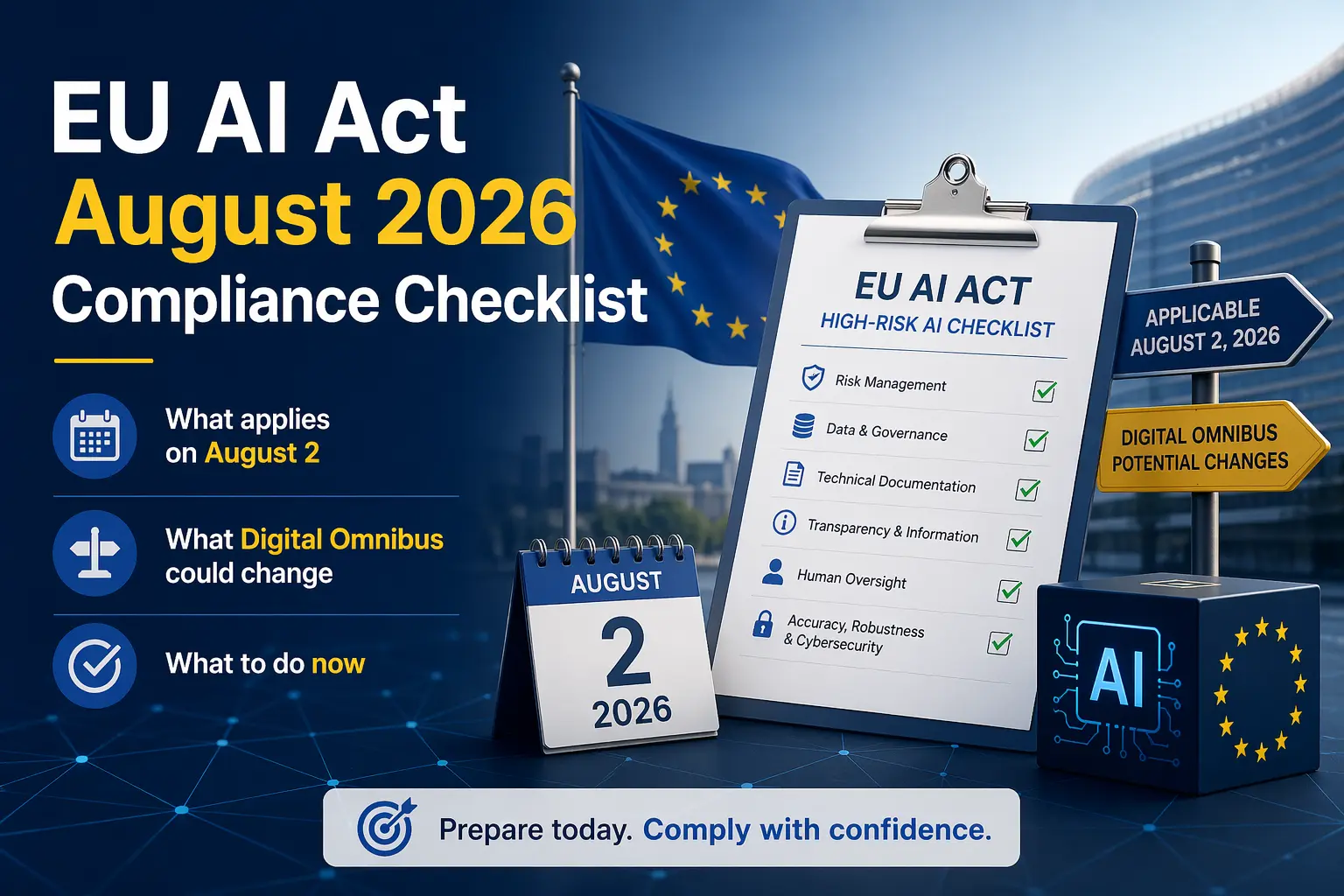
 EU AI Act August 2026 compliance checklist for high-risk AI teams. What applies on August 2, what Digital Omnibus could change, and what to do now.
 AI Regulation
 AI could displace 300M jobs. But the EU AI Act has worker protections most companies miss. Here's what the data and August 2026 enforcement actually require.
 AI Regulation
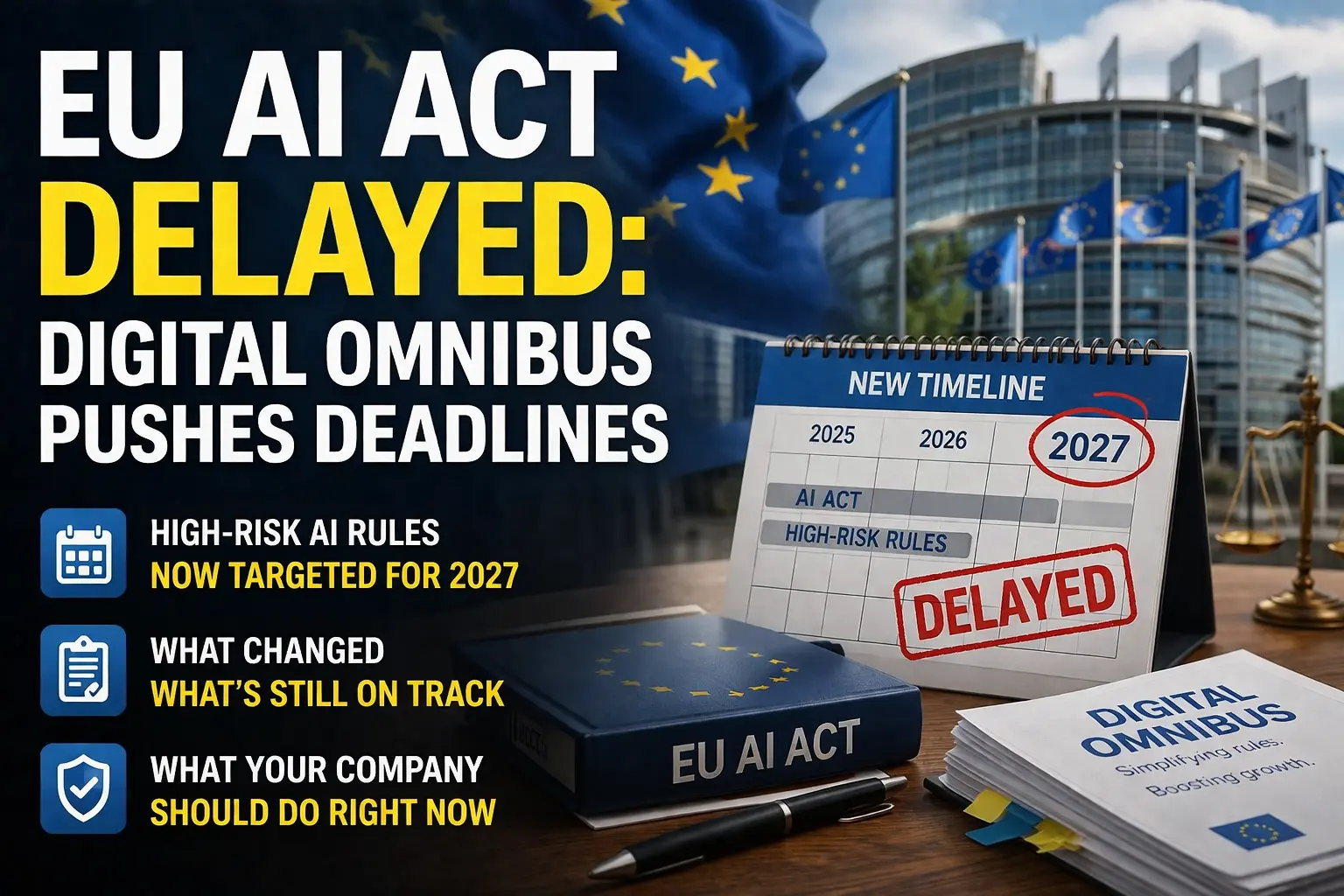
 Is the EU AI Act delayed to 2027? April 2026 enforcement status, Digital Omnibus timeline, what obligations apply now, and how to prepare before August 2026.
 News
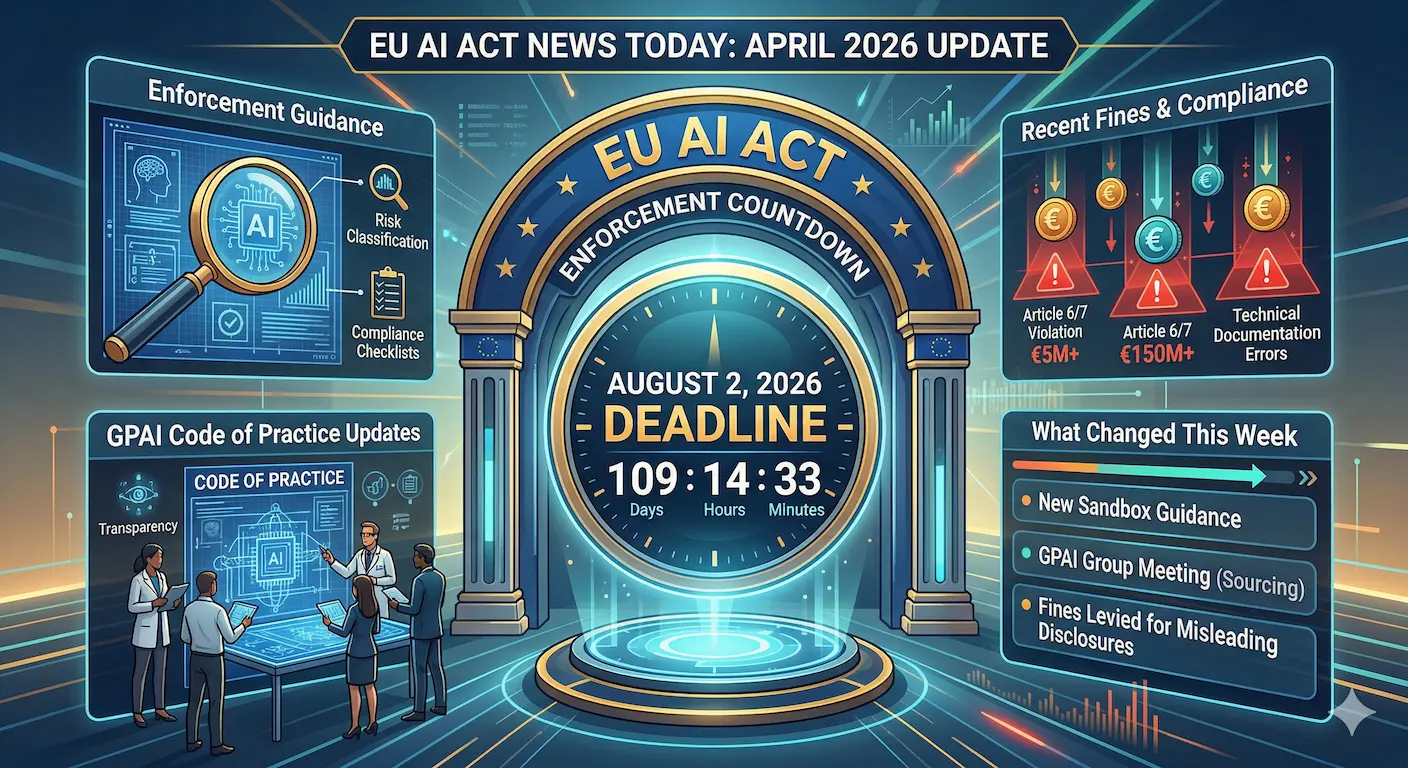
News The latest EU AI Act news for April 2026. New enforcement guidance, GPAI Code of Practice updates, fresh fines, and the August 2 deadline countdown - explained.
 AI Regulation
 Key EU AI Act deadlines in 2026 explained. Learn which obligations take effect, what high-risk AI rules mean for your business, and how to prepare now.
 AI Regulation
 EU AI Act enforcement begins in 2026. Get the latest updates on compliance timelines, high-risk AI rules, and what organizations must do to stay compliant.