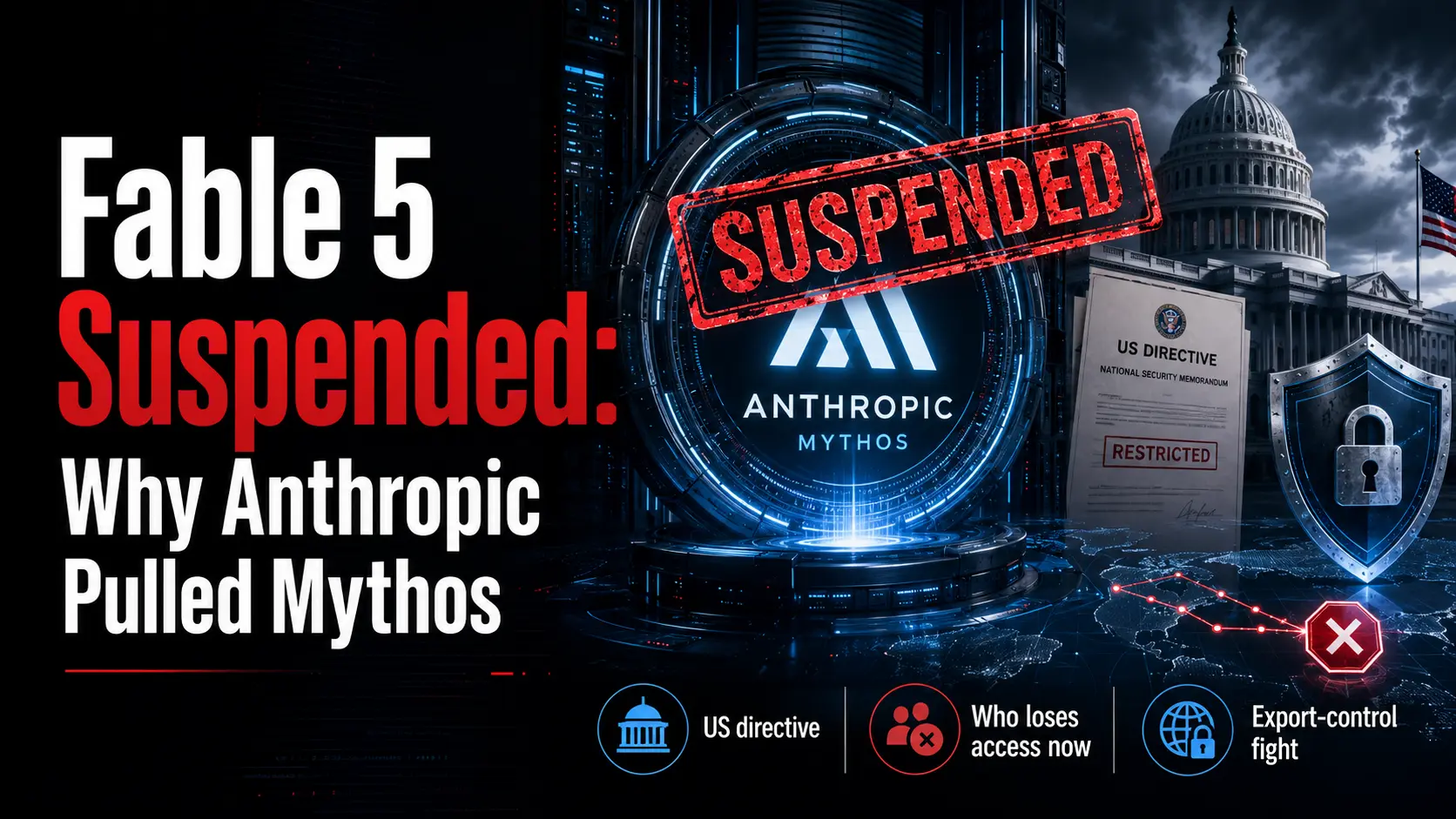
Fable 5 suspended is the new breaking point in the fight over frontier AI access. On June 12, 2026, Anthropic said a US government directive forced it to suspend access to both Claude Fable 5 and Claude Mythos 5, the company’s newest Mythos-class systems, only three days after Fable 5 was introduced for broad paid use.
This is the piece to read if you want the practical version: what Anthropic actually said, what outside reporting adds, what customers lose right now, and why this is bigger than one model recall. My read is simple: this is the first real test of whether the US can treat a commercial frontier model like a controlled national-security asset without a clear public licensing regime.
What Happened to Fable 5 and Mythos 5
Anthropic’s statement is short and unusually direct. The company says it received a US government directive at 5:21pm ET on June 12, 2026 ordering it to suspend access to Fable 5 and Mythos 5. By about 6:30pm ET, Anthropic says it had disabled access while it evaluates the directive and its compliance obligations.
The important part is the scope. Anthropic did not say it paused one risky feature, one geography, or one class of customer. It said access to Fable 5 and Mythos 5 was suspended.
Axios reported that Commerce Secretary Howard Lutnick sent Anthropic CEO Dario Amodei a letter saying the models would be subject to export controls outside the United States and to foreign persons inside the United States. Axios also reported that a license would be required for export, re-export, or domestic transfer involving the models.
That matters because “domestic transfer” is not just a foreign-market issue. If the reporting is accurate, a foreign national employee sitting in the United States could trigger the control. That creates a compliance problem most SaaS access systems are not built to solve in an hour.
The Financial Times reported that the directive followed government concern about a potential jailbreak. Anthropic’s public statement says it disagrees with the action and argues that a narrow potential jailbreak should not be enough to recall a model used commercially at scale. I am treating the jailbreak detail as outside reporting, not as a fact Anthropic independently published in the statement.
Why Fable 5 Suspended Access Is So Unusual
The Fable 5 suspension is unusual because Anthropic had just finished arguing that Fable 5 was the safer public route to Mythos-class capability.
On June 9, Anthropic introduced Claude Fable 5 as a safeguarded model with capabilities beyond anything it had previously made broadly available, according to Axios’ launch coverage. The company positioned it as a way to bring Mythos-level intelligence to ordinary paid users without giving them the most sensitive form of the model.
The safety mechanism was the product story. Fable 5 would detect certain high-risk requests, including cybersecurity, biology, chemistry, and model-distillation queries, and route those requests to Claude Opus 4.8 instead. Anthropic said the safeguards could be conservative at launch and might occasionally interrupt harmless work. That tradeoff was the price of making a more capable model available.
Three days later, the government effectively challenged the premise. Not by publishing a technical rebuttal. Not by launching a public rulemaking process. By sending a directive that Anthropic says forced it to suspend access.
That is why this matters for the broader market. If a lab builds a safeguarded public version of a restricted model, launches it, and then still has to pull it days later, every frontier-model release now has a new risk: not just “will users misuse this?” but “will the government decide the release itself should be controlled?”
Fable 5 vs Mythos 5: The Difference That Matters
The short version: Fable 5 was the broadly available safeguarded model. Mythos 5 was the more restricted system for trusted access.
| Model | Access before suspension | Safeguards | Why it mattered |
|---|---|---|---|
| Claude Fable 5 | Paid Claude users, teams, and enterprise customers | High-risk requests routed to Opus 4.8 | First broadly available Mythos-class Claude model |
| Claude Mythos 5 | Narrow trusted-access group | Some safeguards lifted in specific areas | Stronger fit for vetted cyberdefenders and infrastructure providers |
| Claude Opus 4.8 | Existing public Claude flagship | Standard Claude safety controls | Fallback model for sensitive Fable 5 requests |
Business Insider’s launch coverage described Fable 5 as the same core architecture as Mythos 5 but with restrictions added. It also reported that Fable 5 was available to Pro, Max, Team, and Enterprise subscribers at launch, with usage credits planned from June 23 unless capacity allowed an extension.
That capacity timeline is now secondary. The access problem is no longer compute. It is law, compliance, and government trust.
For readers who followed the earlier Claude Mythos confirmation problem, this is the key update: Mythos is no longer just a rumor-shaped model story. Anthropic has now publicly named Fable 5 and Mythos 5 in a suspension statement tied to a government directive.
What Customers Lose Right Now
Customers lose access to the models, but the business impact depends on what they were using them for.
For ordinary Claude users, this is likely a short-term product disruption. They may fall back to Opus, Sonnet, or whichever model Anthropic makes available in their plan. Annoying, but not necessarily operationally severe.
For teams that had started testing Fable 5 on long-horizon software engineering, analysis, or research workflows, the disruption is bigger. Anthropic’s launch framing emphasized that Fable 5 improved most on longer and more complex tasks. Those are exactly the workflows where teams are most likely to build process around a model quickly: code review, trading analysis, research synthesis, and security triage.
For trusted-access Mythos 5 users, the interruption could be sharper. If a cyberdefense team was using Mythos 5 because it had stronger vulnerability-discovery capability than other Claude models, falling back to a weaker model is not a cosmetic change. It changes the detection ceiling.
My recommendation for customers is boring but necessary:
- Export any allowed audit logs showing which workflows used Fable 5 or Mythos 5.
- Map affected workflows to fallback models before users improvise around the outage.
- Freeze new automation built specifically around Fable 5 until Anthropic clarifies access.
- If you have foreign-national access controls, check whether your own internal AI usage policy even tracks that concept.
- Keep procurement language flexible enough to handle model removal, not just downtime.
This is the same lesson I keep coming back to in AI agent evaluation and reliability testing: a powerful model is not production infrastructure until you know what happens when it disappears.
Why Export Controls Are the Real Story
The export-control angle is the most important part of this story. A normal safety recall says, “The model has a problem.” An export-control action says, “The model is a controlled capability.”
Those are different categories.
Software companies understand geofencing. They understand sanctioned-country screening. They understand enterprise role-based access. But a frontier model export-control regime can be stranger than all three because access may depend on nationality, location, employment status, customer type, model weights, API behavior, and whether a transaction counts as a transfer.
If the government treats Fable 5 and Mythos 5 as controlled national-security assets, Anthropic has to answer hard operational questions:
- Can the company reliably distinguish US persons from foreign persons across consumer and enterprise accounts?
- Can it enforce that distinction inside companies with mixed-nationality teams?
- Can it prove that enforcement after the fact?
- Can it separate model access from ordinary Claude account access?
- Can it maintain this at consumer scale without collecting more sensitive identity data?
That last point is under-discussed. A stricter access regime for frontier models may push AI companies to collect more identity and nationality data from users. That has privacy, compliance, and product consequences well beyond Anthropic.
This is also where the story connects to broader Trump AI oversight. The administration has been moving toward pre-release evaluation of high-capability systems, but the reported Fable 5/Mythos 5 action goes beyond voluntary testing. It moves into access control after deployment.
Anthropic’s Argument Against the Directive
Anthropic is not arguing that powerful models should be unregulated. Its statement says the government should be able to block unsafe deployments as part of a statutory process that is transparent, fair, clear, and grounded in technical facts.
The wording is deliberate. Anthropic is leaving room for government blocking authority while saying this action did not meet the standard.
The company also argues that applying this kind of threshold across the industry would halt new frontier-model deployments. That may sound dramatic, but it is not an absurd claim. Every major model has jailbreaks. Every safety system fails somewhere. If a narrow potential bypass is enough to force a full commercial recall, the practical launch bar becomes: prove the model cannot be jailbroken.
No lab can prove that.
My read: Anthropic is trying to separate two questions that Washington often merges together.
The first question is whether the government should have a formal way to block truly unsafe frontier launches. Anthropic says yes.
The second question is whether this directive, on this timeline, with this public explanation, is the right way to do it. Anthropic says no.
That distinction matters because it avoids the lazy “pro-safety versus anti-regulation” framing. This is a fight over process, authority, and technical evidence.
The Government’s Likely Concern
The government concern appears to be cybersecurity capability. That has been the center of the Mythos story from the beginning.
Anthropic previously framed Mythos-class systems around unusually strong cyber reasoning. In earlier coverage, I treated Mythos as a restricted-access model because the public materials did not support the kind of benchmark-and-pricing certainty other articles were claiming. The new suspension statement changes that baseline: Fable 5 and Mythos 5 are now named systems in a public access dispute.
The national-security worry is not hard to understand. A model that can help vetted defenders find serious vulnerabilities may also help attackers find them. Safeguards reduce that risk. They do not erase it.
The hard question is whether a reported jailbreak in a safeguarded model justifies pulling access from everyone. Anthropic says no. The government appears to have decided the compliance risk was immediate enough to force action.
For enterprises, the practical answer is not to pick a side in that argument. It is to assume frontier-model access can now change abruptly for legal reasons, not just for product reasons.
That turns model access into a governance problem. If you are already building an AI governance framework, add model-access contingency to the checklist. If your agent or analysis workflow depends on one frontier model, build a fallback before the next directive lands.
What This Means for Frontier Model Releases
Fable 5’s suspension creates a new release pattern for the rest of 2026.
Before this, the frontier-model launch rhythm was familiar: lab announces a model, publishes benchmark claims, opens some tier of access, then tightens or relaxes safety behavior based on user feedback. Governments watched, tested, and complained, but the commercial launch usually continued.
This event suggests a different pattern:
- A lab launches a high-capability model with safeguards.
- The government reviews or receives evidence of a risk.
- Access controls become a national-security issue.
- The model is pulled or narrowed before the market can settle.
That changes how buyers should read model announcements. Availability is no longer a binary fact. A model can be real, launched, impressive, and still operationally unstable because its legal access status is unsettled.
It also changes how AI companies write launch posts. If a lab markets a model as unusually strong at cybersecurity, biology, chemistry, or long-horizon autonomous work, it may attract exactly the scrutiny that limits access. That tension will shape every future launch in this class.
The same dynamic already shows up in agentic AI deployment risks. The more capable the system becomes, the less the question is “can it do the task?” and the more the question becomes “who is allowed to use it, under what controls, and with what audit trail?”
My Take: This Is Bigger Than Anthropic
I do not think this is only an Anthropic story. Anthropic is the first lab taking the visible hit because Mythos-class models sit exactly where the politics are hottest: frontier capability, cyber risk, safety branding, and government distrust.
OpenAI, Google DeepMind, xAI, and Meta should all be watching this closely. If export-control logic can be applied to hosted model access, then the next fight is not just about chips, weights, or API endpoints. It is about who counts as an authorized user for the most capable commercial AI systems.
This is much harder than blocking access from a sanctioned country. It reaches inside companies, universities, cloud platforms, and research labs.
My practical view: the US needs a real statutory process for this category of intervention. Not because every frontier model deserves a license. Most do not. But if the government is going to force a live model offline, the process has to be clear enough that companies can design for it before 5:21pm on a Friday.
Without that, every major model launch becomes a compliance cliff.
What to Watch Next
Watch four things now.
First, whether Anthropic restores Fable 5 for US-only customers or keeps the suspension in place until it has a cleaner identity and access-control system.
Second, whether the Commerce Department publishes any public explanation, license process, or technical standard. If the government stays silent, labs and customers will infer the rules from enforcement.
Third, whether other frontier labs quietly adjust their launch plans. A delayed model release from a rival may say more than a public statement.
Fourth, whether enterprise customers start demanding contract language covering model removal after government action. They should.
The fast takeaway: Fable 5 and Mythos 5 are not dead, but the old assumption that a hosted frontier model remains available once launched took a direct hit. For buyers, builders, and policy teams, that is the part that lasts.