Key takeaways (May 17, 2026)
- Mature programs in 2026 anchor on NIST AI RMF, ISO/IEC 42001 and the EU AI Act simultaneously.
- Common gaps: agent identity, data lineage for training and fine-tuning, and red-team cadence.
- Executive-level AI governance committees are now standard at Fortune 500s.
- Treat governance as continuous, not a one-off audit project.
An AI governance framework is a structured set of policies, processes, and controls that defines how an organization develops, deploys, and monitors AI systems — covering risk classification, data governance, documentation, human oversight, monitoring, vendor risk, and accountability. I’ve spent the last year watching companies scramble to build AI governance from scratch. Most of them are doing it wrong. Most of them are doing it wrong. They hire a consultant, get a 200-page PDF full of abstract principles, and then wonder why nothing changes. The compliance deadline sits four months away, and their AI systems are still running without oversight, documentation, or clear ownership.
Here’s the thing: AI governance doesn’t have to be a bureaucratic nightmare. But it does need to be real. Not theoretical. Not aspirational. Actually implemented in your codebase, your deployment pipelines, and your team’s daily workflow.
I’m a developer who ships AI-powered products. These seven strategies come from what I’ve seen work — and what I’ve seen fail spectacularly — across organizations trying to get governance right before the EU AI Act hits full enforcement in August 2026.
Where AI Regulations Stand Right Now
Before diving into strategy, you need to understand the regulatory environment you’re building for. It’s moving fast and it’s fragmented.
The EU AI Act uses a risk-based classification system. High-risk AI systems in healthcare, finance, and employment face strict conformity assessments, documentation requirements, and mandatory human oversight. Maximum penalty: 35 million euros or 7% of global turnover. Our EU AI Act enforcement updates track the specifics as they develop. The employment classification is especially significant — I covered how the EU AI Act’s worker protections interact with AI job displacement concerns in detail.
The NIST AI Risk Management Framework provides US-based organizations with voluntary but increasingly referenced guidelines. If you’re operating in the US, treat NIST AI RMF as your baseline — it’s what regulators and courts will point to.
Japan has taken a more innovation-friendly approach, trying to balance safety with developer productivity. It’s worth studying if you think governance automatically means slower shipping.
The UK’s latest AI regulation updates are worth watching too. Britain still doesn’t have a single AI Act, but the Data Use and Access Act changes, ICO hiring guidance, FCA stance, and MHRA sandbox work show how fast risk can build inside a regulator-led model.
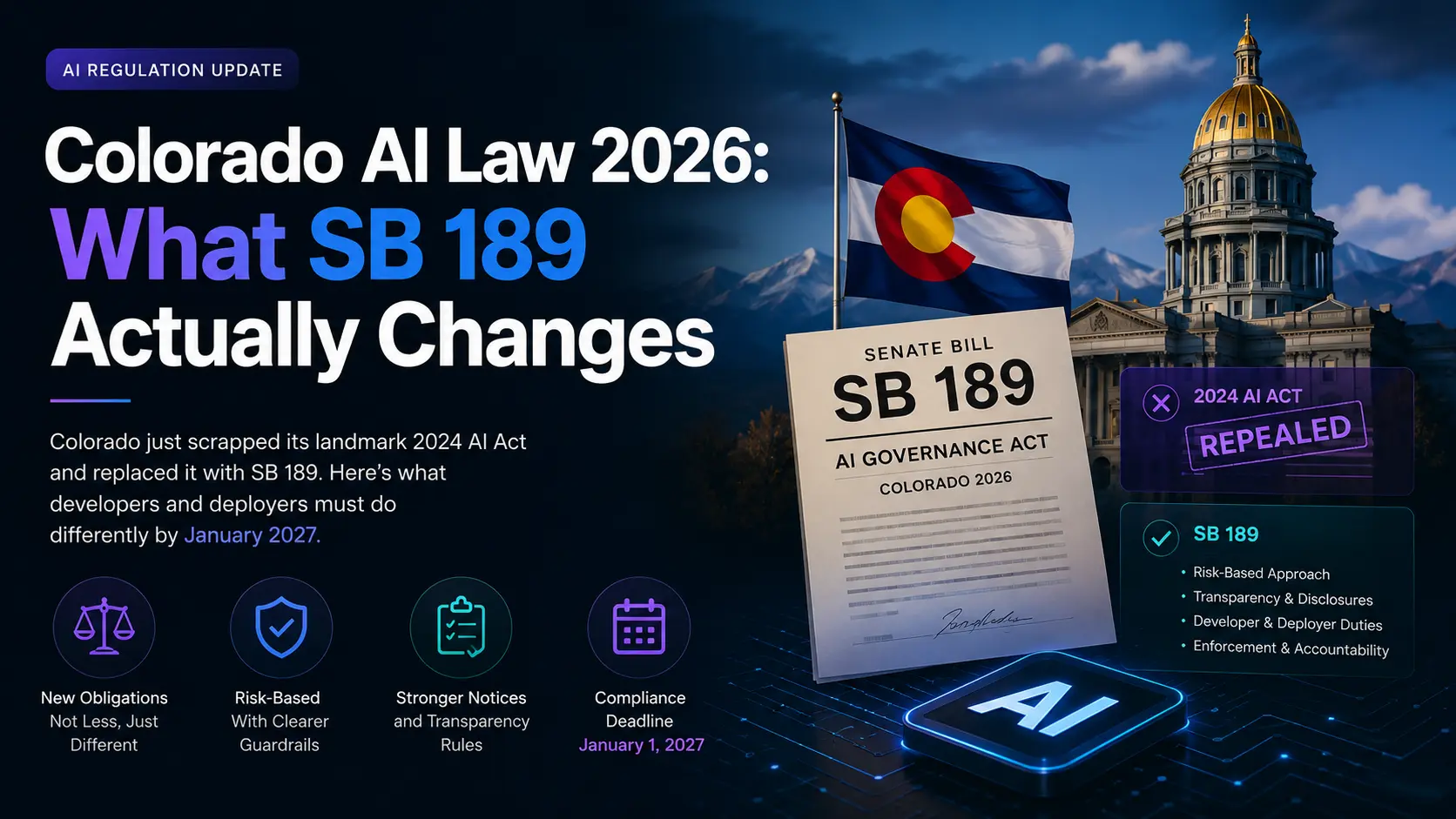
And then there’s the US state-level patchwork: California’s SB 53 requires risk frameworks for large models, Illinois treats AI-based hiring without notice as a civil rights violation, and Colorado just rewrote its entire AI law — SB 189 replaced the original impact-assessment framework with a disclosure-only model that takes effect January 1, 2027. Connecticut went the other direction, passing stronger employment AI obligations. No federal standard exists yet.
Companies operating across borders must track all of these simultaneously. That’s why governance can’t be a one-time project — it needs to be baked into how you build.
Strategy 1: Build an AI Registry Before Anything Else
Every governance framework starts with the same question: what AI systems are we actually running?
Most organizations can’t answer this. Shadow AI — employees using ChatGPT, Claude, Midjourney, or random API integrations without IT approval — is everywhere. A 2025 Gartner survey found that 60% of organizations couldn’t account for all AI tools in active use.
Here’s how to build a functional AI registry:
Start with procurement records. Pull every SaaS contract and API subscription from the last three years. Flag anything with ML, AI, or “intelligent” in the description.
Survey engineering teams. Not with a form — with actual conversations. Ask what APIs they’re calling, what models they’ve fine-tuned, what they’re running in Jupyter notebooks that never went through code review.
Classify by EU AI Act risk levels. For each system, determine if it’s prohibited, high-risk, limited risk, or minimal risk. This classification drives every other governance decision.
Document the basics for each system: what it does, what data it touches, who owns it, when it was last evaluated, and what happens if it fails.
This registry becomes your single source of truth. Without it, every other strategy is built on sand.
Strategy 2: Implement Monitoring That Actually Works
“We monitor our AI systems” is what every company says. “We have automated alerts for model drift, bias detection, and performance degradation” is what almost nobody can demonstrate.
Effective AI monitoring operates on three levels:
Technical monitoring tracks model performance, system reliability, data quality, and drift. If your model was trained on 2024 data and the world has shifted (as it always does), your predictions degrade silently. McKinsey’s 2026 AI report found that 73% of production ML models show measurable performance degradation within 12 months of deployment.
Business monitoring tracks whether the AI is delivering the outcomes you intended — and whether it’s producing unintended consequences. A recommendation engine that optimizes for engagement might be driving users toward harmful content. A hiring algorithm that improves efficiency might be filtering out qualified candidates from underrepresented groups.
Compliance monitoring checks whether you’re meeting regulatory requirements in real time. Under the EU AI Act, high-risk systems need ongoing conformity assessment, not just a check at deployment.
From a developer perspective, this means building monitoring into your CI/CD pipeline. Treat model performance checks like you treat unit tests: if they fail, the deployment stops. Tools like Microsoft’s Responsible AI Dashboard provide frameworks, but you’ll likely need custom implementations for your specific systems. For agent workloads specifically, the Microsoft Agent Governance Toolkit gives you runtime policy enforcement, trust scoring, and compliance evidence collection in a single MIT-licensed stack.
Set alert thresholds. When accuracy drops below X%, when fairness metrics deviate beyond Y%, when data distributions shift by Z% — these should wake someone up, not sit in a log file.
Strategy 3: Create Governance That Adapts (Not Just Complies)
Static governance policies are dead on arrival. I’ve seen companies spend six months writing the perfect AI governance document, only to have it become obsolete when a new regulation drops or a team deploys a new model architecture.
Governance needs a feedback loop. Here’s what that looks like in practice:
Quarterly governance reviews. Not annual. Not “when we get around to it.” Every quarter, review incidents, near-misses, regulatory changes, and performance data. Adjust governance controls based on what you learned.
Post-incident analysis. When an AI system misbehaves — and it will — run a real retrospective. Not a blame session. Figure out what the governance framework should have caught and didn’t. Then fix the framework.
Regulatory watch. Assign someone to track regulatory developments monthly and translate them into governance updates. AI regulation is changing faster than most governance frameworks can adapt.
Version your governance. Seriously. Treat your governance documentation like code. Put it in version control. Track changes. Know who modified what and why. When an auditor asks “what were your governance controls on March 15?”, you should be able to answer in minutes, not weeks.
The organizations that struggle most are those that treat governance as a document to write rather than a system to run. Agentic AI deployments make this even more critical — autonomous systems can drift in behavior in ways that static policies never anticipated.
Strategy 4: Build Cross-Functional Teams (That Actually Talk to Each Other)
AI governance can’t live in one department. But “cross-functional” has become a buzzword that usually means “we invite legal to the engineering standup once a month and call it collaboration.”
Real cross-functional governance requires these roles at the table — not occasionally, but regularly:
- Engineering/Data Science: They know what the systems actually do, as opposed to what the documentation says they do
- Legal/Compliance: They translate regulations into requirements
- Product/Business: They own the use case and the user impact
- Risk Management: They assess organizational exposure
- Ethics/Fairness: They ask the uncomfortable questions
The key is shared language. Engineers shouldn’t need a law degree to understand compliance requirements. Lawyers shouldn’t need to read Python to understand model behavior. Build a shared glossary. Create templates that both sides can work with.
One pattern I’ve seen work well: pair a developer with a compliance officer for each high-risk AI system. They co-own the governance documentation and jointly sign off on changes. It slows things down slightly, but it catches problems that either person alone would miss.
For teams building with AI coding agents, this is doubly important. When an AI agent is writing code that another AI agent will execute, you need humans from multiple disciplines reviewing the chain. I break the engineering side of that down in developer responsibility with generative AI, including release gates, monitoring, and rollback.
Strategy 5: Build Frameworks, Not Just Policies
A policy says “we will ensure fairness in our AI systems.” A framework specifies how you test for fairness, what metrics you use, what thresholds trigger review, who conducts the review, and what happens when a system fails.
Your AI governance framework should cover four domains:
Risk management. Use the NIST AI RMF as a starting point. Identify risks specific to each AI system — not generic AI risks, but the actual ways your specific model in your specific deployment could cause harm. A credit scoring model has different risks than a content recommendation engine.
Quality assurance. Define testing standards for AI systems at every stage: development, pre-deployment, production, and retirement. Include adversarial testing — try to break your models before your users (or regulators) do.
Compliance mapping. Create a matrix that maps each regulation (EU AI Act, NIST, state laws, industry standards) to specific technical requirements and the systems they apply to. This matrix becomes your audit checklist.
Incident response. When something goes wrong — and it will — you need a playbook. Who gets notified? What’s the escalation path? When do you shut down a system vs. apply a hotfix? California’s SB 53 requires reporting critical safety incidents within 15 days. You can’t figure out your response process after the clock starts.
Make frameworks accessible. If your governance framework lives in a SharePoint folder that nobody visits, it’s not a framework — it’s a liability. Put it where teams actually work: in your wiki, your repo, your deployment tooling.
Strategy 6: Govern for the Business You’re Becoming
Your AI governance framework needs to work for the AI systems you’ll deploy next year, not just the ones you’re running today.
This means modularity. Build governance around principles and risk categories, not around specific technologies. When your team decides to deploy MCP-based agentic systems next quarter, your governance framework should accommodate that without a six-month rewrite.
Practical steps:
Evaluate governance quarterly against strategy. Are you entering new markets? Launching AI-powered products? Adopting agentic workflows? Each of these requires governance updates.
Build governance into your product development lifecycle. Don’t bolt it on at the end. When product teams write specs for AI features, governance requirements should be in the spec from day one.
Remove governance bottlenecks that kill innovation. If your governance review takes eight weeks, product teams will route around it. And they’ll be right to — eight weeks is too slow. PwC’s 2026 AI Governance Survey found that 45% of teams bypass governance when it takes longer than two weeks. The fix isn’t stricter enforcement; it’s faster governance. Automate what you can. Pre-approve low-risk patterns. Reserve deep review for high-risk systems.
Track emerging capabilities. Agentic AI systems that plan, execute, and adapt autonomously present governance challenges that didn’t exist two years ago. Your framework needs to evolve as the technology does.
Strategy 7: Build a Culture That Doesn’t Need Policing
The best governance framework in the world fails if your team treats it as an obstacle. Culture is the final strategy because it’s what makes the other six sustainable.
Here’s what governance culture actually looks like:
Leaders use the governance tools themselves. If your CTO hasn’t looked at the AI registry, why would anyone else? If your VP of Engineering doesn’t review model monitoring dashboards, the team won’t either.
Governance catches are celebrated, not punished. When someone flags a bias issue or a compliance gap before it becomes a problem, that’s a win. Treat it like catching a critical bug before it hits production.
Training is ongoing, not one-and-done. The EU AI Act explicitly requires AI literacy training for staff working with AI systems. But beyond compliance, teams need to understand why governance matters. “Because the EU says so” is a weak motivator. “Because our recommendation engine was systematically disadvantaging users and we caught it through monitoring” is a real one.
Invest in people, processes, and tools — in that order. The best governance technology is useless without people who understand it and processes that integrate it into daily work. Start with training, build the processes, then buy or build the tools to support them.
Create feedback channels. Engineers on the ground see governance problems first. Make it easy for them to flag issues, suggest improvements, and challenge policies that don’t make sense. If your governance framework doesn’t have a mechanism for bottom-up input, it’s incomplete.
How to Get Started This Week
If you’re reading this and you don’t have an AI governance framework yet, here’s your first week:
Monday: Appoint an AI governance owner. One person, one accountability.
Tuesday: Start the AI registry. Even a spreadsheet is better than nothing.
Wednesday: Identify your highest-risk AI system. The one that touches customer data, makes automated decisions, or operates in an EU-regulated domain.
Thursday: Map that system against EU AI Act requirements. Identify gaps.
Friday: Write a 30-day governance plan. Not a year-long roadmap — a month of concrete actions.
You can refine everything later. But starting matters more than perfecting. August 2, 2026 doesn’t care about your roadmap timeline. And if you operate in the US, October 1, 2026 is the first deadline under Connecticut’s AI Responsibility and Transparency Act — requiring developer documentation for employment AI tools. The governance infrastructure these strategies build maps directly to what SB 5 requires.
The Real Competitive Advantage
Here’s what most governance articles won’t tell you: the companies that get governance right don’t just avoid fines. They ship faster. They get regulatory approval faster. They win enterprise contracts that require governance documentation. They attract engineers who want to build responsible AI.
Gartner estimates that by 2027, companies with mature AI governance will develop and deploy AI products 40% faster than those without — because they won’t be stopped by last-minute compliance reviews, customer data incidents, or regulatory investigations.
Governance is infrastructure. Like testing, like CI/CD, like security — it feels slow at first and then it makes everything faster.
Build it now. Not because a regulation tells you to, but because your AI systems are already making decisions that affect real people. And someone should be paying attention.
The consequences of skipping this step are real. When the Pentagon blacklisted Anthropic in 2026 over a disagreement about use-case guardrails, it cost Anthropic access to the entire U.S. defense market. Their acceptable-use policy was their governance framework. The DoD rejected it. Whether you agree with either side, the lesson is the same: define your AI governance terms before you sign contracts, not after a dispute turns legal.