Apple’s WWDC 2026 announcement leaves the Siri AI EU launch blocked: the company will ship a revamped assistant called Siri AI later this year but not initially in the European Union or China. On stage and in the days after, Apple pointed the finger at EU regulators. Brussels pointed it right back. This piece covers three things: what Apple actually announced, exactly where the EU’s rules bite, and what the now-confirmed Apple-Google Gemini partnership changes. If you want the mechanics of how third-party AI providers are meant to plug into Apple Intelligence, that lives in our iOS 27 AI Extensions guide; this article stays on the WWDC news and the regulatory standoff.
What Apple announced at WWDC 2026
Apple unveiled a revamped assistant called Siri AI at its WWDC 2026 keynote, the long-promised overhaul of an assistant that has lagged behind standalone chatbots for years. The headline for European readers is the asterisk attached to it.
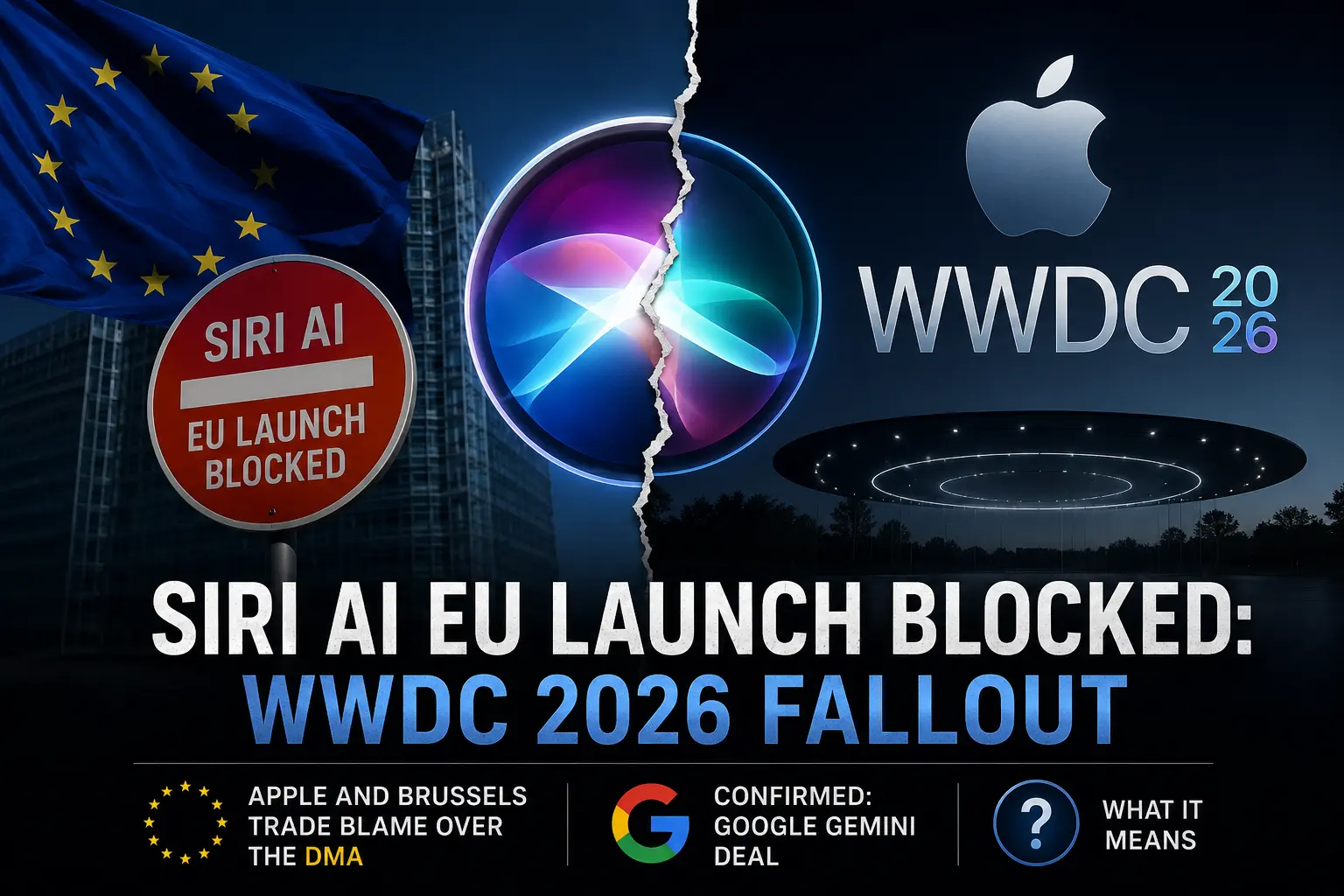
Siri AI is planned to launch in beta later in 2026, but not initially in the European Union or China. Apple said Siri AI would not be available for iPhone and iPad users in the EU and gave no timetable for when, or whether, that changes. That last part matters. A delay with a date is a scheduling problem. A delay with no date is a standoff, and that is what Apple described.
My read: the absence of a timetable is the actual news here. Apple has shipped region-staggered features before. Declining to name any EU launch window signals the holdup is not engineering but a disagreement Apple does not yet know how to resolve.
Inside the Siri AI EU launch blocked standoff: Apple versus Brussels
Apple and the European Commission are now openly blaming each other. The two sides do not even agree on what the rules require.
Apple says the EU delay stems from disputes over how the Digital Markets Act applies to its AI capabilities. Specifically, Apple argues the Commission’s interpretation of the DMA would require competing virtual assistants to receive direct access to user data without Apple’s preferred protections. In Apple’s framing, complying with the rule as Brussels reads it means weakening the privacy and security guarantees the company markets as a differentiator.
The Commission rejects the premise. It says the DMA does not prohibit Apple from introducing new products in the EU at all, that nothing in the law forces Apple to keep Siri AI out. And it says Apple asked for an 18-month exemption rather than providing a compliant solution. That is a pointed accusation: it reframes Apple’s privacy argument as a request for delay.
So you have two incompatible stories. Apple: the rules make a compliant launch impossible without compromising users. Brussels: the rules allow a launch, and Apple is choosing not to build one. Both cannot be fully true, and the gap between them is where EU users are stuck.
Where the DMA actually bites
To see why this is a genuine fight and not just posturing, it helps to read the obligation Apple is pushing against. The Digital Markets Act’s interoperability rules are specific.
The DMA requires Apple to provide free and effective interoperability with hardware and software features controlled by iOS and iPadOS. More pointedly for an assistant, it requires gatekeepers to allow third parties access to the same operating-system hardware and software features available to the gatekeeper’s own services or hardware. Read that against a built-in assistant: if Siri AI gets deep, privileged access to device features and user context, the interoperability principle points toward competing assistants getting comparable access.
That is the heart of Apple’s objection. The Commission has already issued specification decisions covering nine iOS connectivity features and Apple’s process for handling interoperability requests, so this is not abstract; there is an active, detailed enforcement track. And the gatekeeper designation is settled: the Commission says Apple and Google are DMA gatekeepers for mobile operating systems, including Apple’s iOS and iPadOS.
| Question | Apple’s position | European Commission’s position |
|---|---|---|
| Does the DMA block a Siri AI launch? | Effectively yes, as the Commission interprets it | No, the DMA does not prohibit new products |
| What does interoperability require? | Direct data access for rivals without Apple’s protections | Equal access to the same OS features Apple’s own services get |
| What did Apple request? | A workable path that preserves its safeguards | An 18-month exemption instead of a compliant build |
This is also not Apple’s first time making this argument. The company previously delayed Apple Intelligence, iPhone Mirroring, and SharePlay Screen Sharing enhancements in Europe in 2024, blaming DMA regulatory uncertainty. The 2026 Siri AI standoff is the same playbook, two years on, now attached to Apple’s flagship AI feature.
The AI Act runs in parallel — but it isn’t the stated cause
It is worth separating two EU regimes that get blurred together. Apple’s stated reason for the Siri AI block is the DMA, not the AI Act. But the AI Act is the other clock running in the background, and anyone tracking Apple’s EU exposure should hold both.
The EU AI Act’s general-purpose AI model obligations include technical documentation, downstream-provider documentation, a copyright policy, and a public training-content summary. The timing is staged: obligations for providers of general-purpose AI models apply from 2 August 2025, while most of the regulation applies from 2 August 2026. There is a longer runway for older models: providers of general-purpose AI models placed on the EU market before 2 August 2025 must comply by 2 August 2027. Our EU AI Act August 2026 compliance checklist breaks down what lands on that date.
Regulators are also signaling they read the AI Act broadly. European Commission tech chief Henna Virkkunen said the EU believes the AI Act already covers AI agents through technology-neutral provisions on generative AI and risk mitigation. For a company shipping an agentic assistant, that is a signal worth noting: Brussels does not think it needs new law to reach Siri AI’s capabilities. For the broader enforcement picture, see our EU AI Act 2026 enforcement updates and the Digital Omnibus delay analysis.
The Google Gemini deal: confirmed collaboration, unconfirmed price
The other WWDC-window story is the Apple-Google partnership, and here precision matters because the reporting has run ahead of the confirmations.
What is confirmed: Google and Apple announced a multi-year collaboration under which next-generation Apple Foundation Models will be based on Google’s Gemini models and cloud technology. The joint statement also says the collaboration is intended to help power future Apple Intelligence features, including a more personalized Siri. So the deal is real, it is multi-year, and it explicitly touches Siri.
What is not confirmed: the money. The Guardian described the Apple-Google Siri arrangement as a billion-dollar partnership, but no primary source confirms a $1 billion-per-year license figure. I would not repeat that number as fact. Neither company has put financial terms on the record, and a single secondary description is thin ground for a precise annual figure. Treat “$1B/year” as reported, not established.
The strategic shape is clear enough without the price. Apple, which built its AI pitch on doing things its own way, is now leaning on a competitor’s frontier models to power its assistant. For Google, putting Gemini underneath Apple Intelligence is a distribution win at a scale almost nothing else matches. It also lands against a market where ChatGPT’s defaults keep shifting; see our coverage of GPT-5.5 Instant becoming the ChatGPT default for how fast the assistant layer is moving.
What remains unclear for EU users
Here is the part that gets muddled. The one confirmed point is narrow: native Siri AI, the new assistant, is what Apple is withholding from iPhone and iPad users in the EU. Beyond that, the sources here do not settle what EU users can use in its place.
In particular, the official status and EU availability of Apple’s iOS 27 AI Extensions framework — the mechanism meant to let users route requests to third-party AI providers — are open questions, not confirmed facts. We documented how that framework is intended to work in the iOS 27 AI Extensions piece, but its EU rollout is not something this reporting can confirm.
That distinction is the whole ballgame for an EU reader deciding whether this affects them day to day. What is certain is that the deeply integrated, Apple-built assistant Apple spent its keynote selling is the thing being held back at launch. Whether any third-party alternative is an adequate substitute is a judgment call, and a generous reading of Apple’s own argument is that it is not, which is precisely why the company is fighting over native access.
The stakes: Apple, Google, and Brussels
Three parties, three different exposures.
- Apple carries the revenue and reputational risk of visibly withholding its flagship feature from one of its largest markets. Every keynote demo EU users can’t run is a reminder that the most advanced version of the product stops at the border.
- Google gets a distribution win regardless of how the EU fight resolves, since the Gemini collaboration is positioned to underpin future Apple Intelligence features. The DMA standoff is Apple’s problem to litigate, not Google’s.
- Brussels owns the political problem of “features withheld from Europe.” Every blocked launch feeds a narrative that EU rules cost European consumers access to the newest technology, which is exactly why the Commission was quick to insist the DMA does not prohibit Apple from launching. It does not want to wear the blame.
The 2024 precedent is instructive about how a standoff begins: Apple delayed Apple Intelligence, iPhone Mirroring, and SharePlay Screen Sharing enhancements in Europe over DMA regulatory uncertainty. How that earlier standoff ultimately resolved is not something the sources here settle. The open question now is whether Siri AI, a far more central product than iPhone Mirroring, becomes a short delay or a longer-running fight.
What’s still unconfirmed
A few things are not yet nailed down, and honest reporting should flag them:
- Platform-by-platform EU availability. Apple confirmed the iPhone and iPad block. Exactly which other platforms and OS versions are affected in the EU is not established in primary sources.
- EU alternatives. Whether the iOS 27 AI Extensions framework or separate third-party AI apps are available to EU users is not established by the sources used here.
- The precise Apple proposal. The Commission says Apple sought an 18-month exemption. The exact mechanism Apple offered to regulators has been characterized in secondary reporting but is not confirmed in detail.
- The deal economics. As above, the billion-dollar figure is reported, not confirmed by Apple or Google.
The bottom line
My recommendation for EU readers: don’t expect a Siri AI date soon, and watch the DMA negotiation rather than the keynote calendar. The feature’s EU fate is now a regulatory outcome, not a product schedule. Whether Siri AI follows the 2024 features into a later European release or becomes a longer fight is exactly the open question, and it may be the sharpest test yet of whether the DMA’s interoperability rules and Apple’s privacy framing can coexist. For developers tracking Apple’s platform decisions, the signal is that gatekeeper obligations now shape what ships and when, not as an afterthought but as the gating factor.