Key takeaways (May 17, 2026)
- Anthropic has not publicly confirmed a 5–10 trillion-parameter Claude model as of May 17, 2026.
- Confirmed in 2026: Claude Opus 4.7 with a 1M-token context window in fast mode.
- Treat any specific parameter-count claims for Anthropic models as speculative until the company publishes.
- What matters for builders is capability and price, not parameter count.
Claude Mythos is worth watching, but not worth overstating. As of April 21, 2026, Anthropic still has not published the kind of public product documentation that would justify treating Mythos like a normal launch with settled specs, public pricing, and definitive benchmark claims.
That is the cleanest way to frame the story.
There is enough smoke here to justify coverage. There is not enough public documentation to justify the kind of aggressive “10T model with X benchmark score at Y price” article that a lot of AI sites are publishing.
This updated version is built around one principle: separate official confirmation from reported claims and technical inference.
What Anthropic has publicly confirmed
Anthropic’s public materials support three broad conclusions:
- Anthropic is actively shipping stronger Claude models and updating its safety framework for higher-capability systems.
- The company is signaling that stronger model tiers raise more serious deployment and misuse questions.
- Anthropic’s public product surface today is still centered on its documented Claude releases and pricing pages, not on a normal public Mythos launch.
That is meaningful. It just is not the same thing as a public benchmark sheet.
What Anthropic has not publicly confirmed
As of April 21, 2026, I did not find a public Anthropic source confirming:
- a normal public Claude Mythos launch page
- a public API release page for Mythos
- public pricing for Mythos
- a public technical paper specifying Mythos architecture
- a public benchmark table for Mythos
- a confirmed 10-trillion-parameter count
Those omissions matter. When a company has not published those basics, readers should not be told they are settled facts.
The right way to read the Mythos story
Claude Mythos belongs in the category of reported frontier-model development, not fully documented public product release.
That means there are really three layers of confidence:
1. High confidence
- Anthropic is building and releasing stronger Claude systems.
- Anthropic is publicly updating its Responsible Scaling Policy as capability increases.
- Anthropic is clearly treating high-capability model deployment as a safety and governance question, not just a product-marketing question.
2. Medium confidence
- There has been credible outside reporting about a model called Claude Mythos or a stronger Anthropic capability tier beyond currently documented Claude releases.
- The reporting is substantial enough that teams following frontier AI should know it exists.
3. Low confidence unless Anthropic publishes more
- exact parameter count
- exact public benchmark leadership
- exact context window
- exact pricing
- exact release timing
Those are the areas where many articles overreach.
Why the 10-trillion-parameter framing is weak on its own
The “10-trillion-parameter” label is the least reliable part of the Mythos discourse.
Even if a number like that were directionally true, it would still be easy to misread. Modern frontier systems are often discussed in terms that blur:
- total parameter capacity
- active parameters per token
- sparse routing behavior
- real deployment economics
Without a public technical release from Anthropic, turning a speculative parameter number into the headline of the whole story is not good reporting. It produces clicks, but it weakens trust.
A better question is:
What does Anthropic’s public behavior suggest about the direction of stronger models?
That question is more defensible and more useful.
What the public Anthropic material does suggest
Anthropic’s documented public direction points toward:
- stronger long-horizon reasoning and agentic workflows
- more emphasis on tool use and real-world execution
- more attention to misuse and security boundaries
- more willingness to gate deployment when capability rises
That is where the Mythos story becomes genuinely interesting.
The important signal is not “Anthropic may have a huge model.” The important signal is “Anthropic appears to be moving toward a tier of model where deployment controls matter as much as benchmark scores.”
That is a much stronger article thesis than a speculative parameter race.
How I would compare Mythos to public Claude products
If you are a developer, researcher, or buyer, the practical rule is simple:
- use public Claude documentation to evaluate public Claude products
- treat Mythos as a watchlist item, not as a procurement-ready option
Today, the documented Anthropic product surface is still the place to start:
- publicly described Claude model releases
- public pricing pages
- public product and safety documentation
That is what teams can actually test, budget, and govern against.
Why this still matters for the broader AI market
Even with the current uncertainty, the Mythos story matters for two reasons.
1. It changes how people should think about frontier launches
Not every important model story arrives as a clean launch day with a blog post, model card, benchmark table, and pricing. Some arrive first as partial reporting around systems that companies are still handling cautiously.
That does not make them fake. It just means responsible coverage has to be more careful with the verbs:
- say reported, not confirmed
- say appears, not is
- say not publicly documented, not secretly proven
2. It points to tighter access as a normal pattern
If stronger AI systems create larger security or misuse concerns, then restricted rollout may become more common, not less common. We already see that in adjacent areas where labs are more cautious about how frontier capabilities are exposed.
That may be the real strategic importance of Mythos:
not that it is bigger, but that it may represent a stronger model class that companies are less willing to launch casually.
What developers should do right now
If you are building with Anthropic today, I would do four things:
- Base production decisions on publicly documented Claude products, not on Mythos reporting.
- Assume stronger future models will push more work into long-running, tool-using agent loops.
- Invest in approval gates, audit logs, permission scoping, and rollback paths before you expand agent autonomy.
- Watch Anthropic’s official product and safety pages for direct confirmation instead of relying on rumor chains.
That advice still holds even if Mythos never launches publicly under that exact name.
Bottom line
The strongest version of the Claude Mythos story is not “Anthropic definitely has a 10T monster model with known benchmarks and pricing.”
The strongest version is this:
Anthropic appears to be moving toward a stronger capability tier beyond its currently documented public Claude products, but the company has not yet published enough official product detail for Mythos to be treated as a normal public launch.
That is factual, useful, and much more credible.
The strongest external signal came in May 2026, when the Pentagon’s own CTO publicly called Mythos a “separate national security moment” — describing its cyber vulnerability capabilities as distinct from the general Anthropic blacklist. That’s not a rumor. That’s a senior defense official confirming something specific exists.
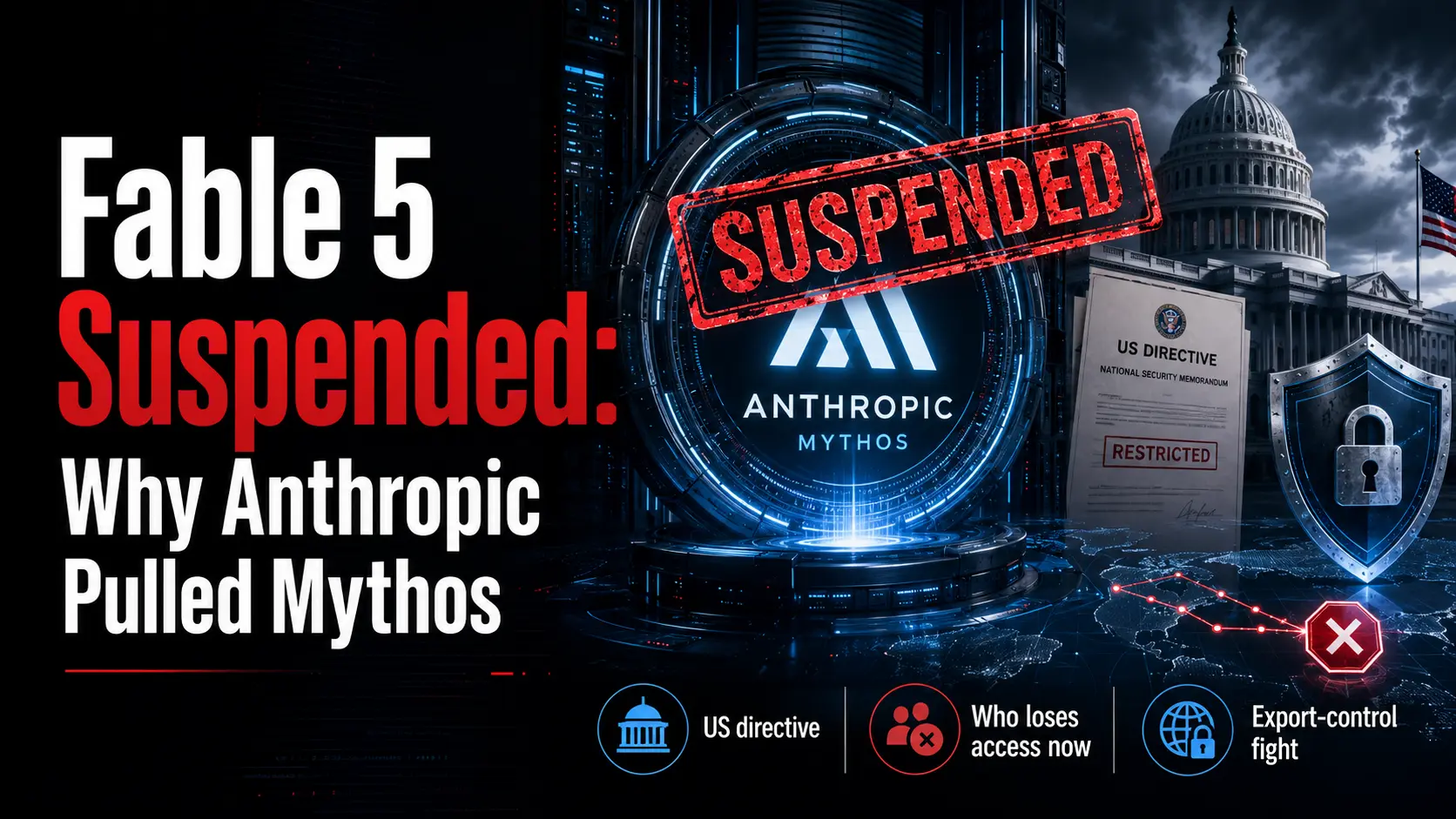
The June 2026 escalation made that signal more concrete: Anthropic later said Fable 5 and Mythos 5 access was suspended after a US government directive, turning Mythos from a restricted-model watchlist item into a live export-control and customer-access dispute.
Sources
Related AI Insights
- Meta Muse Spark vs GPT-5.4: What’s Officially Confirmed
- AI Coding Agents 2026: GPT-5.4, Claude Code & Dev Tools
- Best AI Assistants in 2026 to Work Faster & Smarter
- AI Governance: 7 Strategies for 2026
- Trump AI Oversight: The 2026 Policy Reversal Explained
- Fable 5 Suspended: Why Anthropic Pulled Mythos