Key takeaways (May 17, 2026)
- Google described TurboQuant as a quantization approach that preserves accuracy while cutting inference cost.
- As of May 2026, gains depend heavily on model family and hardware — not a universal speedup.
- Production deployments are concentrated in Google’s own serving stack and partner clouds.
- Independent benchmarks remain limited; treat headline numbers as vendor-reported.
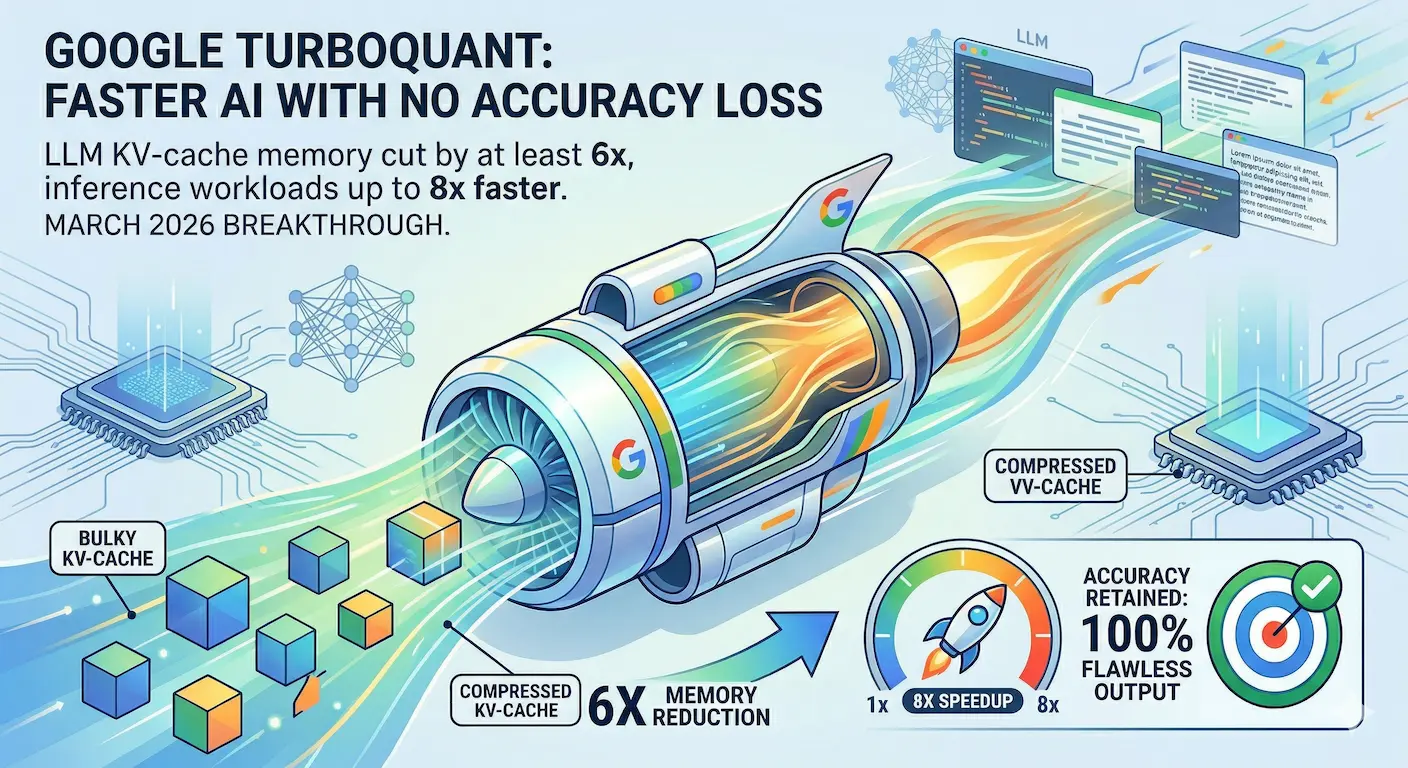
Google TurboQuant is a training-free quantization method, announced March 24, 2026, that cuts LLM key-value cache memory by at least 6x and speeds up attention-logit computation by up to 8x on Nvidia H100 GPUs with zero reported accuracy loss on long-context benchmarks. It is one of those AI infrastructure stories that sounds boring until you realize what it changes. that sounds boring until you realize what it changes. On March 24, 2026, Google Research announced TurboQuant, a quantization method that cuts LLM key-value cache memory by at least 6x and, in Google’s tests, speeds up attention-logit computation by as much as 8x on Nvidia H100 GPUs. The headline many people ran with was “faster AI with zero accuracy loss.” That’s directionally right, but the more honest version is better: TurboQuant makes a specific, expensive part of inference much cheaper without hurting benchmark accuracy.
I think this matters more than another model leaderboard screenshot. Memory has quietly become one of the biggest bottlenecks in AI. Not training, for once. Inference. Long-context inference in particular. If Google can shrink that bottleneck without retraining the model and without obvious quality loss, the downstream impact touches everything: cheaper serving, longer context windows, more viable agent workflows, and better economics for search and retrieval systems.
I went through Google’s research blog, the ICLR 2026 paper listing on OpenReview, and the surrounding coverage to pin down what TurboQuant actually does, what it does not do, and why it matters well beyond one benchmark chart.
Key findings
- Google publicly announced TurboQuant on March 24, 2026 through Google Research.
- The strongest confirmed claims are at least 6x lower KV-cache memory usage and up to 8x faster attention-logit computation on H100 GPUs, not a universal “6x faster AI” across every workload.
- Google says TurboQuant achieves this with zero accuracy loss on the tested long-context and retrieval benchmarks, including LongBench, Needle In A Haystack, ZeroSCROLLS, RULER, and L-Eval.
- The method is training-free for KV-cache compression. That matters because it makes deployment easier than techniques that require fine-tuning or model-specific retraining.
- The bigger story is not just Gemini. TurboQuant targets two expensive primitives across modern AI systems: KV-cache storage and vector search.
What TurboQuant actually solves
The easiest way to understand TurboQuant is to start with the problem it attacks.
Large language models keep a key-value cache during inference. Google’s description of it as a high-speed “digital cheat sheet” is a good one. The model stores intermediate information so it doesn’t have to recompute everything for every token. That cache is one reason long conversations and long-context tasks remain practical. It’s also one reason serving modern LLMs is expensive.
The longer the context, the bigger the KV cache grows. The bigger the cache, the more memory you need. And once memory becomes the limiter, a lot of bad things happen at once:
- You fit fewer concurrent requests on the same hardware
- You hit bandwidth limits sooner
- Long-context workloads get more expensive than teams expect
- Retrieval-heavy applications start burning money on infrastructure
This is one reason the infrastructure side of AI now matters as much as the models themselves. We talk a lot about frontier performance in articles like AI coding agents in 2026, but the economics underneath those agents are what decide whether teams can actually deploy them at scale.
TurboQuant goes after that memory burden directly by compressing vectors in a way that keeps the attention math accurate enough to preserve downstream quality.
Why this is a bigger deal than a normal quantization story
Quantization is not new. Everyone in AI infrastructure has been chasing lower precision for years. The reason TurboQuant got attention is that Google is not pitching a routine 8-bit or 4-bit tradeoff where quality drops a little and you decide whether the speedup is worth it.
The interesting claim is sharper:
- compress the KV cache to 3 bits
- do it without training or fine-tuning
- keep benchmark accuracy effectively unchanged
- reduce memory by at least 6x
- speed up a key inference path by up to 8x
That’s why the story spread beyond research circles. If those claims hold up in real production workloads, TurboQuant is not just an optimization trick. It’s a change in the cost model for long-context AI.
I think that’s also why this story landed harder than a lot of abstract model-compression papers. You don’t need to be deep in systems research to understand the appeal of “same quality, much less memory, faster runtime.”
How TurboQuant works, in plain English
Google’s write-up says TurboQuant combines two ideas: PolarQuant and Quantized Johnson-Lindenstrauss, usually shortened to QJL.
At a high level, the process looks like this:
- Rotate the vector so its geometry becomes easier to compress.
- Quantize the bulk of the information efficiently with PolarQuant.
- Use a tiny 1-bit residual correction stage with QJL to remove bias and recover attention-score accuracy.
That third step matters a lot. Plenty of quantization methods save memory while introducing just enough distortion to hurt attention quality. TurboQuant’s pitch is that the residual correction stage cleans up the hidden errors that usually show up when you compress aggressively.
Google frames PolarQuant as the main compression engine and QJL as the error-correction layer. That’s a useful way to think about it. Most of the bits go toward preserving the signal. A very small extra piece goes toward keeping the inner-product math honest.
If that sounds abstract, here’s the practical interpretation: TurboQuant tries to behave like an ultra-light storage format without making the model “forget” what matters during attention.
The research claim behind the hype
The OpenReview page for the ICLR 2026 paper is where the more technical framing shows up. The authors describe TurboQuant as an online vector quantization method with a near-optimal distortion rate. That phrase matters because this is not just “we tried a clever compression trick and it looked decent on a benchmark.” Google is making a theoretical claim too.
That doesn’t mean the result is automatically universal. Research results rarely are. But it does mean TurboQuant is trying to solve a real mathematical limit, not just tune around one narrow production issue.
From my point of view, that’s what separates this from thin benchmark theater. Google is claiming three things at once:
- strong empirical results on long-context tasks
- practical usefulness for vector search and KV-cache compression
- a theoretical foundation showing the method operates near known limits
That’s a much stronger package than most AI efficiency announcements.
What Google actually tested
According to Google’s March 24 post, the experiments covered standard long-context benchmarks and retrieval tasks using open-source models including Gemma and Mistral. The published benchmark set included:
- LongBench
- Needle In A Haystack
- ZeroSCROLLS
- RULER
- L-Eval
Google says TurboQuant achieved perfect downstream results on the needle-in-a-haystack tests while reducing KV memory by at least 6x. It also says the method quantized KV cache to 3 bits without training or fine-tuning and still preserved model accuracy.
Those are strong claims, but they still need to be read carefully. “Zero accuracy loss” in this context means no measurable loss on the tested tasks and settings. It does not mean every production workload, every model family, and every latency stack will behave identically. That’s not a flaw in the work. That’s just how real systems research works.
I think this is where a lot of coverage gets sloppy. TurboQuant is not magic. It is a serious algorithmic improvement aimed at a specific bottleneck. That’s already enough.
Why KV-cache compression matters so much in 2026
This story makes more sense if you zoom out. AI in 2026 is not limited by model weights alone. It’s limited by everything that accumulates around inference:
- KV caches
- memory bandwidth
- concurrency limits
- retrieval overhead
- cost per long-running session
This is especially relevant for agent systems. The more you move from short chat turns to long-running workflows, the more context sticks around, and the more infrastructure pain you feel. That’s part of the same shift we covered in the agentic AI revolution and in agentic AI deployments and risks. Agents are not just model problems. They are systems problems.
If TurboQuant really reduces KV memory by 6x or more in production-like settings, you get several immediate advantages:
- More simultaneous users per GPU
- Longer context windows without the same memory penalty
- Lower serving cost for retrieval-heavy apps
- Better economics for coding agents, research agents, and search products
- A path to smaller-footprint deployments on constrained hardware
That last point is easy to miss. People hear “Google Research” and think only hyperscale data centers. But any method that reduces memory pressure this aggressively also matters for edge inference, private deployments, and enterprise teams trying to squeeze more life out of existing hardware.
TurboQuant vs the usual AI efficiency tradeoff
Most efficiency announcements make some version of the same bargain: you give up a bit of accuracy to gain speed, memory savings, or lower cost.
TurboQuant is interesting because Google is explicitly arguing that this usual bargain is not necessary for the tested workloads.
| Approach | Typical tradeoff | What TurboQuant claims |
|---|---|---|
| Lower-precision inference | Faster and cheaper, but often some quality drop | No measurable accuracy loss on tested benchmarks |
| Fine-tuned compression | Good task-specific savings, but extra training cost | No retraining or fine-tuning required |
| Heavier vector quantization | Good compression, but hidden memory overhead | Better compression with near-zero overhead |
| Simple cache shrinking | Lower memory, but weaker long-context behavior | 3-bit KV compression while preserving downstream accuracy |
This is why people are describing TurboQuant as a breakthrough instead of just another systems paper. It targets the place where AI teams usually have to compromise.
Where this could show up first
I don’t think the first major impact will be consumers noticing that chatbots feel vaguely snappier. I think it shows up in systems where memory pressure is already painful.
1. Long-context assistants
Any model serving long documents, long chats, or persistent work sessions benefits from lower KV-cache overhead. That’s the obvious first win.
2. Coding agents
Coding agents keep more state alive than standard chat apps do. They inspect files, track edits, run tools, and carry context across many steps. That is exactly the kind of workload where cheaper memory changes the economics. If you’ve read our breakdown of AI coding agents, this is the infrastructure layer underneath that experience.
3. Vector search and retrieval
Google is clear that TurboQuant is not only about LLM inference. Vector search is a major target too. As search systems move further toward semantic retrieval, compressed high-quality vector operations become more important, not less.
4. Enterprise AI serving
A lot of enterprise deployments are cost-capped before they are capability-capped. They can run the model. They just can’t afford to run enough of it, for enough users, with enough context. TurboQuant directly attacks that bottleneck.
What this means for Google specifically
The obvious product connection is Gemini, but I think the broader Google angle matters more.
Google sits on three layers where TurboQuant has real strategic value:
- frontier models
- search and retrieval infrastructure
- hyperscale serving economics
That combination is unusual. A startup can invent a clever compression method. Google can potentially use the same family of ideas across model serving, semantic search, and large internal infrastructure fleets.
This is also why the story got framed by some commentators as a “DeepSeek moment” for Google. Not because TurboQuant is a direct model release. It isn’t. But because it suggests Google may have found a way to bend the cost curve on a part of AI infrastructure that everybody has been paying for.
And cost-curve changes matter. A lot. They decide who can scale products, who can lower prices, and who can support more agentic workloads without turning every power user into a margin problem.
What this does not mean
I think this is the section a lot of articles skip. So here’s the part worth saying plainly.
TurboQuant does not mean:
- every AI model is now automatically 6x faster
- memory is no longer a bottleneck
- model quality problems are solved
- inference cost suddenly stops mattering
- all existing deployments can swap this in overnight with the same results
It also does not mean benchmark claims automatically translate cleanly into every real-world stack. Kernel engineering, model architecture, batch size, serving framework, and workload shape still matter.
This is still a very big deal. It just needs to be described accurately. The stronger version of the truth is that Google appears to have found a much better way to compress one of the most expensive moving parts in modern AI inference.
My take on why this story matters now
I think AI coverage still overweights model launches and underweights infrastructure. That’s backwards.
A frontier model with great benchmarks but terrible serving economics has a ceiling on its impact. An infrastructure improvement that keeps quality stable while lowering memory and speeding up a core path can reshape what companies can afford to ship.
That’s what makes TurboQuant interesting to me. It hits the exact layer where theory, systems engineering, and business reality meet:
- researchers care because the distortion bounds matter
- product teams care because latency and memory costs matter
- CFOs care because GPU utilization and serving margins matter
There is also a second-order effect here. Better memory efficiency makes longer-running, more capable agent systems easier to justify. That’s one reason I think this story belongs in the same broader arc as MCP-enabled agent infrastructure and the move toward more autonomous workflows. Cheaper context means more room for agents to stay on task.
What happens next
The next question is not whether TurboQuant sounds impressive on a Google blog. It does. The real questions are these:
- How well does it generalize across more model families?
- How much of the benchmark gain survives production serving stacks?
- How quickly does it show up in real Google products or open implementations?
- Do competing labs ship similar KV-cache compression methods this year?
If the answer to even half of those comes back positive, TurboQuant will age as one of the more important AI systems stories of 2026.
Not flashy. Not consumer-facing. But important in the way infrastructure breakthroughs usually are. Quietly, then all at once.
Related AI Insights
- AI Coding Agents 2026: GPT-5.4, Claude Code & Dev Tools
- The Agentic AI Revolution: Why 2026 Changes Everything
- MCP Agentic AI: How Model Context Protocol Works
- Agentic AI in 2026: Use Cases, Risks & What’s Next
- Best AI Assistants in 2026 to Work Faster & Smarter
- AI Energy Crisis Solved? 100x Efficiency Breakthrough
- Meta Muse Spark vs Claude Mythos 5 vs GPT-5.4