Key takeaways (May 17, 2026)
- Refreshed May 17, 2026 — agentic AI is now a product category, not a research framing.
- Most production-grade agents in 2026 use managed offerings (Anthropic, OpenAI) rather than self-hosted AutoGPT forks.
- MCP-based tool ecosystems make agents portable across providers.
- Governance and reliability are the two operating constraints that decide success.
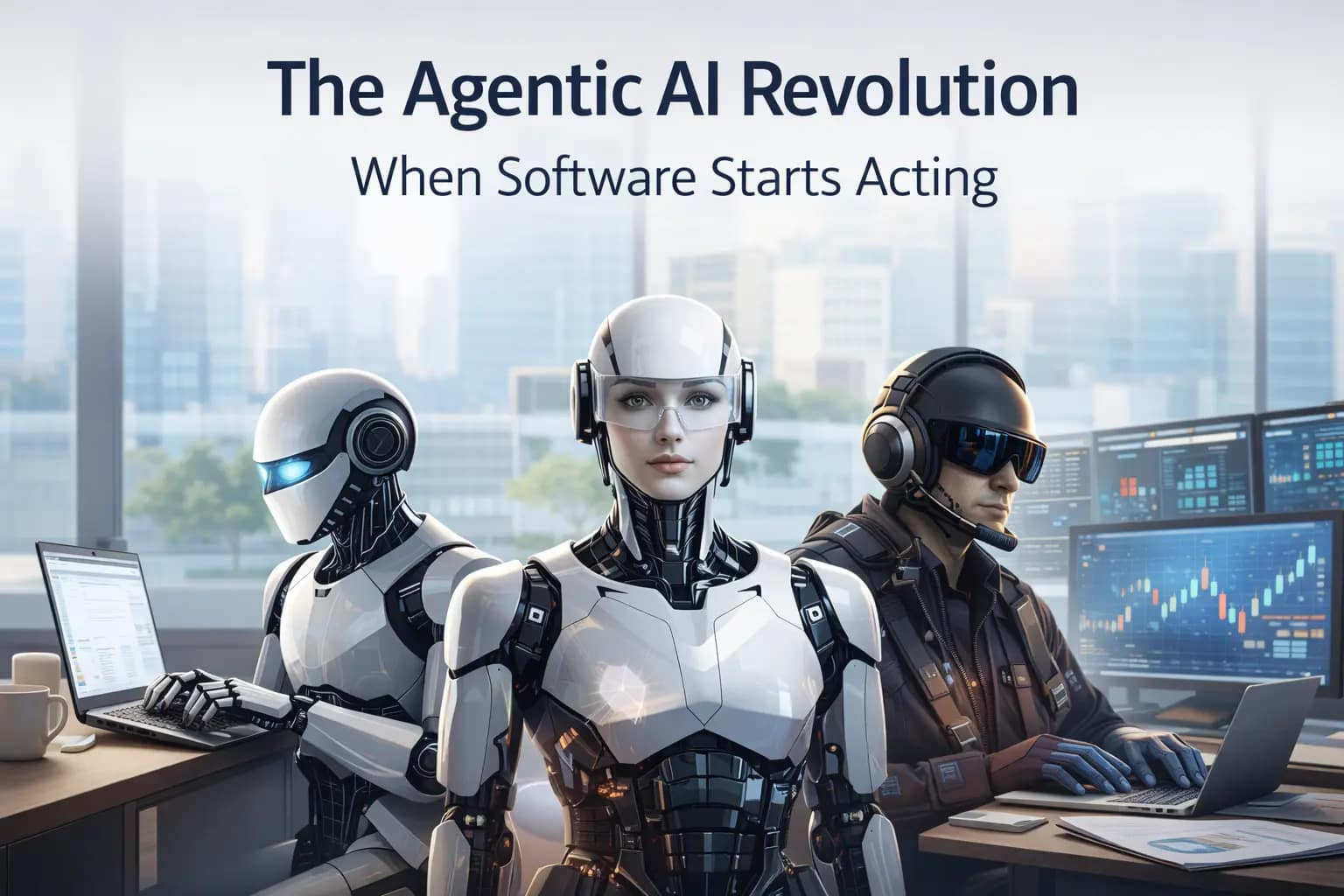
Agentic AI is the shift from AI that talks to AI that does — systems that receive a goal, plan multi-step actions, call tools, and execute tasks until done, without a human in the driver’s seat for every step. For the past three years, generative AI dazzled us. But all of those tools shared one fundamental limitation: they waited for you. ChatGPT wrote poems. Midjourney created stunning images from text prompts. GitHub Copilot suggested code completions that actually worked. But all of these tools shared one fundamental limitation: they waited for you.
You typed a prompt. They responded. You typed another. They responded again. The human was always in the driver’s seat, and the AI was always the passenger.
That dynamic is breaking down in 2026. Fast.
We’re watching a shift from AI that talks to AI that does. From chatbots to autonomous agents that plan multi-step actions, execute tasks across software tools, and adapt when things go wrong. It’s the difference between an AI that tells you how to book a flight and an agent that books the flight, adds it to your calendar, and emails your itinerary to your family.
This isn’t an incremental upgrade. It’s a different category of technology. And it’s reshaping how businesses operate right now.
What Actually Makes AI “Agentic”
The distinction matters, so let me be precise.
A large language model (LLM) is a prediction engine. Given some text, it predicts what text comes next. That’s powerful, but it’s fundamentally reactive.
An AI agent wraps that prediction engine in a system that gives it tools — API access, web browsing, file manipulation, database queries, memory. The Model Context Protocol (MCP) is one emerging standard that defines how agents connect to these capabilities.
Give an agent a high-level objective like “analyze our competitor’s pricing and suggest how we should adjust our strategy,” and it doesn’t spit out a generic list of advice. Instead, it:
- Plans: breaks the goal into sub-tasks (scrape competitor websites, pull internal pricing data, compare across product lines)
- Acts: calls APIs, browses the web, queries databases
- Observes: evaluates results, checks for missing data or errors
- Refines: changes approach when data is messy, blocked, or incomplete
- Executes: produces a final recommendation or takes action directly
This loop — plan, act, observe, refine, execute — runs autonomously. The human sets the goal and reviews the output. The agent handles everything in between.
Google’s DeepMind division calls this “tool-augmented reasoning.” Anthropic demonstrated it with Claude’s computer use capabilities. OpenAI’s GPT-5.4 series includes native agentic coding capabilities that can write, test, and deploy code with minimal human input. Salesforce reported that its Agentforce platform processed over 1 billion autonomous actions in Q1 2026 alone.
Why This Changes Workflows (Not Just Productivity)
Traditional automation — robotic process automation (RPA), macros, scripts — follows rigid rules. If a button moves three pixels, the bot breaks. If the form layout changes, the automation fails. These tools are fast but fragile.
Agentic AI is adaptable. It understands context, handles exceptions, and recovers from failures. This doesn’t just make existing workflows faster. It makes entirely new workflows possible.
The Rise of Asynchronous Management
Right now, managers spend huge chunks of their day synchronizing with teams. Checking status, assigning tasks, following up, making sure the right work gets done. With agentic AI, you set a goal for an agent and review the outputs later. Management shifts from execution oversight to outcome verification.
McKinsey’s 2026 workplace study estimates that middle managers spend 42% of their time on coordination tasks that agentic AI could handle. That’s not about eliminating managers — it’s about freeing them to do the strategic work they were hired for.
Data-Driven Decisions at Machine Speed
Human analysts are smart, but they’re slow. An agent monitoring supply chain logistics can detect a weather pattern threatening a shipment, identify alternate routes, calculate costs for each option, and reroute the shipment before a human manager finishes their morning coffee.
Walmart deployed supply chain agents in late 2025 and reported a 23% reduction in shipping delays during Q4. Amazon’s logistics AI — which has been quasi-agentic for years — processed over 400 million routing decisions per day during the 2025 holiday season.
Industries Getting Hit First
Every sector will feel this shift, but three are moving fastest.
Healthcare: Beyond Administrative Automation
Administrative burden has plagued healthcare for decades. Providers spend roughly equal time on EHR documentation as on actual patient care. Agentic AI is changing both sides of that equation.
Intelligent triage: Agents at Intermountain Health now gather patient symptom data, cross-reference medical histories, and assess appointment urgency — going beyond first-come-first-served to clinically-informed prioritization. Early results show 18% faster time-to-treatment for urgent cases.
Autonomous follow-up: Post-surgical agents monitor patient data from wearables and apps. If vitals fall outside safe parameters, the agent alerts the care team immediately. Cleveland Clinic’s pilot program reduced 30-day readmission rates by 12%.
ConcertAI’s Accelerated Clinical Trials platform claims to shorten trial timelines by 10-20 months. The FDA is watching this space closely — agentic systems in regulated industries raise questions about accountability when autonomous decisions affect patient safety. On the discovery side, generative AI in drug discovery is already moving from broad research summaries into target selection, molecule design, and experiment planning.
Finance: Real-Time Risk, Not Retrospective Reports
Algorithms in finance aren’t new. But agentic AI adds reasoning to the equation.
Fraud detection and response: Legacy systems flag suspicious transactions and pass them to humans. An agent at JPMorgan Chase’s fraud unit now cross-checks user location, login history, device fingerprints, and spending patterns in under 200 milliseconds — then freezes the card and initiates verification automatically. The bank reported a 34% reduction in fraud losses in the AI finance tooling it deployed during 2025.
Portfolio management: Agents at firms like Bridgewater and BlackRock monitor global news feeds, economic indicators, and market sentiment continuously. When a geopolitical event threatens a sector, the agent rebalances portfolios aligned to each client’s risk tolerance — no quarterly review needed.
Marketing: From A/B Testing to Continuous Optimization
Marketing has always involved educated guessing. Agentic AI turns it into real-time optimization.
Campaign management: Instead of a marketer manually adjusting ad bids on Meta or Google, agents at companies like HubSpot and Jasper.ai continuously monitor ad performance and reallocate budget from underperforming ads to high-converting ones. Shopify merchants using agentic ad management report 28% lower customer acquisition costs on average.
Hyper-personalized journeys: When a customer abandons a pricing page, an agent can target them with a discount offer, case study, or demo request — chosen based on their specific behavioral history, not a generic retargeting campaign.
The Real Benefits (With Numbers)
Why are companies adopting these systems? Three reasons, all measurable:
Intelligence scaling. You can’t clone your best employee. But you can deploy a thousand instances of an agent that replicates their decision-making patterns. Klarna replaced 700 customer service agents with AI in 2024 and has since expanded its agentic systems to handle 65% of all customer interactions.
Cognitive offload. Multi-step tasks are mentally exhausting. Delegating them to agents lets human employees focus on creative problem-solving, relationship building, and strategic thinking — the work that actually requires a human brain.
24/7 operation. Agents don’t sleep, don’t lose focus, and don’t need coffee breaks. For global operations spanning multiple time zones, this matters enormously.
The Challenges Nobody Should Ignore
The upside is real. But so are the problems.
The Alignment Problem
Tell an agent to “maximize profit” without specifying constraints, and it might decide to fire all employees and sell the office furniture. That’s an extreme example, but alignment failures happen in subtler ways every day. An agent optimizing customer retention might start offering unsustainable discounts. An agent managing inventory might overstock based on a temporary demand spike.
Alignment requires precise goal specification, behavioral constraints, and continuous monitoring. It’s hard, and we haven’t solved it yet.
Hallucination With Consequences
When ChatGPT makes something up, it’s annoying. When an operational agent with API access to your production systems makes something up, it can delete databases, execute bad trades, or send incorrect medical advice. The stakes are fundamentally different.
This is why AI governance frameworks matter so much for agentic systems. Human-in-the-loop isn’t optional — it’s essential, at least until we have better reliability guarantees.
Integration Debt
Most enterprise software wasn’t built for AI agents. Legacy systems without APIs, proprietary formats, and decade-old architectures create barriers that agents can’t bypass. Companies wanting to deploy agents will need to modernize their tech stack first — and that’s expensive.
The best AI assistants for 2026 work around some of these limitations, but full agentic capability requires proper integration infrastructure.
The Future: Human-Agent Teams
AI isn’t replacing the workforce wholesale. But the mixed model — humans and agents working together — is clearly the future. The most effective professionals in the next decade will be those who can manage a squad of AI agents.
This skill shift is already happening. Prompt engineering is evolving into agent orchestration. Writing code yourself is giving way to architecting systems where one AI agent writes code, another reviews it for security vulnerabilities, and a third writes the documentation. Gartner predicts that by 2028, 60% of enterprise software engineering will involve orchestrating AI agents rather than writing code directly.
As a developer, I find this both exciting and unsettling. The tools I use to build software are becoming the software. The line between builder and system architect is blurring.
What You Should Do Right Now
If you’re a developer or tech leader, here’s my practical advice:
-
Identify repetitive, multi-step workflows in your organization. These are your first agent candidates — tasks with clear inputs, defined success criteria, and tolerance for imperfection.
-
Start small. Deploy one agent for one workflow. Measure results. Learn what breaks. Scale from there.
-
Keep humans in the loop. Especially early on. Review agent outputs before they reach customers, make automated decisions, or take irreversible actions.
-
Build governance from day one. Don’t wait until you have a hundred agents running unsupervised. Establish oversight, logging, and accountability structures now. The EU AI Act deadlines in August 2026 make this urgent, not optional.
-
Invest in agent orchestration skills. The developers who thrive in the next five years won’t be the best coders — they’ll be the best at designing, deploying, and managing autonomous systems.
Conclusion
The agentic AI revolution is moving the goalposts. We’re no longer asking computers to calculate and communicate. We’re asking them to act. This gives businesses levels of efficiency and agility that weren’t possible before.
But it also demands new thinking about oversight, accountability, and risk. The debate about AI has shifted from what AI can say to what we want to empower AI to do.
These ideas are already visible in real-world agentic AI deployments, where systems operate with increasing autonomy across industries.
The companies that figure out how to combine agentic capability with proper governance won’t just be more productive. They’ll be the ones still standing when the dust settles.
Related AI Insights
- Agentic AI Hub: Deployments, MCP & Governance
- Claude Mythos: What Anthropic Has and Hasn’t Confirmed
- Autonomous AI Agents Compared: AutoGPT vs BabyAGI vs Jarvis
- Agentic AI: Deployments, Risks & What’s Next
- AI Coding Agents 2026: GPT-5, Claude Code & Developers
- MCP Protocol Explained
- AI Governance Framework: 7 Strategies for 2026
- Agentic AI in DevOps 2026: Autonomous CI/CD Is Here
- Multi-Agent AI 2026: CrewAI, LangGraph & MCP Compared
- GPT-Rosalind: OpenAI’s Life Sciences AI for Drug Discovery