Key takeaways (May 17, 2026)
- Meta’s Muse / Spark line, Anthropic’s Claude lineup and OpenAI’s GPT-5.x cover three different bets on consumer + developer AI.
- Meta optimises for in-product distribution; Anthropic for reasoning and long context; OpenAI for ecosystem breadth.
- Open weights from Meta and DeepSeek keep pricing pressure on closed-frontier players.
- Pick the model that fits your distribution and budget, not the one with the loudest demo.
Short answer: GPT-5.5 is now the cleanest public developer choice, Muse Spark is Meta’s consumer AI model with private-preview API access, and Claude Mythos Preview is real but restricted around defensive security. Treating all three as equal “public models” would be misleading.
The April 2026 model race moved again. Meta announced Muse Spark on April 8. OpenAI announced GPT-5.5 on April 23 and updated the post on April 24 to say GPT-5.5 and GPT-5.5 Pro are available in the API. Anthropic’s public materials now point to Project Glasswing and Claude Mythos Preview cybersecurity testing, but that is not the same thing as broad public model access.
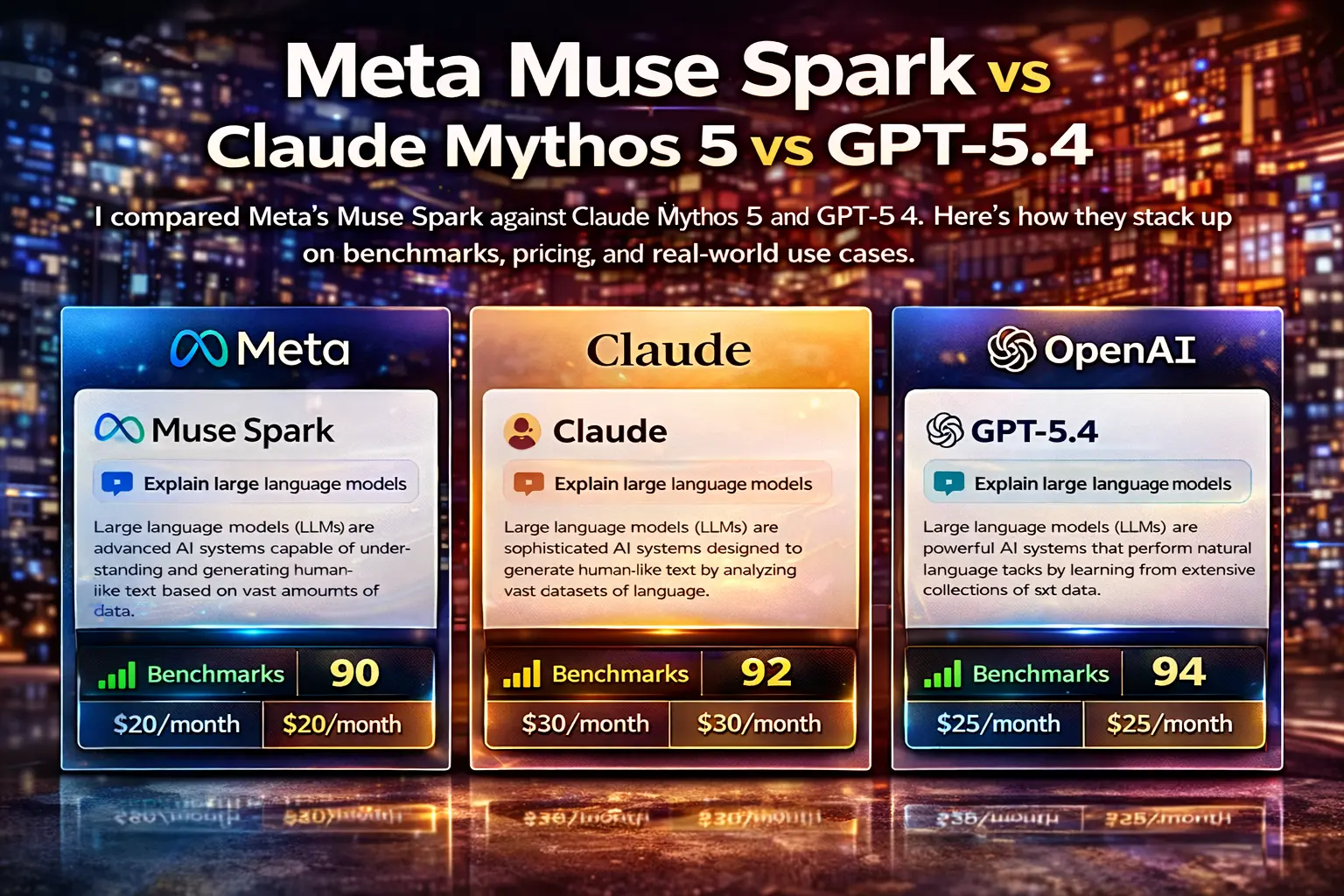
If you want a factually clean April 2026 comparison, the practical public matchup is Meta Muse Spark versus OpenAI GPT-5.5, with GPT-5.4 as the previous OpenAI baseline. Claude Mythos Preview belongs in the discussion, but only as a restricted security-focused frontier model.
That distinction matters. A lot of AI coverage collapses “publicly released,” “reported in credible press,” and “rumored from leaks” into one comparison table. Google generally does not reward that. Neither should readers.
So this version does something simpler and more defensible:
- compare Muse Spark and GPT-5.5 using official product pages
- treat Claude Mythos Preview as a restricted-access model with public security materials, not a normal retail model
- separate what is confirmed from what is still inference or outside reporting
Methodology
I updated this article on April 25, 2026 using current official product pages, API availability notes, and safety materials where they exist:
- Meta’s April 8, 2026 Muse Spark announcement
- OpenAI’s April 23, 2026 GPT-5.5 release page and April 24 API availability update
- OpenAI’s March 5, 2026 GPT-5.4 release page as the previous baseline
- Anthropic’s Project Glasswing page and Mythos Preview cybersecurity assessment
Where a company has not published normal product details, I say so directly instead of filling the gap with leaked or secondary benchmark tables.
What is officially public today
| Model | Public status on April 25, 2026 | What is officially confirmed | Developer relevance |
|---|---|---|---|
| Meta Muse Spark | Public product, limited API preview | Powers Meta AI app and meta.ai; multimodal capabilities; private-preview API for select partners | Relevant, but not broadly open to developers yet |
| GPT-5.5 | Public product and API model | OpenAI says GPT-5.5 is available in ChatGPT, Codex, and the API, with GPT-5.5 Pro also available for higher-accuracy work | Clearest default for developers who need public docs and API access |
| GPT-5.4 | Public previous-generation baseline | Still useful as the March 2026 baseline for GPT-5.5 comparisons | Relevant for cost, migration, and benchmark comparisons |
| Claude Mythos Preview | Restricted access | Anthropic has published Project Glasswing and security-testing materials, but the model is not a broad public API default | Relevant for defensive security programs, not ordinary app teams |
That table is less exciting than the usual frontier-model race chart. It is also more trustworthy.
Meta Muse Spark: what Meta actually announced
Meta officially announced Muse Spark on April 8, 2026 as the first model in a new Muse series built by Meta Superintelligence Labs. According to Meta’s own post, the model is:
- powering the Meta AI app and
meta.ai - rolling out to WhatsApp, Instagram, Facebook, Messenger, and AI glasses
- designed to support both reasoning and multimodal tasks
- available in private preview via API to selected partners
The most important takeaway from Meta’s announcement is strategic, not benchmark-related. Meta is positioning Muse Spark as:
- a consumer-facing assistant model
- a foundation for more advanced future Muse models
- a model tied tightly to Meta’s product ecosystem and social graph
That means Muse Spark matters most in two scenarios:
- you care about where Meta AI is headed as a consumer product
- you are a partner who may receive API preview access
It matters less if your question is simply: “What frontier model can I adopt broadly in production today?”
What Meta did not publish clearly enough
Meta’s product announcement is strong on positioning and rollout, but weaker on the details developers usually want:
- no broadly available API
- no clean public pricing sheet
- no complete public benchmark table comparable to an API-model launch
- no clear enterprise onboarding path for most teams
That does not make Muse Spark weak. It means it is still a less mature developer product than GPT-5.5.
GPT-5.5: the cleanest public developer option
OpenAI announced GPT-5.5 on April 23, 2026 and updated the post on April 24 to say GPT-5.5 and GPT-5.5 Pro are available in the API. That matters because you can verify the core product questions directly:
- what the model is
- how to access it
- where it is available
- what the current API pricing is
That level of documentation is exactly why GPT-5.5 is the cleanest recommendation for developers evaluating frontier models in public.
OpenAI positions GPT-5.5 as a stronger model for agentic coding, computer use, knowledge work, tool use, and scientific research. It is also now the relevant OpenAI comparison point because the release page directly compares GPT-5.5 against GPT-5.4 on several evaluations.
Why GPT-5.5 wins the practicality test
In late April 2026, the practical advantage of GPT-5.5 is straightforward:
- public API access exists
- pricing is public
- Codex integration is public
- the release page documents how OpenAI wants the model used
- GPT-5.4 remains available as a clear previous baseline
That does not prove GPT-5.5 is the best model on every benchmark. It proves it is the easiest frontier model here to evaluate honestly and deploy responsibly.
Why Claude Mythos should not be in the same benchmark table
This is the key fix from the earlier version of this article.
Claude Mythos Preview can be discussed. It should not be treated as a fully public benchmark-and-pricing product in the same way as GPT-5.5.
Here is what I am comfortable saying:
- Anthropic has published Project Glasswing, which describes Claude Mythos Preview as part of a defensive security initiative with launch partners
- Anthropic has also published a technical security assessment for Mythos Preview
- Anthropic has not positioned Mythos Preview as a normal public API model with standard pricing and broad developer availability
That means the article should not present Mythos with:
- a definitive context window
- definitive public pricing
- definitive public benchmark leadership claims
unless Anthropic publishes them directly.
The right way to talk about Mythos right now
The defensible framing is:
Claude Mythos Preview is officially discussed by Anthropic, but it is not a normal public product with the availability, pricing, and API documentation needed for a clean retail comparison.
That is still a useful thing to tell readers. It just belongs in a different category from public launches.
If you are choosing a model today
Choose GPT-5.5 if:
- you need a public API today
- you want the least ambiguous product documentation
- you care about coding, tool use, or professional workflows
- you want a model you can price and test immediately
Watch Muse Spark if:
- Meta’s product ecosystem matters to your business
- you want to understand where Meta AI is heading in consumer products
- you may qualify for private-preview API access
Do not plan around Claude Mythos yet if:
- your team needs public documentation and predictable availability
- your procurement process requires pricing, SLA conversations, or standard product docs
- your evaluation process depends on verifiable benchmark or API details
The actual comparison readers need
Too much AI writing still treats every frontier model story as a horse race. But there are really three different kinds of stories:
- public product launches with docs and pricing
- restricted-access products with limited official detail
- rumor-heavy or leak-led model narratives
Muse Spark sits mostly in category one for consumer use and category two for API access. GPT-5.5 sits clearly in category one. Claude Mythos Preview sits in category two: real and officially discussed, but restricted.
That is the comparison that helps readers make decisions.
Bottom line
As of April 25, 2026, Meta Muse Spark and GPT-5.5 are real public launches with official product pages. Claude Mythos Preview is real and officially discussed, but it does not deserve equal footing as a normal public developer model.
If you want the safest production recommendation, pick GPT-5.5. If you want to track Meta’s consumer AI direction, watch Muse Spark closely. If you want to follow Anthropic’s next frontier tier, watch Claude Mythos Preview without pretending restricted security access is the same as normal API availability.
Sources
- Meta: Introducing Muse Spark
- OpenAI: Introducing GPT-5.5
- OpenAI: Introducing GPT-5.4
- OpenAI API pricing
- Anthropic: Project Glasswing
- Anthropic red team: Claude Mythos Preview cybersecurity assessment