Key takeaways (May 17, 2026)
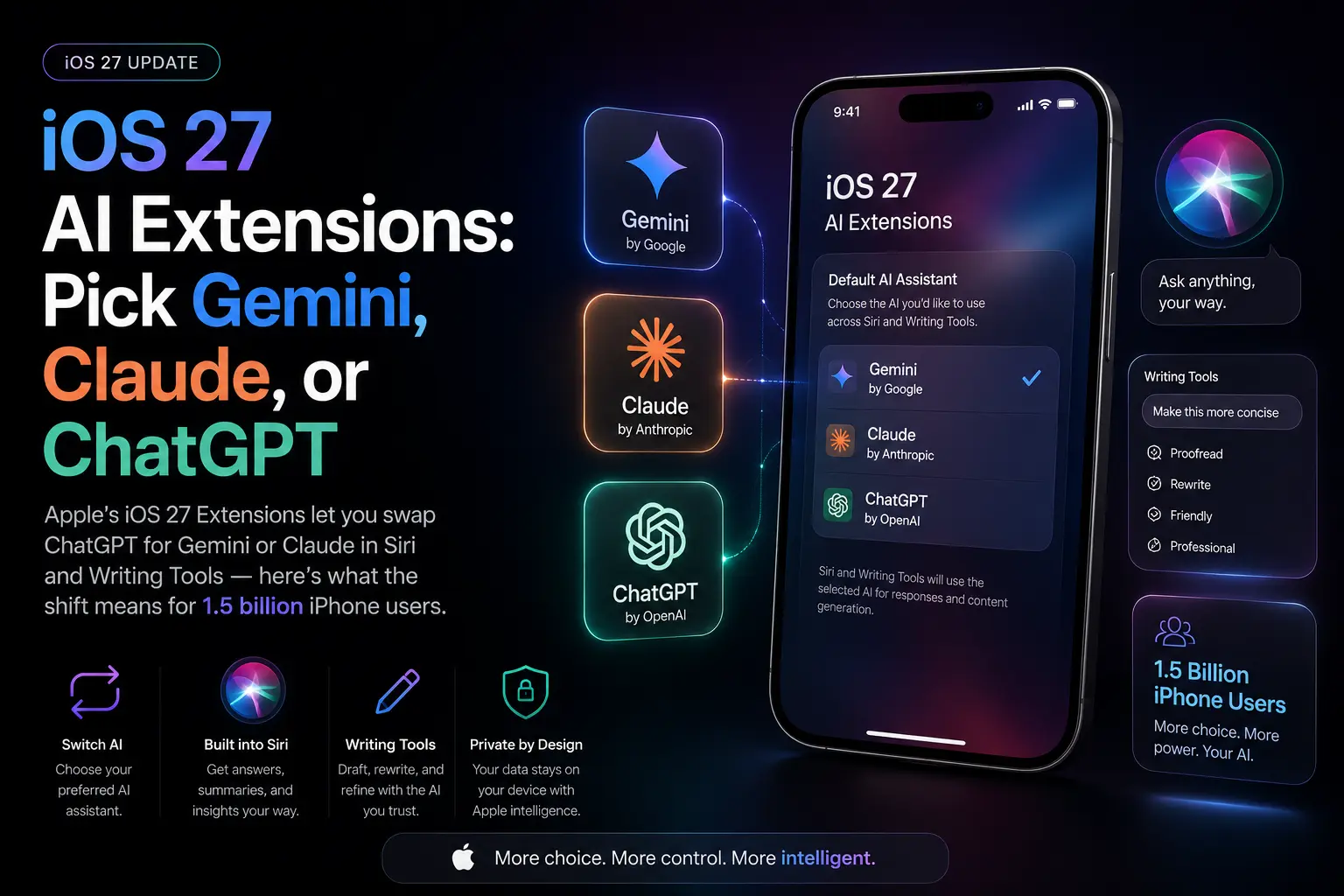
- iOS 27 opens Apple Intelligence extensions to third-party models — Gemini, Claude and ChatGPT are the first integrations announced.
- Activation lives in Settings → Apple Intelligence; users can choose providers per task.
- Privacy posture: prompts are routed through Apple’s Private Cloud Compute or directly to the chosen provider depending on opt-in.
- Developers can declare model preferences via App Intents in iOS 27 SDK.
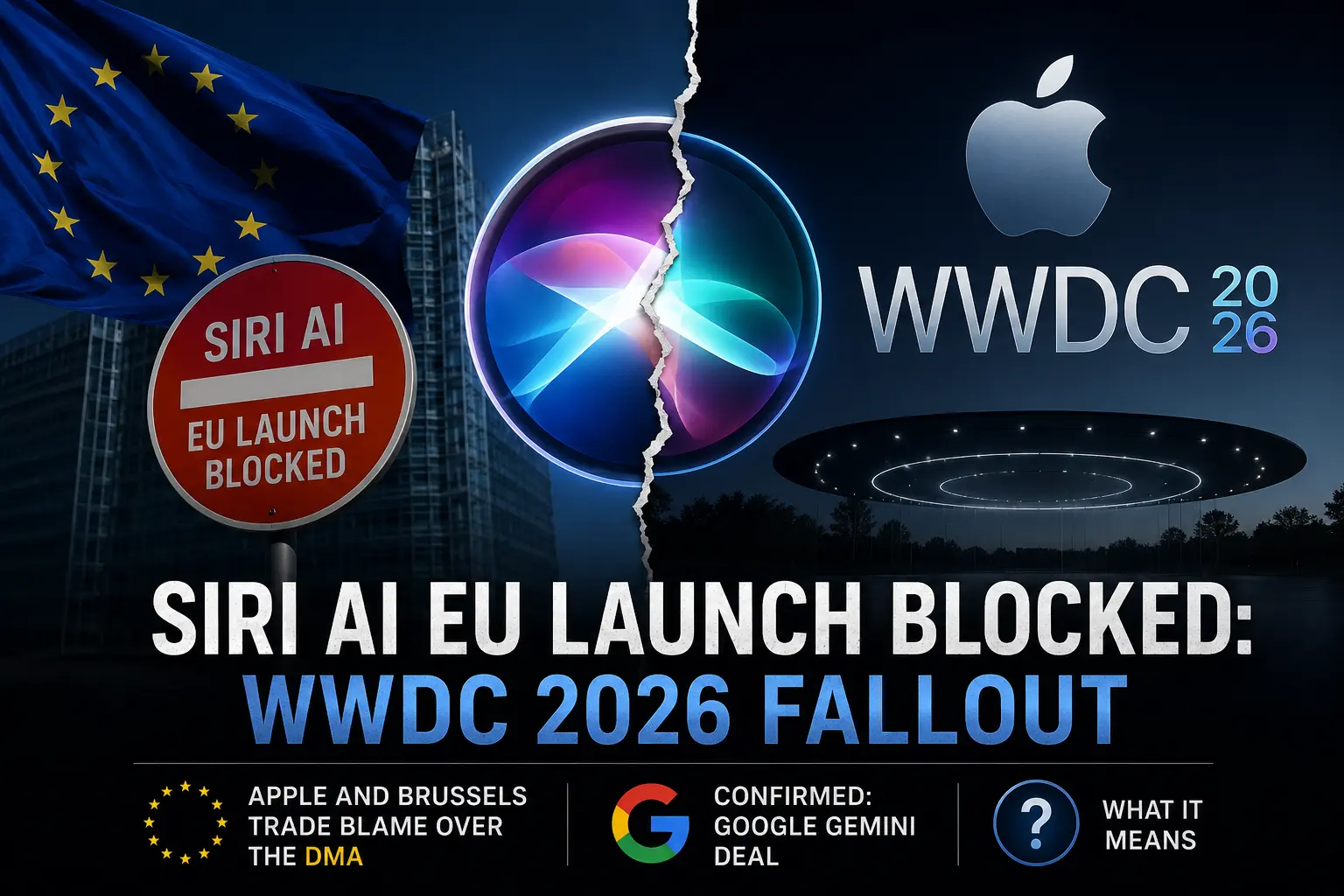
Update (June 13, 2026): WWDC 2026 has happened. Apple unveiled its revamped Siri AI but is withholding it from EU iPhone and iPad users amid a Digital Markets Act standoff. For the latest, see Siri AI’s blocked EU launch and the Apple–Google Gemini deal.
iOS 27 is about to change the way AI models work on your iPhone. Bloomberg reported on May 5 that Apple is introducing an “Extensions” framework in iOS 27, iPadOS 27, and macOS 27 that lets you set Google Gemini or Anthropic Claude as the AI powering Siri, Writing Tools, and Image Playground — features where ChatGPT has held a unique, exclusive position since iOS 26.
I’ve been tracking every source and leak since this story broke last week, and this is one of the more significant AI platform moves of 2026. For the first time, 1.5 billion iPhone users get to pick who processes their requests — OpenAI, Google, Anthropic, or whoever else ships an Extensions-compatible app. The change looks like a settings menu update. The competitive fallout runs much deeper.
Here’s exactly what the Extensions framework is, how it works, what each AI provider gains or loses, and why the WWDC announcement on June 8 will tell us a lot about which AI companies Apple actually wants to win.
What the iOS 27 Extensions Framework Actually Is
Apple’s current ChatGPT integration in iOS 26 was a bespoke deal. OpenAI got system-level Siri access that no other AI company had — a handshake arrangement that gave ChatGPT distribution to hundreds of millions of users without them needing to download anything.
Extensions is structurally different. It’s a formal developer framework, similar to how iOS already handles default browsers, email clients, and translation apps. Install a compatible AI app — the Claude iOS app, Google Gemini, whatever — and iOS 27 registers it as an available provider inside Settings > Apple Intelligence. You choose which model handles which features. ChatGPT stays available but becomes one option among many rather than the system default.
The feature name “Extensions” comes from internal Apple testing builds, first spotted by 9to5Mac. Apple hasn’t publicly confirmed that name, but Bloomberg’s Mark Gurman reported the full feature scope on May 5, 2026, and MacRumors corroborated the key details.
Extensions handles the handoff between Apple Intelligence — which still processes on-device requests locally — and the third-party model that handles more complex queries. Apple Intelligence remains the gatekeeper. An Extension only fires when Apple Intelligence decides a query exceeds on-device capabilities.
How to Switch Your AI Model in iOS 27
The flow, based on what Apple has tested internally, is straightforward.
You install the AI provider’s iOS app. The app registers with the Extensions system. You open Settings > Apple Intelligence and see a list of installed compatible providers. You can assign defaults per-feature or pick one provider for everything.
Apple also plans a voice distinction feature for Siri. If you route Siri through Gemini, that response arrives in a Gemini-specific voice, audibly different from Siri’s own voice. I find this genuinely useful — mixed-AI outputs on other platforms regularly create confusion about which system generated which response. Knowing in real time which model is speaking is a reasonable transparency layer.
According to TechCrunch’s coverage, the feature is slated for iOS 27 in fall 2026, with the full announcement at WWDC on June 8.
Which AI Models Will Be Available at Launch
Apple is already internally testing integrations with Google Gemini and Anthropic Claude. OpenAI’s ChatGPT will transition from a privileged partner into a standard Extensions participant. Reports mention Grok (xAI) as a possibility, though no confirmed testing has surfaced.
Here’s how the three confirmed-or-near-confirmed providers compare in the context of iPhone use:
| Provider | iOS 26 Status | iOS 27 Status | Key Strength for iPhone Users |
|---|---|---|---|
| ChatGPT (OpenAI) | Exclusive system-level partner | One option among many | Broadest general capability, existing familiarity |
| Gemini (Google) | App available, no system access | Full Extensions access | Google Workspace integration, multimodal search |
| Claude (Anthropic) | App available, no system access | Full Extensions access | Long-form writing, coding, nuanced reasoning |
| Apple Intelligence | On-device default | Still the privacy-first baseline | On-device speed, no external data transfer |
ChatGPT: From Exclusive to Equal
OpenAI’s iOS 26 deal was genuinely valuable. System-level Siri access meant ChatGPT reached hundreds of millions of users without them installing anything — the distribution moat that comes with being the only option.
Extensions neutralizes that completely. OpenAI moves from a structural advantage to a competitive position. That’s harder. Users who defaulted to ChatGPT via iOS 26 largely did so because there was no alternative. When that changes, some percentage will switch.
OpenAI’s best bet is model quality. The GPT-5.5 Instant update I covered does show real improvements — 52.5% fewer hallucinations on high-stakes topics, significantly faster outputs. But model quality alone won’t hold every user who now has a real choice.
Gemini: Google’s Biggest iOS Foothold in Years
For Google, this is the most meaningful access to iPhone users since the Safari default search arrangement. Gemini has been available as an iOS app, but app installs are passive. Getting Siri-level system access — where responses flow through Gemini whenever a user requests it — is a completely different order of magnitude.
When I looked at the best AI assistants for 2026, Gemini came out strongest for users already living in Google Workspace. That use case maps directly onto iPhone users who rely on Gmail, Google Calendar, and Google Docs. A Gemini Extension that can answer Siri questions with full Google account context — your actual meetings, emails, documents — is meaningfully more useful than a disconnected model.
Emarketer analysts described this as potentially significant as the Safari search deal in terms of platform reach. I think that comparison is about right.
Claude: Anthropic’s Consumer Breakout Moment
This is, by some margin, the largest consumer distribution opportunity in Anthropic’s history. Claude has grown fast in enterprise and via developer APIs. Anthropic’s recent agent work — including the “dreaming” technique that shipped in May — has been technically impressive. But the Claude app has never broken into mainstream consumer awareness.
Extensions changes that. Once Claude is a selectable system-level option on a billion-plus iPhones, Anthropic’s model gets daily exposure that no marketing spend could replicate. For iPhone users who write a lot — long emails, documents, detailed plans — Claude’s Writing Tools integration is exactly where its particular strengths show up. Anthropic’s bet that quality writing and long-context reasoning matter to consumers gets its biggest real-world test yet.
Privacy: How Apple Handles Data Across Providers
This part matters most if you’re sending sensitive requests through a third-party Extension.
Apple Intelligence processes everything it can on-device first, using Apple’s own local models. If a request is too complex for on-device handling, it escalates. Before iOS 27, that meant Private Cloud Compute (Apple’s own infrastructure) or an opt-in ChatGPT handoff. With Extensions, the escalation goes to whichever third-party provider you’ve configured.
Your data leaves your device and goes to that provider’s cloud. Apple’s own privacy guarantees don’t extend to what happens there. OpenAI’s, Google’s, and Anthropic’s own privacy policies govern the data from that point forward.
Bloomberg’s full report notes that Apple builds in transparency through the Apple Intelligence Report, accessible at Settings > Privacy & Security > Apple Intelligence Report. It logs which AI processed which request, how the request was routed, and what data was included. That visibility is better than most mixed-AI integrations currently offer.
My recommendation: Keep Apple Intelligence set as the default for privacy-sensitive tasks — health questions, financial details, confidential work communications. Use third-party Extensions for the tasks where model quality is the priority and the data isn’t sensitive.
This matters beyond individual preference. For anyone working through EU AI Act compliance requirements or similar regulations, knowing exactly which AI processed which enterprise request may be a legal obligation, not just a preference.
What This Means for the AI Industry
Apple is not building the best foundation model. It’s building the best AI distribution layer. That’s a deliberate strategic choice, and iOS 27 Extensions is the clearest public signal of it yet.
Apple’s on-device models are solid for local tasks. They’re not competitive with GPT-5.5, Gemini 2.0, or Claude Opus 4.7 on complex reasoning. Rather than spend years trying to close a gap that keeps moving forward, Apple is positioning itself as the switchboard — controlling access to 1.5 billion users while the AI labs compete to be the preferred destination.
This is the App Store model applied to AI: Apple runs the platform, developers compete on the merits, Apple captures value through the relationship with users rather than through the underlying technology.
For multi-agent AI systems and consumer AI tools, the implications flow from this platform dynamic. Whichever model gets embedded deepest into daily iPhone interactions builds loyalty, training signal, and brand presence at a scale that enterprise contracts don’t match. The agentic AI deployment patterns I’ve tracked in enterprise settings are significant, but consumer daily-use volume is a different kind of leverage entirely.
The AI lab that wins the iOS 27 default for most users will be ahead in ways that compound over years.
What to Expect at WWDC on June 8
Apple officially previews iOS 27 at WWDC in eight weeks. A few things I’m watching:
The full partner list. Gemini and Claude are confirmed through testing leaks. OpenAI is certain. Perplexity fits the research-tool use case well and is a plausible addition. Grok (xAI) has Elon Musk’s high-profile relationship with Apple and could appear as a surprise partner.
Per-feature granularity. Current reporting describes feature-level configuration — a different AI for Siri versus Writing Tools versus Image Playground. If Apple delivers that level of control, the design of that settings interface becomes critically important. Whichever AI gets the default slot on the main screen will capture a disproportionate share of users who never change settings.
Whether Extensions is an open framework or a closed partner program. If any AI company can add Extensions support via a public API, competition intensifies and smaller AI products get a real shot. If it stays a hand-selected partner list, the dynamic stays concentrated around the three big names.
Siri’s redesign. MacRumors reported alongside the Extensions story that Siri is getting a major redesign with a dedicated chat interface. The question is whether Apple positions Siri as an AI in its own right or as a routing layer for whichever AI you’ve chosen. That framing tells you a lot about how Apple sees its model ambitions going forward.
My Take
Apple’s move here is both competitive and honest. The company doesn’t have a frontier model. Rather than pretend otherwise, it’s building something it actually has an advantage in: access to the world’s most loyal hardware audience.
What I find interesting is how this changes the calculus for the AI companies involved. Anthropic, specifically, has operated primarily as an enterprise and API business. A system-level iOS integration is the kind of consumer exposure that shifts brand perception at scale — the sort of thing that suddenly makes “Claude” a household name the way “Siri” became one in 2011.
Watch the WWDC reveal on June 8. The partner list and the default configuration will tell you which companies Apple is genuinely backing and which are just there for regulatory optics.
Related AI Insights
- Best AI Assistants in 2026: Which One Fits Your Workflow
- GPT-5.5 Instant: What Changed When ChatGPT Updated Its Default
- Claude Managed Agents and Dreaming: What Anthropic Actually Shipped
- Multi-Agent AI Systems in 2026: CrewAI, LangGraph, and MCP
- Agentic AI: 7 Real-World Deployments, Risks, and What’s Next