Key takeaways (May 17, 2026)
- On May 7, 2026 the Council and Parliament reached a provisional agreement to delay Annex III high-risk AI obligations to December 2, 2027 and Annex I to August 2, 2028.
- Article 50 transparency duties and full GPAI enforcement still kick in on August 2, 2026 — Commission fines of up to 3% of global turnover or €15 million for GPAI providers go live that day.
- Generative-AI providers whose models shipped before August 2, 2026 get only until December 2, 2026 to apply watermarking, not the February 2027 date the Commission first proposed.
- Practical move: keep your Article 11 documentation, Article 50 disclosures, and AI literacy training on the August 2, 2026 schedule — the delay is for high-risk obligations only, and the provisional agreement is not yet formally adopted.
As of May 17, 2026, the EU AI Act is already in force. The ban on unacceptable-risk AI systems — social scoring, certain real-time biometric surveillance — took effect on February 2, 2025. GPAI obligations applied from August 2, 2025. And the big one, full enforcement of high-risk AI system obligations, was originally set for August 2, 2026 with fines up to €35 million or 7% of global annual turnover.
But here’s what changed: the EU’s Digital Omnibus proposal landed a provisional political agreement on May 7, 2026, pushing those high-risk deadlines to December 2, 2027 for stand-alone Annex III systems and August 2, 2028 for product-embedded Annex I. Formal adoption is still pending. That doesn’t mean you can relax — Article 50 transparency obligations and GPAI enforcement are still hitting on August 2, 2026 regardless, and the AI Office is openly planning early enforcement actions to set precedents.
I’ve been tracking this since the Act entered into force on August 1, 2024, and what strikes me is how many dev teams still treat it as a future problem. It isn’t. If you’re shipping AI products that touch EU users, your compliance clock is already ticking — the only question is which deadline applies to your specific system.
EU AI Act 2026: The Full Enforcement Timeline
Here’s the timeline that matters, with specific dates from the official Act text:
| Date | What Happens | Who’s Affected |
|---|---|---|
| Aug 1, 2024 | AI Act enters into force | Everyone — the law exists |
| Feb 2, 2025 | Banned AI practices prohibited | Anyone using social scoring, manipulative AI, untargeted facial recognition databases |
| Aug 2, 2025 | Obligations for general-purpose AI (GPAI) models apply; governance structures must be operational | Foundation model providers, GPAI deployers |
| Aug 2, 2026 | High-risk AI system obligations fully enforceable | Healthcare AI, recruitment tools, credit scoring, law enforcement AI, education systems |
| Aug 2, 2027 | Obligations for high-risk AI embedded in EU-regulated products (Annex I) | Medical devices with AI, automotive AI, aviation systems |
That August 2026 deadline was the big one for most software companies — until the Digital Omnibus proposal introduced a potential delay to December 2027 for Annex III systems and August 2028 for Annex I. If you’re building an AI-powered hiring tool, a loan approval system, or anything that makes decisions about people’s access to essential services, the timeline depends on whether the omnibus passes. Either way, you should be deep into compliance preparation by now.
What Changed in Early 2026
Several things happened between January and April 2026 that developers need to know about.
The AI Office published guidance on GPAI obligations. The European Commission’s AI Office released detailed technical guidance for general-purpose AI model providers. This includes transparency requirements, copyright compliance documentation, and the systemic risk framework for models above the 10^25 FLOP threshold. The final GPAI Code of Practice — published July 10, 2025 — gives providers a route to a presumption of conformity, though it stops short of an automatic safe harbor.
Member states began establishing AI regulatory sandboxes. Under Article 57, each EU member state must have at least one operational regulatory sandbox by August 2, 2026. As of April 2026, France, Germany, the Netherlands, and Spain have launched theirs. Others are still setting up. These sandboxes let companies test AI systems under regulatory supervision before full market deployment.
Standards bodies released harmonized standards drafts. CEN and CENELEC — the European standards organizations — published draft harmonized standards that will give companies a “presumption of conformity” if followed. Following these standards is the clearest path to demonstrating compliance without getting into legal arguments about what “adequate” risk management means.
And the biggest development: the Digital Omnibus proposal. I’ve written a full breakdown of the Digital Omnibus and its impact on AI Act deadlines, but the short version is that high-risk AI obligations could shift by 16 months if trilogue negotiations conclude as expected in late April 2026.
For broader context on how these deadlines connect to global AI policy shifts, see our EU AI Act deadlines tracker.
The Penalty Structure: Real Numbers
The fines aren’t symbolic. The EU AI Act establishes a three-tier penalty structure:
- €35 million or 7% of global turnover for violations involving banned AI practices
- €15 million or 3% of global turnover for non-compliance with high-risk AI obligations
- €7.5 million or 1% of global turnover for supplying incorrect information to authorities
For SMEs and startups, the Act specifies that the lower of the two amounts (fixed or percentage) applies. But even the “small” fines are significant enough to sink an early-stage company.
Beyond fines, national authorities can issue corrective orders, force product withdrawal from the EU market, or mandate operational changes. In my experience building apps that touch regulated markets, the market access threat is often scarier than the fine itself — getting pulled from the EU market means losing access to 450 million potential users.
Compare this with Japan’s softer approach, which relies on administrative guidance rather than automatic penalties. The difference in enforcement philosophy is dramatic.
Who Exactly Needs to Comply?
The Act uses specific roles. Understanding which one applies to you determines your obligations.
Providers (you build the AI system) carry the heaviest burden. Conformity assessments, technical documentation, quality management systems, post-market monitoring — all on you.
Deployers (you use someone else’s AI system in your business) are responsible for using the system as intended, monitoring for risks, conducting data protection impact assessments, and keeping human oversight in place.
Importers and distributors who bring non-EU AI products into the EU market must verify that the provider has completed conformity assessment.
High-Risk Categories That Catch Developers Off Guard
Most developers know healthcare and law enforcement AI are high-risk. But the Annex III list includes categories that surprise people:
- Recruitment and HR: Any AI that screens resumes, ranks candidates, or evaluates employees during performance reviews. I wrote about how the EU AI Act’s worker protections affect job displacement fears — the obligations here are more detailed than most employers realize
- Education: AI that scores exams, determines admissions, or monitors students during tests
- Credit and insurance: Systems that assess creditworthiness or set insurance premiums
- Critical infrastructure: AI managing electricity grids, water supply, or digital infrastructure
- Migration and border control: AI used in asylum application processing or border surveillance
If your SaaS product touches any of these areas — even indirectly — you likely fall under the high-risk obligations. This affects a surprising number of B2B tools. I’ve seen project management platforms with AI features that technically fall under the “workplace monitoring” classification because they track employee productivity patterns.
For teams building agentic AI systems that make autonomous decisions in these domains, the compliance requirements are even more significant because demonstrating human oversight becomes harder when the whole point of the system is autonomy.
The High-Risk Compliance Checklist
Under Articles 8-15 of the Act, high-risk AI systems must meet these requirements before August 2, 2026. I’ve turned the legal text into a practical developer checklist.
If you want the tighter April 2026 version with provider versus deployer actions and the Digital Omnibus caveat built in, read my EU AI Act August 2026 compliance checklist.
Risk Management System (Article 9)
- Identify and analyze known and foreseeable risks
- Estimate and evaluate risks from intended use AND reasonably foreseeable misuse
- Implement risk mitigation measures
- Test the system against the identified risks
- Document all of the above in a living document that gets updated
Data Governance (Article 10)
- Training data must be relevant, representative, and as error-free as possible
- Document data sources, collection methods, and preprocessing decisions
- Address potential biases in training datasets
- If using personal data, ensure GDPR compliance (this is a double-whammy — AI Act + GDPR)
Technical Documentation (Article 11)
- General description of the system’s purpose and intended use
- Design specifications and development methodology
- Monitoring, functioning, and control descriptions
- Detailed info on training data, validation, and testing
- Performance metrics and known limitations
Record Keeping (Article 12)
- Automatic logging of system operations
- Logs must enable traceability of decisions
- Retain records for the period appropriate to the system’s purpose
Human Oversight (Article 14)
- Build interfaces that allow human operators to understand the system’s capabilities and limitations
- Enable humans to override or interrupt the system
- Ensure operators can decide not to use the system or disregard its output
This isn’t optional. And it isn’t something you bolt on in the last month. In my experience, the technical documentation requirement alone takes teams 2-3 months to do properly. Start now.
For a broader governance strategy that covers these requirements, check out our AI governance framework guide.
GPAI and Foundation Model Obligations
If you provide a general-purpose AI model (think: foundation models, large language models), you face a separate set of obligations under Articles 51-56.
All GPAI providers must:
- Maintain up-to-date technical documentation
- Provide information and documentation to downstream providers who integrate your model
- Implement a policy to comply with EU copyright law
- Publish a sufficiently detailed summary of training data content
GPAI models with systemic risk (>10^25 FLOPs or equivalent) additionally must:
- Perform model evaluations including adversarial testing
- Assess and mitigate systemic risks
- Track, document, and report serious incidents
- Ensure adequate cybersecurity protections
The NIST AI Risk Management Framework provides a complementary structure that many teams are using alongside EU requirements, especially for the risk assessment components.
The Brussels Effect: Why This Matters Even Outside Europe
Just like GDPR became the de facto global privacy standard, the EU AI Act is already shaping AI governance worldwide. This isn’t speculation — it’s happening.
Japan’s AI regulation framework is softer in enforcement but increasingly references EU risk categories. Canada’s Artificial Intelligence and Data Act (AIDA) mirrors several EU AI Act provisions. Brazil’s AI bill borrows the risk-based classification system almost directly.
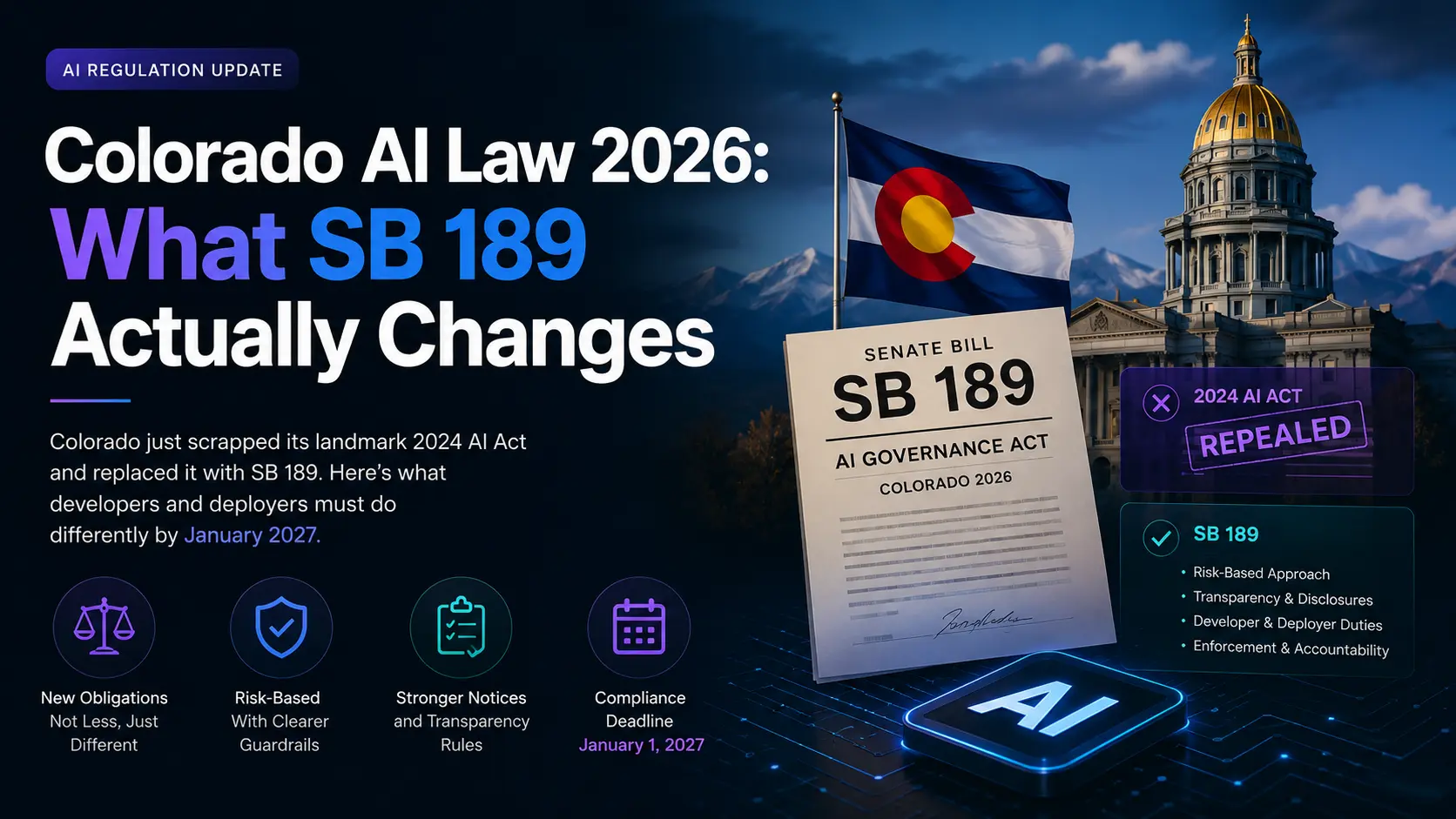
For developers building products for a global market, EU compliance is effectively becoming the baseline. The governance strategies that work for the EU AI Act will cover you in most other jurisdictions too. In the US, Connecticut’s AI Responsibility and Transparency Act passed in May 2026 with employment AI developer obligations hitting October 1, 2026 — the first US state law to mirror the EU’s risk-based approach at scale. Colorado took the opposite route: SB 189, passed May 12, 2026, repealed the state’s original duty-of-care AI law and replaced it with a lighter disclosure-only framework, showing how quickly the political ground can shift against proactive regulation.
What I’ve noticed building cross-platform apps: if you design for EU AI Act compliance from the start, adapting to other regulatory frameworks becomes straightforward. The reverse — trying to retrofit compliance into an existing system — is expensive and painful.
What Smart Teams Are Doing Right Now
Based on conversations with other developers and what I’m seeing in the ecosystem:
1. Running AI system inventories. You can’t comply with rules about systems you don’t know exist. Map every ML model, every automated decision pipeline, every AI-powered feature in your product.
2. Classifying risk levels early. Don’t wait for a regulator to tell you your hiring tool is high-risk. Read Annex III, apply the classifications yourself, and plan accordingly.
3. Building documentation into the dev process. The teams treating compliance documentation as a separate project are struggling. The ones embedding it into their CI/CD pipeline — generating model cards automatically, logging training runs, version-controlling risk assessments — are ahead. If you’re using agentic AI in your DevOps pipelines, this becomes even more important since automated systems need documented oversight chains.
4. Joining regulatory sandboxes. If your country has one, apply. The feedback from regulators during sandbox testing is invaluable. You’d rather learn you’re non-compliant in a sandbox than from an enforcement notice.
5. Watching the standards. Follow the CEN-CENELEC work on harmonized standards. These standards will become the practical playbook for compliance. The European Commission’s AI policy page tracks published standards and guidance.
What Comes After August 2026
Enforcement doesn’t end at the deadline — it starts there. National market surveillance authorities will begin active monitoring and investigation. The EU AI Office will coordinate cross-border enforcement actions.
The August 2027 deadline for Annex I high-risk systems (AI embedded in already-regulated products like medical devices) will bring another wave of compliance requirements.
And the Act includes a review mechanism. The European Commission will assess whether additional AI practices should be banned or additional categories added to the high-risk list. The regulatory scope will likely expand, not contract.
For companies deploying autonomous AI agents or building with agentic architectures, keep a close eye on how regulators interpret the human oversight requirements. Autonomous systems that operate with minimal human intervention in high-risk domains will face the most scrutiny.
Disclaimer: This article is for informational purposes only and does not constitute legal advice. Consult qualified legal counsel for compliance decisions.
FAQs About the EU AI Act 2026
What is the EU AI Act 2026? The EU AI Act is the world’s first comprehensive AI regulation. While it entered into force in August 2024, the term “EU AI Act 2026” refers to the year when high-risk AI system obligations become fully enforceable — specifically August 2, 2026.
What are the fines for non-compliance? Up to €35 million or 7% of global annual turnover for banned practices, €15 million or 3% for high-risk violations, and €7.5 million or 1% for providing incorrect information. SMEs get proportionally lower caps.
Does the EU AI Act apply to non-EU companies? Yes. If your AI system is placed on the EU market or its output is used in the EU, you’re in scope regardless of where your company is headquartered.
What’s the difference between a provider and a deployer? Providers build or develop the AI system. Deployers use it in their business operations. Providers have heavier obligations including conformity assessments and technical documentation. Deployers must ensure proper use and human oversight.
Is open-source AI exempt? Partially. Open-source AI models are exempt from most obligations unless they’re classified as high-risk or as GPAI models with systemic risk. Free and open-source GPAI models have lighter transparency obligations unless they present systemic risks.