Key takeaways (May 17, 2026)
- August 2, 2026 triggers GPAI obligations and full applicability of governance provisions.
- Most providers should already have: technical documentation, copyright policy, training-data summary, downstream provider information package.
- Codes of practice from the AI Office are the practical reference, not the regulation text alone.
- High-risk system obligations follow on August 2, 2027.
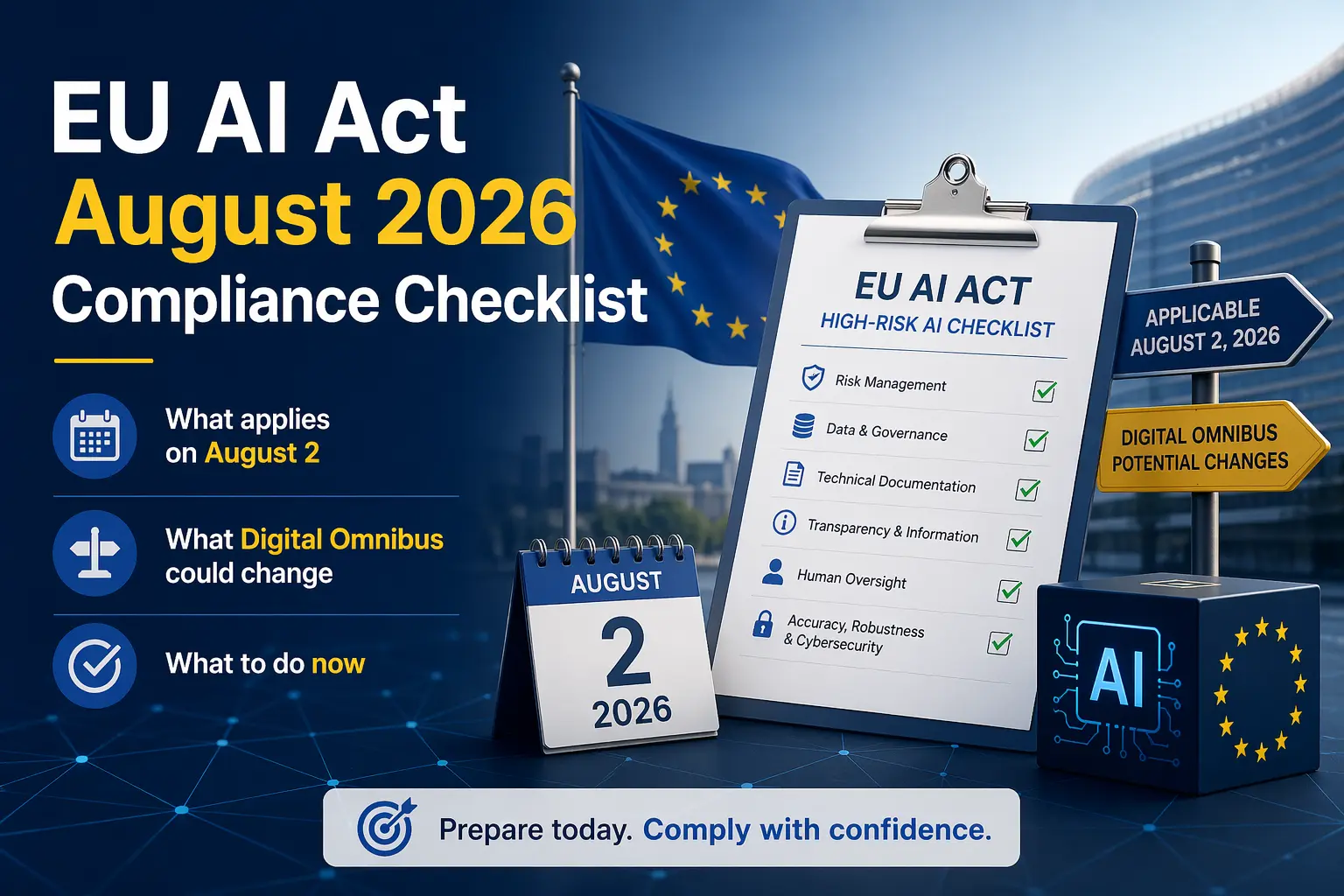
EU AI Act August 2026 compliance checklist starts with one uncomfortable fact: as of April 23, 2026, the official EU implementation timeline still points to August 2, 2026 for Annex III high-risk AI systems. That means a lot of teams that kept calling this “next year’s problem” are now looking at a deadline that is a little over three months away.
I went back through the EU’s own implementation timeline, the AI Act Service Desk explainers for Article 6 high-risk classification and Article 26 deployer duties, plus the Commission’s note on AI Act standardisation and the Service Desk Digital Omnibus FAQ. The picture is messy, but it is not mysterious. The law is live. Some dates are phased. And the proposed delay is real but not final.
If you build recruiting AI, student assessment tools, credit models, public-sector decision systems, or workplace monitoring products, this is the version I would use internally. Not the polished board slide. The working checklist.
The short version: plan for August 2, 2026 unless Brussels formally changes the date. The Digital Omnibus proposal exists because the EU still lacks all of the support tools companies want, especially harmonised standards and common guidance. But the Commission has not changed the official timeline yet. The risk is not that you start too early. The risk is that you bet your whole compliance program on a delay that has not become law.
EU AI Act August 2026: what changes on 2 August
The easiest way to get this wrong is to treat every AI Act deadline as one big blob. That is how teams confuse themselves. The rollout is split, and the split matters.
| Date | What starts | Why you should care |
|---|---|---|
| February 2, 2025 | Prohibited practices rules and AI literacy obligations | Banned uses are already off the table, and staff training is already a live requirement |
| August 2, 2025 | General-purpose AI obligations and AI Office governance | Foundation model providers already have documentation and copyright-related duties |
| August 2, 2026 | Annex III high-risk AI obligations, Article 50 transparency duties, national sandboxes and notifying authorities | This is the live deadline most software and enterprise AI teams care about |
| August 2, 2027 | Annex I high-risk systems used as safety components in regulated products | Medical devices, machinery, toys, aviation, and similar product AI land later |
That table lines up with the official EU implementation timeline and with the explanation already in my EU AI Act deadlines tracker. I keep seeing posts that say “all high-risk AI moved to 2027.” That is not what the official timeline says on April 23, 2026.
The confusion comes from the Digital Omnibus proposal. The Commission’s own FAQ says the proposal would link the application date for high-risk AI rules to the availability of support tools such as harmonised standards, common specifications, and guidance, with a maximum delay of 16 months. That is a real proposal. It is also still a proposal. Until the legal text changes, I would not run a compliance program as if the deadline already slipped.
First question: are you actually building a high-risk AI system?
Before you build a 40-item compliance spreadsheet, answer the classification question properly.
Under Article 6, there are two main ways to end up in the high-risk bucket.
First, you can fall under Annex I. That is AI used as a safety component, or the product itself, within existing EU product-safety legislation. Think medical devices, machinery, toys, lifts, aviation equipment, and similar products that already live inside a conformity-assessment world.
Second, and this is where most software companies get caught, you can fall under Annex III. That list covers named use cases, including:
- biometrics
- critical infrastructure
- education and vocational training
- employment and worker management
- essential public and private services, including credit scoring
- law enforcement
- migration and border management
- administration of justice and democratic processes
If you sell software into hiring, lending, insurance, education, public services, or workplace management, you should assume somebody inside the company needs to write down a classification memo now. Not in June. Now.
The part teams usually over-read is the Article 6(3) carve-out. The Service Desk says some Annex III systems can fall out of the high-risk bucket if they only perform a narrow procedural task, improve the result of a completed human activity, detect decision patterns without replacing the human assessment, or do preparatory work for an Annex III activity. That carve-out is narrower than people want it to be. If your model ranks applicants, filters people into buckets, influences credit outcomes, or materially steers a real decision, the “just decision support” argument gets thin very fast.
I would be especially careful if you are building agentic AI systems in these domains. The more autonomy you add, the harder it gets to defend weak human oversight or hand-wavy classification logic.
The checklist I would run before August 2, 2026
I would not treat this as a legal memo. I would treat it as a launch plan with owners.
| Workstream | Provider focus | Deployer focus |
|---|---|---|
| Classification | Article 6 memo, intended use, Annex mapping | Intended use review, procurement review, vendor due diligence |
| Documentation | Technical docs, instructions for use, quality management, post-market plan | Internal operating procedures, logs, notices, oversight records |
| Risk controls | Data governance, testing, human oversight, cybersecurity | Oversight, input-data checks, incident escalation, user-facing controls |
| Market steps | Conformity assessment, declaration, CE marking, registration | Fundamental rights impact assessment where required, workplace consultation, deployment governance |
1. Freeze your AI inventory and role map
Start with a hard list of every system you provide, fine-tune, white-label, embed, or operate in production. Include the boring ones. Resume screeners. Fraud flags. Voice analytics. Productivity scoring. Internal tools used by HR or support teams.
Then map your role. Are you a provider, deployer, importer, distributor, or a messy combination of three? A lot of B2B SaaS teams still talk like deployers even after they have fine-tuned a third-party model, wrapped it in their own UX, and sold it under their brand. At that point, you may have provider obligations whether you like the label or not.
2. Write the Article 6 classification memo
This does not need to be fancy. It does need to be real.
For each in-scope system, write down:
- intended purpose
- user group
- whether Annex I or Annex III applies
- whether Article 6(3) is being relied on
- why the system is or is not high-risk
- who signed off on that view
I keep seeing teams skip this because they want certainty before they document anything. That is backwards. Writing the memo is how you discover where the uncertainty is.
If your system touches workplace decisions, read this alongside my breakdown of EU AI Act worker protections. Employment AI is one of the easiest areas to underestimate and one of the hardest to explain away later.
3. Build the risk management system under Article 9
The Article 9 summary is not glamorous reading, but it is the backbone of the whole regime. You need a documented process to identify foreseeable risks, test mitigation measures, evaluate residual risk, and keep the process current over the system lifecycle.
This is the point where a lot of AI programs still look fake to me. They have a policy PDF, maybe a review committee, and almost no product-level evidence. What regulators will care about is more concrete:
- what harms did you identify
- what controls did you add
- what failed in testing
- what remains risky
- who owns the decision to ship anyway
If you already have a broader control program, my piece on AI governance strategies for 2026 is the right companion here. The AI Act work goes much faster when governance already exists outside the legal team.
4. Clean up data governance and test evidence
Article 10 is where “we’ll fix bias later” dies.
You need evidence around training, validation, and test data quality, relevance, representativeness, known limitations, and bias controls. No, this does not mean your datasets need to be perfect. It does mean you need a grown-up story about why the data is fit for the system’s intended purpose and what happens when it is not.
I would want one file per system that explains:
- data sources
- inclusion and exclusion rules
- preprocessing steps
- labeling or annotation method
- known demographic or context gaps
- test results on the failure modes that actually matter
Most teams do fine on benchmark screenshots and badly on domain drift. That is especially true in hiring, education, fraud, and credit. The model looked great in staging. Then the real world moved.
5. Finish technical documentation, instructions, and quality management
The Article 11 technical documentation, Article 13 instructions for deployers, and Article 17 quality management system pieces all hit the same organizational weakness: teams know how to build, but not how to leave an audit trail that another adult can follow.
If I were auditing your file set, I would expect to find:
- a plain-language system description
- architecture and model information
- intended use and reasonably foreseeable misuse
- performance metrics and limitations
- monitoring plans
- incident escalation paths
- instructions the deployer can actually use
This is the work most founders delay because it feels non-product. Then July arrives, and suddenly everybody is begging one engineer and one lawyer to reconstruct six months of decisions from Slack messages.
6. Put human oversight in the product, not in a policy slide
The Article 14 human oversight requirement is one of those rules that sounds obvious until you inspect what teams actually shipped.
Real oversight means the operator can understand the system well enough to spot bad output, challenge it, and stop or override it when needed. It does not mean there is technically a human somewhere in the chain who clicks approve 500 times a day. That kind of fake oversight will get torn apart.
For me, the acid test is simple: if the model started making obviously bad decisions for two hours, who would notice, how quickly, and what could they do from the interface they already have? If the honest answer is “we would find out from customer complaints,” the oversight story is not done.
7. Test accuracy, robustness, cybersecurity, and logging like you mean it
The Article 15 summary and Article 12 record-keeping pages are where a lot of AI programs become ordinary engineering again, which is good news.
You need tests for failure, not just for happy-path performance. I would expect:
- threshold setting with a business reason behind it
- adversarial or abuse testing where it makes sense
- fallback behavior when confidence drops
- immutable or at least reviewable logs
- a plan for model updates that does not wreck your documentation trail
This is also where teams using multi-model workflows get surprised. A chain of “low-risk” components can still create one ugly high-risk decision path. I covered that problem from the system-design angle in my multi-agent AI framework comparison, and the governance headache is even worse than the architecture headache.
8. Decide your conformity-assessment route early
You do not want this conversation for the first time in July.
The Service Desk explainer for Article 43 conformity assessment, plus the Article 47 declaration of conformity and Article 49 registration pages, makes one thing pretty clear: market steps are not just paperwork at the end. They depend on everything you should have been doing before.
At minimum, your team should know:
- which conformity-assessment path applies
- whether harmonised standards are available for your use case
- whether common specifications will matter
- whether provider registration or public-sector deployer registration applies
- who owns the declaration and release decision
I would also decide now how you are going to explain your file set to a skeptical outsider. That outsider may be a regulator later, but it might be a procurement team first.
9. Handle deployer duties before first use
Too many AI Act conversations still treat deployers like passive software customers. That is not how Article 26 reads.
Deployers need operating rules. They need human oversight. They need to use the system according to the provider’s instructions. They need to monitor incidents and cooperate with providers and authorities when something goes wrong. And for some use cases, they need more than that.
The Article 27 fundamental rights impact assessment page is the one I would bring to every public-sector buyer and every private company delivering essential services. If your deployment affects access to education, work, credit, insurance, public benefits, policing, or migration decisions, check early whether a FRIA is required before first use. Do not leave that question to procurement week.
If the system touches workers, you also need to think about notice, consultation, and escalation. Again, the employment article matters here because workplace AI tends to trigger compliance work faster than teams expect.
10. Do not miss Article 50 transparency duties
This is the part teams miss when they get tunnel vision about high-risk systems.
The Article 50 transparency page covers duties for systems that interact with people, emotion-recognition and biometric-categorisation systems, and synthetic content such as deepfakes. Some of these duties apply whether or not your product is high-risk.
What I would check immediately:
- do users know when they are dealing with AI, unless it is obvious from context
- are synthetic audio, image, or video outputs labeled where required
- does your text-generation workflow fall inside the public-interest/editorial exemption, and can you prove human review and editorial responsibility
- are customer-facing disclosures consistent across product, support, and sales claims
This matters even more if your company also sells AI coding agents or internal copilots. The product may not be high-risk. The disclosures can still be sloppy.
What Digital Omnibus changes, and what it does not
I understand why companies want the proposal to be final already. The standards situation is not great. The Commission itself says the proposal is about linking high-risk obligations to the availability of support tools. That is a fair problem to solve.
But here is what I would not do.
I would not:
- stop system classification work
- stop documentation work
- assume Article 50 goes away
- assume oversight design can wait for harmonised standards
- bet my release calendar on Brussels politics
And here is what I would do:
- track the final text weekly, not casually
- write your compliance plan against the law as it stands today
- identify which tasks truly depend on final standards and which do not
- use any extra time, if it comes, to harden evidence instead of delaying the start
That is also the big difference between the EU and lighter models like the UK’s regulator-led approach or Japan’s softer coordination model. Brussels may move more slowly, but when it does move, it expects proof.
My 90-day plan if I were starting today
If I were dropped into a product team on April 23, 2026, this is the sequence I would run.
- Days 1-14: finish the system inventory, role map, and Article 6 classification memo for every AI feature that touches a regulated use case.
- Days 15-35: build the gap register across Articles 9 to 17, Article 26, Article 27, and Article 50. Assign owners. No floating tasks.
- Days 36-60: close the product gaps first. Oversight UX, logging, documentation, testing, notices, incident response, and vendor evidence.
- Days 61-90: lock conformity-assessment planning, registration questions, FRIA status, executive sign-off, and evidence packaging for procurement or regulatory review.
That is not a perfect plan. It is a practical one. And practical beats clever when the date on the calendar is this close.
If your team gets only one thing right this quarter, make it honesty. Honest classification. Honest documentation. Honest oversight. The companies that get burned first will not be the ones trying hard and missing a paragraph. They will be the ones pretending a real decision system is “just assistive AI” because the alternative was more work.
Disclaimer: This article is for informational purposes only and does not constitute legal advice.