Key takeaways (May 17, 2026)
- AutoGPT and BabyAGI are still useful for understanding the agent pattern but are no longer competitive with managed agents from Anthropic and OpenAI as of May 2026.
- Production-grade autonomy lives inside frameworks like LangGraph, CrewAI and Anthropic’s managed agents — not standalone AutoGPT forks.
- JARVIS-style multi-tool orchestration is now a feature of mainstream platforms, not a separate project.
- Choose modern frameworks for new builds; keep AutoGPT/BabyAGI as teaching references only.
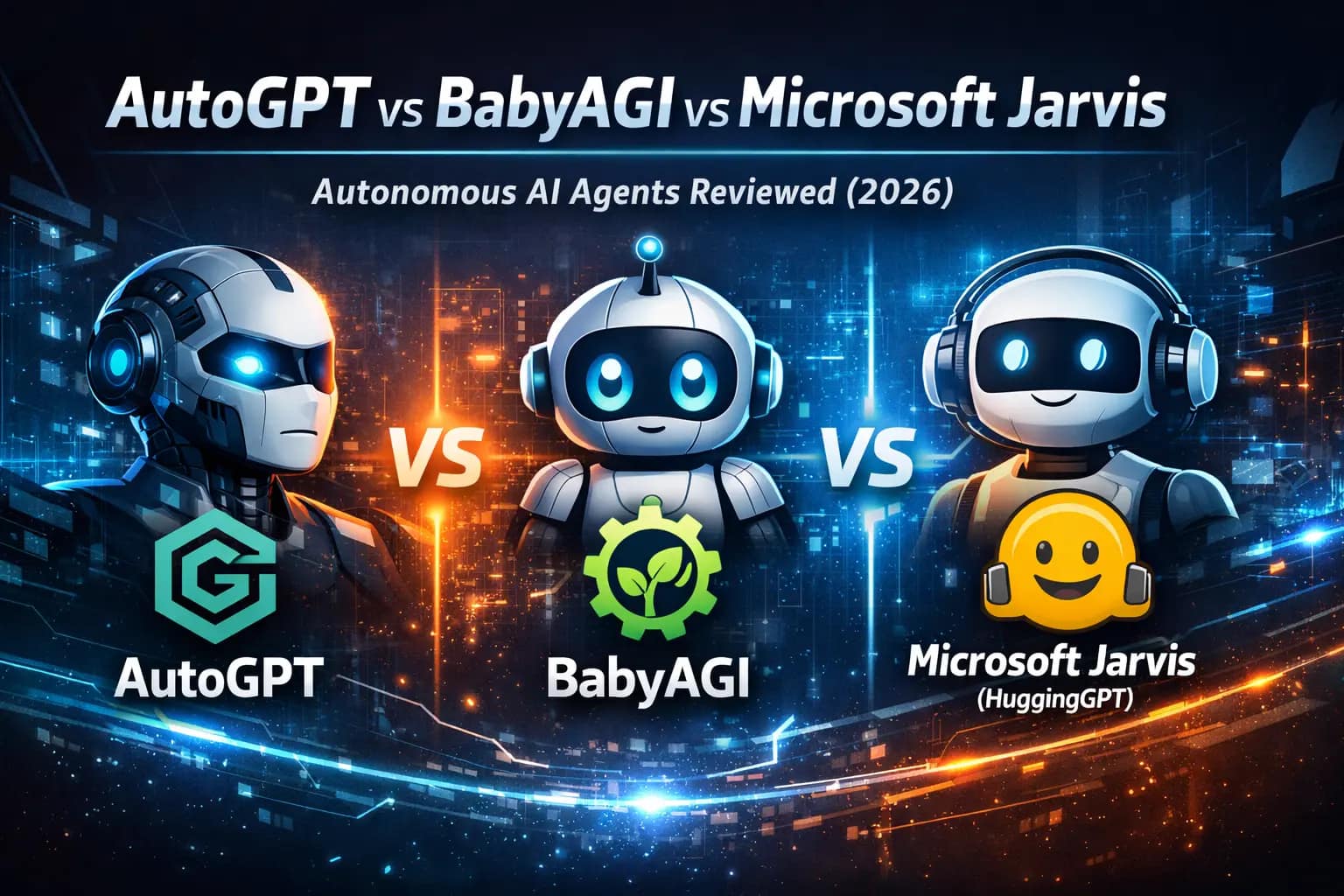
An autonomous AI agent is a system that receives a goal (not a fixed instruction), decomposes it into subtasks, picks tools and APIs, executes actions, evaluates intermediate results, and continues until the goal is met or it determines it cannot proceed. I’ve spent a good chunk of the past year testing autonomous AI agents—deploying them on side projects, watching them fail spectacularly, and occasionally being genuinely impressed. The three names that keep coming up in every conversation about autonomous agents are AutoGPT, BabyAGI, and Microsoft Jarvis (HuggingGPT). They’ve each taken fundamentally different approaches to the same problem: how do you build AI that doesn’t just respond to prompts but actually gets things done?
But here’s what most comparison articles won’t tell you: the autonomous agent landscape in 2026 looks almost nothing like it did when these projects launched. AutoGPT has reinvented itself. BabyAGI pivoted hard. Jarvis quietly evolved into something more interesting than its original HuggingGPT concept. And a wave of newer entrants—CrewAI, Autogen, OpenAI’s Operator—have pushed all three to adapt or become irrelevant.
Let me break down where each one stands right now, how they actually compare in practice, and which one you should pick for different use cases.
What “Autonomous” Actually Means in 2026
First, let’s be precise. An autonomous AI agent isn’t just a chatbot with extra steps. It’s a system that:
- Receives a goal (not a specific instruction)
- Decomposes it into subtasks
- Selects and uses tools (APIs, web browsing, file systems, code execution)
- Evaluates results and adjusts its approach
- Continues until the goal is met or it determines it can’t proceed
The agentic AI revolution is fundamentally about this shift from reactive (respond to each prompt) to proactive (work toward an objective). And the differences between AutoGPT, BabyAGI, and Jarvis come down to how they handle steps 2 through 5.
AutoGPT: The Pioneer That Grew Up
Origin and Evolution
AutoGPT exploded onto the scene in March 2023 as a GPT-4-powered agent that could browse the web, write code, and manage files autonomously. It was the first project to capture mainstream attention for autonomous AI, hitting 100,000 GitHub stars within weeks (Wikipedia).
But early AutoGPT had serious problems. It got stuck in loops. It burned through API credits at alarming rates. And it frequently went off-task, pursuing tangential subtasks with impressive confidence and zero usefulness.
By 2026, AutoGPT has matured significantly. The team released AutoGPT Forge—a rebuilt architecture with better memory management, configurable action boundaries, and support for multiple LLM backends including GPT-5.2 and Claude 3.5.
How It Works Now
AutoGPT’s architecture follows a loop: perceive, reason, act, evaluate.
- Goal parsing: Takes a natural language objective and breaks it into an initial task plan
- Tool selection: Chooses from available tools (web search, code execution, file I/O, API calls)
- Execution: Runs the selected action and captures results
- Self-evaluation: Assesses whether the result advances the goal
- Iteration: Adjusts the plan and repeats
The key improvement in 2026: AutoGPT now supports what they call “guardrailed autonomy”—configurable boundaries that prevent the agent from taking actions outside a defined scope. This alone fixed the biggest complaint about early versions.
Strengths
- Maximum flexibility: Handles open-ended, ambiguous goals better than any other agent
- Rich tool ecosystem: Integrates with web browsers, code interpreters, file systems, and external APIs
- Active community: 160,000+ GitHub stars, extensive plugin marketplace
- Multi-model support: Works with GPT-5.2, Claude, Gemini, and open-source models
Limitations
- Still expensive: A complex task can easily cost $5-15 in API calls
- Loop risk: Despite improvements, it still occasionally gets stuck in unproductive cycles
- Setup complexity: Getting AutoGPT configured properly for a specific use case takes real effort
- Inconsistent on structured tasks: The open-ended architecture works against it for well-defined workflows
When I tested AutoGPT Forge on a research task—“find the top 10 AI agent frameworks, compare their GitHub activity, and create a summary report”—it produced solid results in about 25 minutes and $3.40 in API costs. Not cheap, but the output was genuinely useful and saved me a few hours of manual research.
BabyAGI: The Minimalist That Found Its Niche
Origin and Evolution
BabyAGI started as an elegantly simple concept by Yohei Nakajima: an AI system that creates tasks, executes them, and generates new tasks based on the results. Where AutoGPT tried to do everything, BabyAGI focused purely on intelligent task management (GitHub).
The original BabyAGI was about 140 lines of Python. That simplicity was both its greatest strength and its biggest limitation.
By 2026, BabyAGI has evolved into something quite different from its origins. Nakajima shifted the project toward what he calls “function-based agents”—composable agent architectures where each function is a self-contained unit that can be chained together. The framework now emphasizes developer extensibility over autonomous operation.
How It Works Now
BabyAGI’s core loop remains elegant:
- Task execution: Complete the highest-priority task in the queue
- Result evaluation: Assess what was accomplished and what changed
- Task creation: Generate new tasks based on results and the original objective
- Prioritization: Reorder all tasks using context from the vector database
Everything is stored in a vector database (Pinecone, Chroma, or similar), which gives the agent persistent memory across task cycles. This means BabyAGI actually learns from its previous actions within a session—something AutoGPT handles less gracefully.
Strengths
- Clean architecture: Easy to understand, modify, and extend
- Efficient: Uses fewer API calls per task cycle than AutoGPT
- Strong task management: Excels at breaking down complex objectives into ordered subtasks
- Developer-friendly: Python-native, composable function architecture
- Predictable behavior: The constrained loop makes it less prone to runaway actions
Limitations
- Limited tool access: Doesn’t natively browse the web or execute code (requires plugins)
- CLI-focused: No polished UI; you need to be comfortable with Python
- Not multimodal: Handles text well but doesn’t process images, audio, or video
- Smaller community: Less plugin ecosystem compared to AutoGPT
BabyAGI shines in scenarios where you need reliable, structured task decomposition. When I used it to plan a Flutter app migration (breaking down the migration into prioritized tasks, tracking dependencies, generating implementation checklists), it outperformed AutoGPT because it stayed focused and didn’t try to actually execute the migration—just planned it thoroughly.
Microsoft Jarvis (HuggingGPT): The Orchestrator
Origin and Evolution
Jarvis, originally published as HuggingGPT in a research paper by Zhejiang University and Microsoft Research, took a fundamentally different approach. Instead of one model doing everything, Jarvis uses an LLM as a controller that delegates tasks to specialized AI models hosted on Hugging Face (arXiv).
Need image generation? Jarvis picks Stable Diffusion. Need speech recognition? It routes to Whisper. Need text classification? It selects the best-performing model on the Hugging Face Hub for that specific task. The LLM handles planning and coordination; specialist models handle execution.
By 2026, Jarvis has evolved beyond its original research prototype. Microsoft integrated elements of the Jarvis architecture into Azure AI services, and the open-source project now supports local model deployment alongside cloud-hosted models. The shift toward MCP (Model Context Protocol) has also benefited Jarvis, since its multi-model orchestration approach aligns naturally with standardized tool protocols.
How It Works Now
Jarvis operates as a four-stage pipeline:
- Task planning: The controller LLM parses user input and creates an execution plan
- Model selection: For each subtask, Jarvis queries the Hugging Face Hub to find the best-fit model based on task type, performance metrics, and availability
- Task execution: Each selected model runs its assigned subtask and returns results
- Response synthesis: The controller LLM integrates all results into a coherent output
This is a meta-agent architecture: Jarvis doesn’t do the work itself; it manages a team of specialists.
Strengths
- True multimodal: Handles text, images, audio, video, and code through specialized models
- Best-of-breed execution: Each subtask uses the optimal model, not a general-purpose one
- Scalable: Adding new capabilities just means connecting new models
- Enterprise-aligned: Microsoft’s backing gives it integration with Azure services
Limitations
- Complex deployment: Running multiple models requires significant infrastructure
- Latency: Multiple model calls add up; not suitable for real-time applications
- Cost at scale: Using premium models for each subtask gets expensive fast
- Less autonomous: Better at executing complex multi-modal tasks than pursuing open-ended goals
In my testing, Jarvis excelled at a task that involved analyzing a competitor’s website: it used a vision model to analyze screenshots, a text model to evaluate content, and a code model to audit the HTML structure. No single agent could have handled all three modalities as effectively.
Head-to-Head Comparison
| Feature | AutoGPT | BabyAGI | Jarvis (HuggingGPT) |
|---|---|---|---|
| Primary strength | Flexible autonomy | Structured task management | Multimodal orchestration |
| Architecture | Single-agent loop | Task queue + vector memory | Multi-model coordinator |
| LLM support | GPT-5.2, Claude, Gemini, open-source | GPT-5.2, Claude, open-source | Controller: GPT/Claude; Workers: any HF model |
| Web browsing | Native | Plugin required | Via specialized models |
| Code execution | Native | Plugin required | Via code models |
| Multimodal | Limited (text + basic vision) | Text only | Full (text, image, audio, video) |
| Setup difficulty | Medium-High | Low-Medium | High |
| Cost per task | $3-15 | $0.50-3 | $2-20 |
| Loop/runaway risk | Medium (improved in 2026) | Low | Low |
| Community size | 160K+ GitHub stars | 20K+ GitHub stars | 15K+ GitHub stars |
| Best for | Open-ended research, flexible workflows | Structured planning, task decomposition | Complex multi-modal tasks |
| Production readiness | Medium | Medium-High | Medium |
The Newer Entrants You Should Know About
The original three aren’t the only game in town anymore. Several frameworks launched or matured in 2025-2026 that deserve attention:
CrewAI has become arguably the most developer-friendly agent framework. It models agents as team members with defined roles, goals, and tools. When I need to spin up a quick multi-agent workflow, CrewAI is my first choice. Its hierarchical process model—where a manager agent delegates to specialists—is intuitive and effective.
Microsoft Autogen focuses on multi-agent conversations. Agents collaborate through structured dialogues, making it excellent for complex reasoning tasks where different perspectives matter. Microsoft is actively integrating it with Azure services.
OpenAI’s Operator takes a different approach entirely: it controls a web browser visually, clicking buttons and filling forms like a human would. It’s less “intelligent orchestration” and more “robotic process automation powered by GPT.” Limited in scope but incredibly useful for specific tasks like filling out forms or navigating legacy web applications.
LangGraph (from the LangChain team) provides a graph-based framework for building stateful, multi-step agent workflows. If you’re already in the LangChain ecosystem, it’s the natural choice for agent development.
For a broader overview of how these agents fit into real-world deployments, including enterprise case studies and risk analysis, check our deployment guide.
Which One Should You Actually Use?
After testing all three extensively, here’s my practical advice:
Choose AutoGPT if: You need an agent for open-ended research, exploration, or tasks where you can’t precisely define the steps in advance. It’s the best at improvising. But set strict token budgets and action boundaries—AutoGPT without guardrails is a credit card bill waiting to happen.
Choose BabyAGI if: You need reliable task decomposition and planning for structured objectives. It’s great for project planning, content calendars, migration checklists, and any scenario where the goal is a well-organized plan rather than direct execution. It’s also the cheapest to run.
Choose Jarvis if: Your task involves multiple types of media or requires best-of-breed model performance for specific subtasks. If you need an agent that can analyze images, process audio, and generate text in a single workflow, Jarvis is the clear winner.
Choose CrewAI if: You want the fastest path to a working multi-agent system. The developer experience is superior to all three original agents, and the team-based mental model makes complex workflows intuitive. This is what I’d recommend for most developers starting with agents in 2026.
Choose none of them if: Your task is well-defined and repetitive. Traditional AI assistants or even basic API integrations will be cheaper, faster, and more reliable for straightforward automation. Not everything needs an autonomous agent.
The Governance Question
Whichever agent you pick, you need a governance plan. Autonomous agents that can take actions in the real world—send emails, execute code, make purchases, modify databases—need guardrails. This isn’t optional, especially with the EU AI Act enforcement deadlines approaching.
At minimum, implement:
- Action logging: Record every action the agent takes, with timestamps and context
- Permission scoping: Limit what tools and APIs the agent can access
- Cost limits: Set hard caps on API spending per task
- Human-in-the-loop gates: Require approval for high-impact actions
- Kill switches: Be able to stop any agent immediately
Our AI governance framework guide covers these controls in detail. And for developers building agent integrations, understanding the MCP protocol will help you implement standardized tool access with built-in security boundaries.
Where Autonomous Agents Are Headed
The trajectory is clear: autonomous agents are moving from developer tools to enterprise infrastructure. By the end of 2026, I expect:
- Agent orchestration platforms will become a standard part of the cloud stack, similar to how container orchestration (Kubernetes) became standard for deployment.
- Multi-agent collaboration will replace single-agent architectures for complex tasks. The CrewAI and Autogen approach of multiple specialized agents working together is simply more reliable.
- Agent identity and security will become a distinct discipline within cybersecurity. Agents need credentials, permissions, and monitoring just like human users do.
- The cost will drop significantly. As open-source models improve and inference costs fall, running autonomous agents will become economically viable for small teams and individuals.
The AI coding agents comparison shows how these trends are already playing out in software development specifically.
Bottom Line
AutoGPT, BabyAGI, and Jarvis each represent a different philosophy of autonomous AI: maximum flexibility, structured efficiency, and multimodal orchestration. All three have evolved significantly since their launches, and all three face increasing competition from newer frameworks.
The right choice depends on your specific use case, technical comfort level, and budget. But the more important decision isn’t which agent to use—it’s whether you have the governance and observability infrastructure to deploy any autonomous agent responsibly.
Build the guardrails first. Pick the agent second. And start with a small, well-scoped task before you try to automate the world.