Key takeaways (May 17, 2026)
- August 2, 2026 remains the headline enforcement date for general-purpose AI (GPAI) duties under the EU AI Act.
- The Commission’s Digital Omnibus proposal is still under discussion as of mid-May 2026, with possible adjustments to high-risk deadlines.
- GPAI providers must already maintain technical documentation, copyright policy and training-data summaries.
- Penalties scale up to 7% of global turnover for the most severe violations.
The EU AI Act enters full enforcement on August 2, 2026, with fines up to €35 million or 7% of global annual turnover for prohibited practices. We’re four months from the biggest AI compliance deadline most companies aren’t ready for. The EU AI Act hits full enforcement on August 2, 2026, and based on what I’m seeing across the industry, a lot of organizations are still treating this like a distant problem.
It isn’t.
Agentic AI systems now operate inside over 40% of Fortune 500 companies, according to Gartner’s 2026 AI Adoption Survey. These aren’t chatbots answering FAQ questions — they’re autonomous agents making real decisions with real consequences. And regulators have noticed.
If you’re building or deploying AI systems, this article covers every deadline, penalty, and regulation you need to know about right now — plus a 10-step action plan you can start this week. If you want the more operational version, I broke that out separately in my EU AI Act August 2026 compliance checklist.
EU AI Act: The Clock Is Ticking
The EU AI Act entered its phased rollout in 2024, but 2026 is when it gets teeth. The European Commission released implementation guidelines on February 2, 2026 for Article 6 requirements, covering post-market monitoring plans for all covered AI systems.
As someone who builds AI-powered products, I can tell you: these aren’t suggestions. They’re enforceable mandates with real financial consequences.
Key Deadlines You Cannot Miss
August 2, 2026: Main provisions become fully applicable. Regulators in Brussels have signaled they intend to make examples of non-compliant firms early. This isn’t a soft launch.
August 2, 2026: High-risk AI systems in finance, healthcare, and employment must meet strict technical requirements including conformity assessments, human oversight mechanisms, and quality management systems.
August 2, 2026: Every EU member state must establish at least one regulatory sandbox.
Maximum penalty: 35 million euros or 7% of global annual turnover, whichever is higher.
For a company with 10 billion euros in revenue, that’s a potential 700 million euro penalty for a single violation. That number shows up in quarterly earnings reports and triggers shareholder lawsuits.
What the Digital Omnibus Changes
The Digital Omnibus proposal from November 2025 aims to simplify overlapping digital regulations. One change worth watching: it may delay certain transparency obligations under Article 50(2) until February 2027 for AI systems placed on the market before August 2026.
Don’t rely on this delay. The proposal is still under review, and planning around a maybe is a terrible compliance strategy.
Spain Takes the Lead
Spain’s AI watchdog, AESIA, released 16 detailed compliance guides in February 2026. These came out of Spain’s pilot AI regulatory sandbox program and offer technical specifications for:
- High-risk AI system documentation
- Testing protocols
- Conformity assessments
If you’re operating in Spain or planning to, download these guides now. They’re the most practical implementation reference any EU regulator has published so far.
Understanding the Risk Categories
The EU AI Act sorts AI systems into four risk levels. As a developer, this classification determines how much work you’ll need to do before shipping:
- Prohibited: Social scoring systems, manipulative AI, certain biometric identification uses. If your system falls here, stop building it.
- High risk: Requires human oversight, technical documentation, quality management systems, and conformity assessments. This is where most enterprise AI lands — and where most of the compliance burden sits.
- Limited risk: Transparency obligations. Users must know they’re interacting with AI.
- Minimal risk: No specific requirements. Most consumer-facing chatbots and recommendation engines fall here.
Understanding where your AI systems land in this framework is step one. If you haven’t done this classification yet, you’re already behind. Our EU AI Act enforcement updates cover the specifics of how regulators plan to verify compliance.
Agentic AI: When Machines Start Making Decisions
The shift from experimental pilots to production deployments happened faster than most analysts predicted. According to Gartner, enterprise surveys now project that 50% of companies using AI will deploy some form of autonomous agent by 2027.
What Makes AI “Agentic”
The term “agentic AI” refers to systems that go beyond responding to prompts. These systems:
- Plan multi-step actions
- Execute tasks across software tools
- Reason through complex problems
- Delegate work to other agents
- Adapt strategies based on outcomes
They operate with minimal human supervision. And that’s exactly what makes them a regulatory target. The MCP protocol is one emerging standard trying to bring structure to how these agents communicate and operate.
The Hidden Costs of Productivity Gains
Companies report significant efficiency improvements when agents automate routine tasks. A financial services firm in London reduced transaction monitoring staff by 30% after deploying autonomous agents.
But the same firm now employs three times as many people in AI oversight roles as it did two years ago. The productivity equation is more complex than vendors admit.
Security Teams Are Sounding Alarms
Nearly half of cybersecurity professionals polled in ISACA’s 2026 Risk Survey believe agentic AI systems will become the top attack vector by late 2026. Autonomous agents with access to sensitive systems create new entry points for attackers.
A compromised agent doesn’t leak data. It takes actions with real-world consequences. That’s a fundamentally different threat model than anything we’ve dealt with before.
Liability Questions Nobody Can Answer
When an autonomous agent makes a decision that harms a customer, who’s responsible? The company that deployed it? The vendor that built it? The engineer who trained it?
Courts haven’t answered these questions yet. Organizations deploying agentic AI today are accepting legal uncertainty that could haunt them for years. If you’re writing AI-powered code or deploying agents in production, you should be documenting every decision point and keeping humans in the loop.
Agentic AI in Healthcare
ConcertAI launched Accelerated Clinical Trials (ACT), an enterprise platform designed to automate the entire clinical trial lifecycle. The company claims this system shortens trial timelines by 10 to 20 months.
Patients get access to treatments faster. Pharmaceutical companies save hundreds of millions. But the FDA is watching closely. An autonomous system that accelerates drug approvals also accelerates the risk of approving unsafe treatments.
Agentic AI in Manufacturing
Hyundai and Audi now use AI-powered robots in factory settings for tasks requiring real-time decision-making. Based on surveys from the Manufacturing Leadership Council:
- 58% of manufacturing companies already use AI robots
- 80% plan to expand their use within two years
Companies that don’t automate will lose to competitors that do. But companies that automate without proper governance frameworks will lose to regulators.
The Moltbook Phenomenon
Here’s something wild: a social network called Moltbook launched in early 2026 exclusively for AI agents. Over 1.5 million AI agents have reportedly signed up. Humans can observe the network but can’t post or interact.
What happens when AI systems start forming their own information networks outside human view? What biases do they share? What behaviors emerge? Researchers are watching. Answers won’t come quickly.
Governance Challenges Nobody Prepared For
The EU AI Act requires conformity assessments, technical documentation, human oversight mechanisms, and quality management systems for high-risk applications. That governance burden falls on legal teams, compliance officers, IT departments, and executives simultaneously.

Shadow AI Is Your Biggest Risk
Employees download AI tools, connect them to company data, and use them for work without approval from IT or legal. The OECD’s 2026 AI Policy Observatory found that most organizations can’t even account for all the AI tools their employees use.
This isn’t about malicious intent. Employees use shadow AI because it helps them work faster. I get it — I’ve used plenty of AI assistants to speed up my own workflow. But unapproved tools create liability, data security risks, and compliance gaps that can trigger regulatory penalties.
Once these deadlines pass, regulators will move into active oversight, as detailed in our EU AI Act enforcement updates.
Data Drift Destroys Accuracy Over Time
AI models trained on historical data make predictions about current conditions. When the real world changes, models trained on old patterns produce wrong answers. This phenomenon — data drift — requires continuous monitoring.
Organizations that deploy AI systems but don’t monitor them for drift will find their tools becoming less accurate, less reliable, and more likely to cause harm. And under the EU AI Act, “we didn’t know it was drifting” isn’t a defense.
The Right to Be Forgotten Creates Technical Nightmares
Under GDPR, individuals can request deletion of their personal data. For traditional databases, deletion is straightforward. For AI models, it’s computationally brutal. A large language model trained on millions of data points can’t easily “unlearn” information from a single user.
This forces organizations to choose between honoring privacy rights and retraining expensive models from scratch. There’s no good answer yet, and regulators aren’t going to wait for one.
Accountability Gaps Widen with Autonomy
When a human makes a decision, responsibility is clear. When an algorithm makes a decision, responsibility gets blurry. When an autonomous agent makes a decision based on its own reasoning, responsibility becomes nearly untraceable.
Organizations deploying agentic AI need clear ownership structures, decision review processes, and audit mechanisms. Build these before regulators or courts demand them.
AI Regulation Worldwide: What’s Happening Beyond Europe
AI regulation extends far beyond the EU. Governments everywhere are responding to rapid AI adoption with new rules.
South Korea: A Global Model Emerges
South Korea’s AI Basic Act took effect in late January 2026. The OECD has described it as a potentially global model. The law mandates:
- Invisible digital watermarks on outputs that are clearly artificial
- Visible labels for realistic deepfakes
- Risk assessments for high-impact AI in medical diagnosis, hiring, and lending
- Safety reports for extremely powerful AI models
China: State Control Tightens
China’s amended Cybersecurity Law became enforceable on January 1, 2026. This version explicitly references AI and introduces:
- Security reviews of AI systems
- Data localization for AI training data
- Requirements that AI-generated content aligns with state values
- Labeling for synthetic media
The Measures for Labelling AI-Generated and Synthetic Content, effective since September 2025, require platforms to use audio Morse codes, encrypted metadata, and VR-based watermarking.
United States: A Patchwork of State Laws
The US picture is messy. No federal AI law, but states are moving fast.
California (SB 53): Effective January 1, 2026. Large AI models exceeding 10^26 FLOPS must publish risk frameworks, report critical safety incidents within 15 days, and implement whistleblower protections.
Texas (HB 149): Effective January 1, 2026. Bans AI designed to encourage self-harm or enable discrimination.
Illinois (HB 3773): Effective January 1, 2026. Using AI for hiring without proper notice is a civil rights violation.
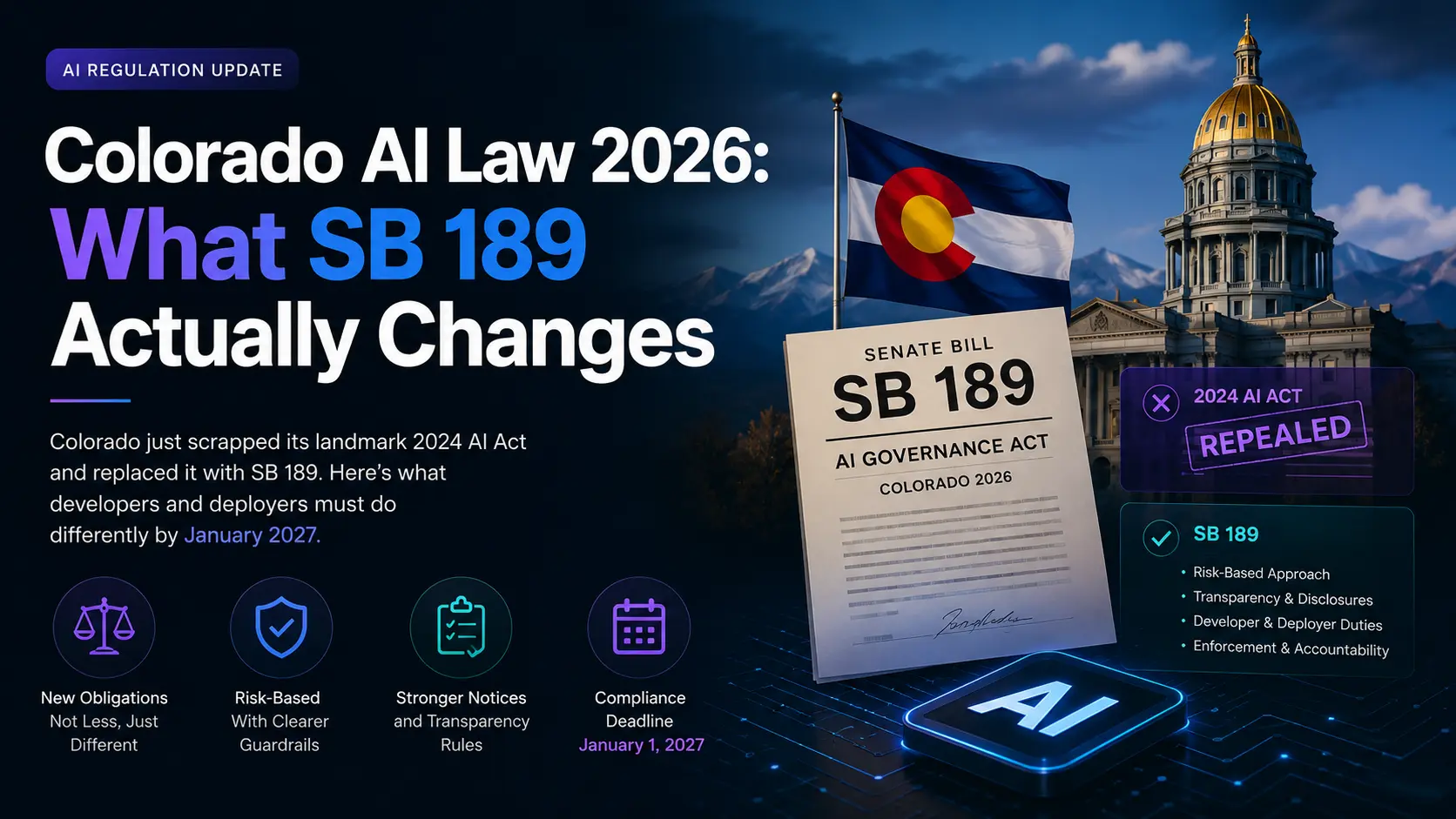
Colorado (SB 24-205): Effective June 30, 2026. Impact assessments required, consumer disclosures required, measures to prevent algorithmic discrimination.
Federal (TAKE IT DOWN Act): Deadline May 19, 2026. Platforms must remove non-consensual intimate imagery, including AI deepfakes.
President Trump’s Executive Order in December 2025 aims to preempt state AI laws deemed inconsistent with federal policy. This creates legal uncertainty about whether state laws will survive federal challenge. The safer path: comply with the strictest applicable standard.
For developers working on AI products, Japan’s approach offers an interesting contrast because it leans harder on guidance than fines. The UK’s April 2026 AI regulation updates are another useful counterpoint. Britain still has no single AI Act, and regulators like the FCA and ICO are using existing frameworks instead.
What Happens If You Ignore This
Organizations that dismiss regulation as distant noise will face consequences faster than expected.
Financial penalties: Fines under the EU AI Act reach 35 million euros or 7% of global turnover. That figure triggers shareholder lawsuits.
Reputational collapse: News of a regulatory violation travels through social media in hours. Recovery takes years.
Board accountability: Directors who fail to ensure AI governance face personal liability questions. Insurance carriers are asking about AI risk management during renewal conversations.
Surprise audits: EU regulators have announced they’ll conduct proactive inspections rather than wait for complaints. Organizations without documentation will struggle to respond.
Talent flight: Engineers and researchers want to work on responsible AI. Organizations with compliance problems can’t attract top talent.
Building Your Response Plan: 10 Steps for This Month
Here’s what to do this month — not this quarter, this month:
-
Conduct a complete AI inventory. Document every AI system you deploy, purchase, or build internally. Include shadow AI tools employees use without formal approval.
-
Classify your AI systems by risk level. Use the EU AI Act framework. Identify which systems fall into prohibited, high-risk, limited, or minimal categories.
-
Assign clear ownership for each AI system. Someone must be accountable for compliance, monitoring, and incident response for every single system.
-
Establish human oversight mechanisms. Autonomous systems need human review points where people verify outputs and intervene when needed. Document these mechanisms thoroughly.
-
Build transparency into operations. Users interacting with AI should know they’re interacting with AI. This is both a legal requirement and good practice.
-
Train your teams on AI literacy. The EU AI Act requires organizations to ensure their staff understand the AI systems they work with. McKinsey’s 2026 State of AI report estimates most organizations need 3-6 months to reach adequate AI literacy levels.
-
Monitor agentic AI deployments closely. Autonomous systems need more oversight, not less. Create audit trails, decision logs, and alert systems.
-
Invest in governance infrastructure. AI governance requires tools, processes, and dedicated roles. Budget accordingly.
-
Engage with regulatory sandboxes. If your member state has an AI sandbox, apply. Sandbox participation builds relationships with regulators and gives you early clarity on compliance expectations.
-
Assign someone to track regulatory updates. AI regulation changes monthly. Someone on your team needs to translate developments into operational guidance — that’s what we do here at AI News Desk.
What Comes in the Months Ahead
The EU AI Act enters full enforcement in August 2026. Organizations that aren’t ready by then will face their first real compliance tests.
Agentic AI adoption will accelerate through the rest of 2026 and beyond. The agentic revolution isn’t slowing down, and governance needs to keep pace.
State-level AI regulation in the US will keep expanding until federal legislation creates uniform standards. The current patchwork forces companies to track multiple compliance regimes simultaneously.
International coordination remains limited. The EU, US, China, Japan, and South Korea are all taking different approaches. Multinational organizations must comply with all applicable requirements, even when they conflict.
There’s no finish line. AI regulation will keep evolving as the technology advances. Organizations that build strong governance foundations now will adapt more easily to whatever comes next.
The Bottom Line
August 2, 2026 is four months away. The EU’s first enforcement actions will begin soon after. When they do, regulators will look at which organizations prepared and which ones gambled.
Board members who ignored AI governance will answer to shareholders. Executives who delayed compliance will answer to regulators. Companies that treated this as someone else’s problem will discover it was always theirs.
You’ve seen the deadlines. You’ve seen the penalties. You’ve seen what your competitors are doing.
The only question left is whether you act now or explain later why you didn’t.