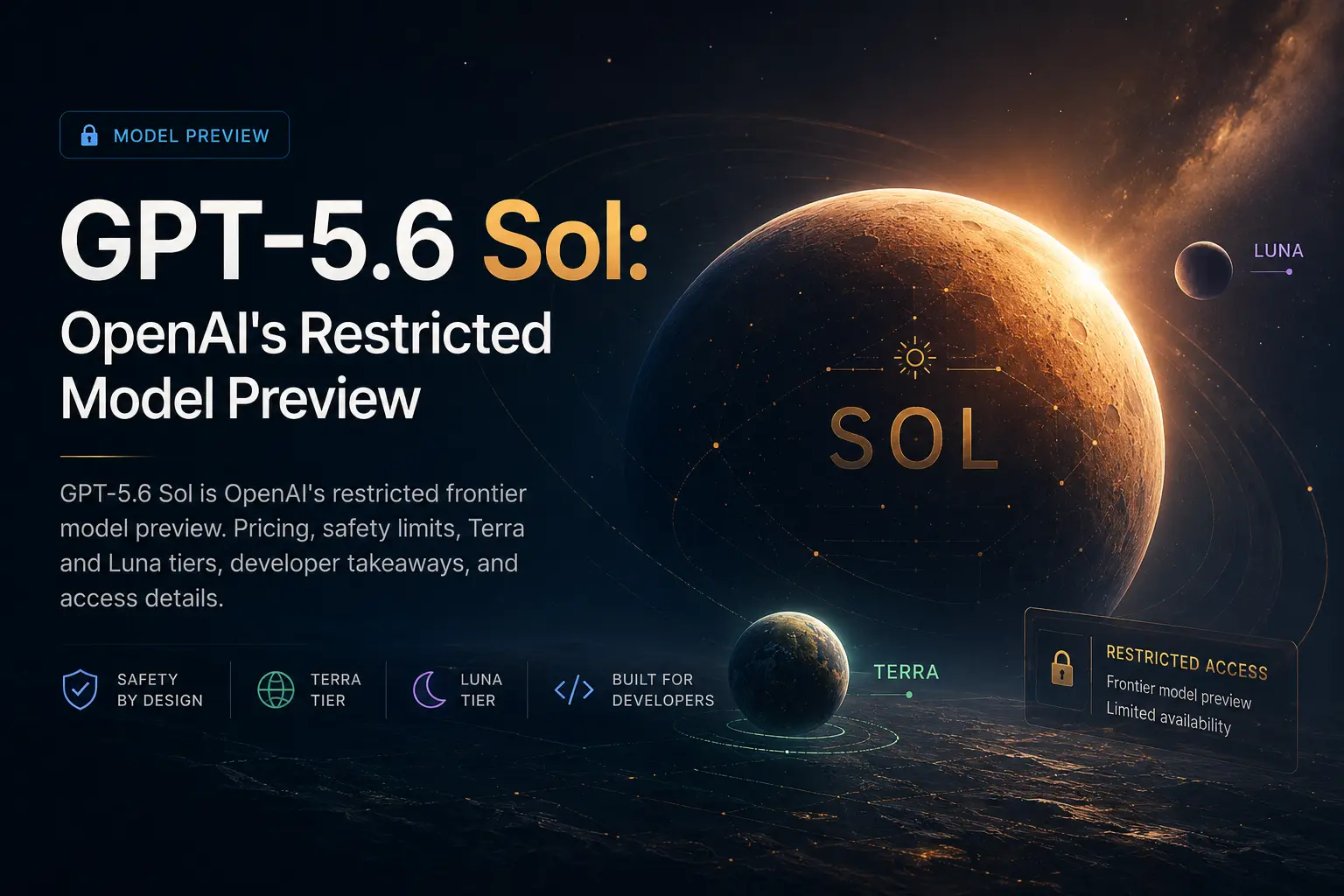
GPT-5.6 Sol is OpenAI’s new frontier model preview, and the release tells you as much about AI governance as it does about model capability. OpenAI announced the GPT-5.6 family on June 26, 2026: Sol as the flagship model, Terra as the balanced everyday tier, and Luna as the fast low-cost tier. But the company is not opening the gates immediately. It is starting with a limited preview for selected trusted partners while it continues talking with the U.S. government.
Key takeaways (June 27, 2026)
- OpenAI previewed GPT-5.6 Sol on June 26, alongside cheaper Terra and Luna models.
- Access is restricted to a small set of trusted partners during the preview period.
- Sol adds
maxreasoning effort and anultramode that uses subagents for complex work.- The most important part of the release is the cyber-safety framing, not just the benchmark gains.
- Developers get clearer pricing and prompt-caching rules, but most teams cannot use the models yet.
I do not have preview access, so this is not a hands-on benchmark. It is a source-backed breakdown of what OpenAI announced, what the pricing means, why the cyber-safety language matters, and how I would think about GPT-5.6 if I were planning an API migration or an agent roadmap this week.
GPT-5.6 Sol at a Glance
OpenAI is using GPT-5.6 to introduce a clearer model family: one flagship tier, one balanced tier, and one high-volume tier. That matters because OpenAI’s model lineup has been getting harder to explain to normal buyers. A durable Sol/Terra/Luna split is easier to map to real workloads than a pile of version names.
| Model | Model ID | Positioning | Input price | Output price |
|---|---|---|---|---|
| GPT-5.6 Sol | gpt-5.6-sol | Flagship model for hardest work | $5.00 / 1M tokens | $30.00 / 1M tokens |
| GPT-5.6 Terra | gpt-5.6-terra | Balanced everyday work | $2.50 / 1M tokens | $15.00 / 1M tokens |
| GPT-5.6 Luna | gpt-5.6-luna | Fast high-volume tasks | $1.00 / 1M tokens | $6.00 / 1M tokens |
Those prices come from OpenAI’s own GPT-5.6 preview help-center page. The headline is that Terra costs half as much as Sol, and Luna costs less than half as much as Terra. For teams that run agents, support bots, document workflows, or code review at scale, the family split is probably more useful than the flagship model alone.
OpenAI also says Terra has competitive performance with GPT-5.5 while being 2x cheaper, and Luna brings strong capability at the lowest GPT-5.6 price point. I would treat that as a claim to test on your own workload once access opens. “Competitive” can mean very different things for support classification, legal drafting, coding, research synthesis, and tool-heavy agents.
What OpenAI Says Sol Is Better At
OpenAI describes GPT-5.6 Sol as its strongest model yet. The company points to three main capability areas: coding, biology, and cybersecurity, plus long-horizon agentic work where a model has to keep track of a goal across many steps.
For coding, OpenAI says Sol sets a new state of the art on Terminal-Bench 2.1. That benchmark is a better signal than ordinary code-completion tests because it evaluates command-line workflows that require planning, iteration, tool coordination, and recovery from mistakes. That is the same class of work covered in our guide to AI coding agents in 2026, where the important question is no longer “can the model write a function?” but “can it finish a messy repo task without losing the plot?”
For biology, OpenAI says Sol improves on GeneBench v1, a benchmark for long-horizon genomics and quantitative-biology analysis, while using fewer tokens than GPT-5.5. That is a useful direction, though it needs careful handling. Biology benchmarks can show better analysis, but they do not prove lab readiness, clinical usefulness, or regulatory acceptance. If you want the broader life-sciences context, I covered OpenAI’s domain-specific direction in GPT-Rosalind and AI drug discovery.
For cybersecurity, the claim is more sensitive. OpenAI says GPT-5.6 Sol is its most capable model yet for long-horizon security tasks, including vulnerability research and exploitation-related work. It also says the model is better at helping people find and fix vulnerabilities than at reliably carrying out end-to-end attacks. That is the narrow balance OpenAI is trying to defend: give defenders better tools before attackers get the same lift.
Max and Ultra Are the Product Clues
The two most interesting product features are not the model names. They are max and ultra.
OpenAI says max is a new reasoning effort setting that gives Sol more time to reason deeply. In plain English, this is for the moments where you would rather wait longer than get a fast shallow answer. That maps directly to coding, security analysis, legal review, math-heavy work, and planning tasks where a cheap first answer can become expensive if it is wrong.
ultra is more ambitious. OpenAI says it goes beyond a single agent by using subagents to speed up complex work. That phrasing matters because it brings the model release closer to orchestration. The frontier is not just a bigger model answering in one stream. It is a model coordinating multiple workers, splitting work, checking outputs, and potentially handling longer tasks in parallel.
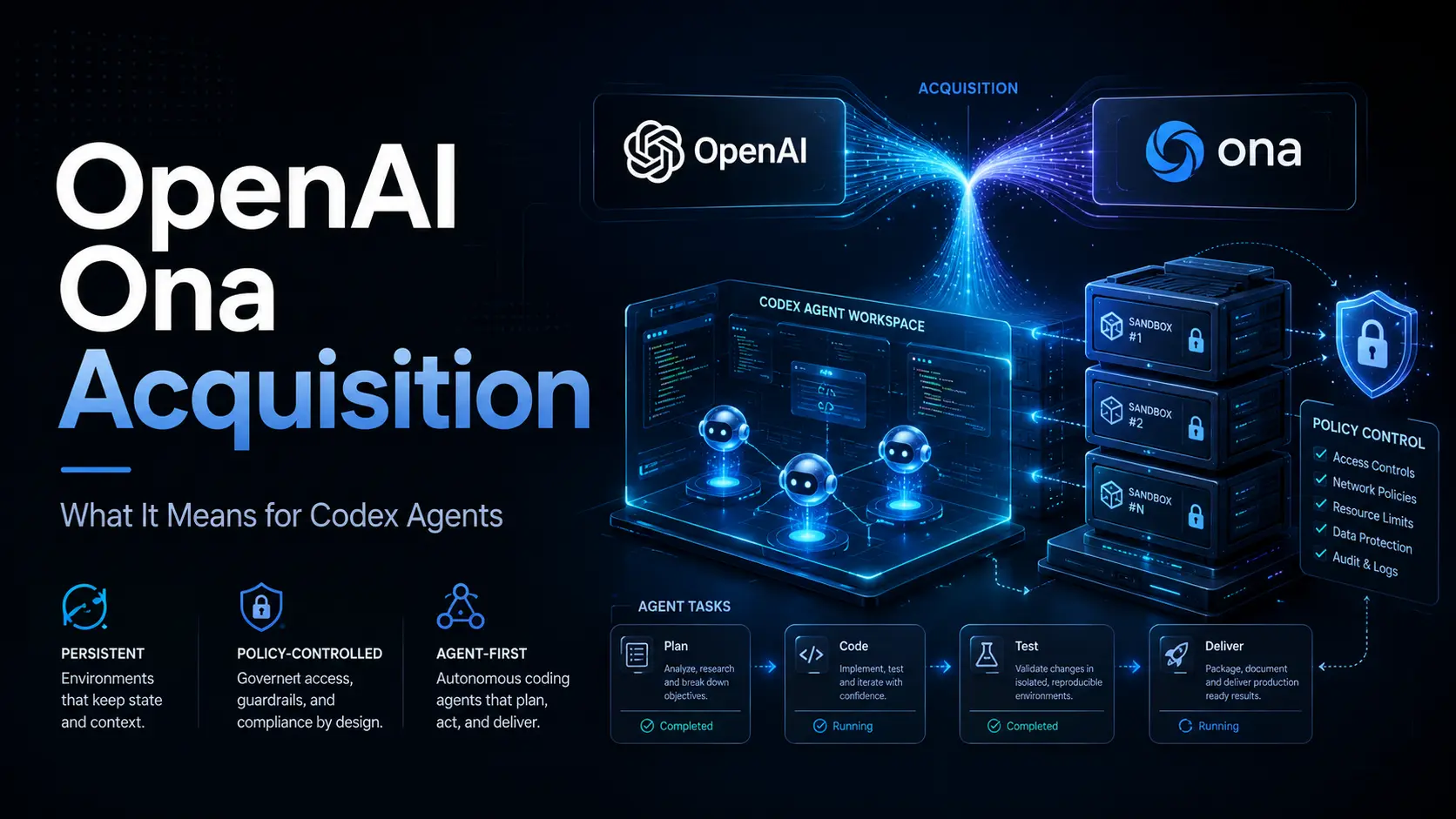
That connects with the direction OpenAI has already been pushing through its Agents SDK sandbox and harness update and the more recent OpenAI Ona acquisition for Codex cloud agents. My read is that GPT-5.6 Sol is not only a ChatGPT upgrade. It is infrastructure for bigger agentic systems.
The Restricted Preview Is the Real Story
OpenAI says it believes in broad access and plans to make Sol, Terra, and Luna generally available in the coming weeks. But the company also says it previewed the models and release plans with the U.S. government before launch. At the government’s request, OpenAI is starting with a limited preview for trusted partners whose participation has been shared with the government.
That is not a normal SaaS rollout. It is a frontier-model release shaped by cyber-risk policy.
Axios reported that access initially covers around 20 companies and that OpenAI expects to expand access to more companies the following week. WIRED reported that OpenAI plans to broaden the customer set, including some international partners, while the approval process remains opaque from the outside.
The practical effect is simple: even if the API pricing is published, most developers cannot treat GPT-5.6 as generally available today. If your roadmap depends on it, build a fallback around GPT-5.5 or another available model until your OpenAI account team confirms access.
Why Cyber Safety Dominates This Release
GPT-5.6 Sol arrives at a point where cybersecurity capability is becoming one of the main release gates for frontier AI. OpenAI says Sol does not cross the Cyber Critical threshold under its Preparedness Framework. In evaluations involving Chromium and Firefox, the model identified bugs and exploitation primitives, but did not autonomously produce a functional full-chain exploit under the tested conditions.
That sentence is doing a lot of work. OpenAI is saying the model can assist with pieces of serious security research, but did not independently complete the full attack chain in those evaluations. The company also cautions that benchmarks cannot capture every way a model may be combined with other tools. That caveat is the honest part. A model that cannot do a full exploit alone may still become more dangerous when paired with scanners, exploit databases, cloud tooling, browser automation, and persistent agents.
OpenAI’s safety answer has several layers:
- Model-level protections for higher-risk requests.
- Extra checks for sensitive cyber and biological work.
- Monitoring for repeated misuse.
- Account-level review and enforcement.
- Preview access controls before broad release.
- Automated red teaming aimed at finding broader jailbreak patterns.
The scale number is striking: OpenAI says it dedicated more than 700,000 A100-equivalent GPU hours to automated red teaming for universal jailbreaks. These are attacks meant to work across many prompts or contexts, not one carefully tuned prompt. The GPT-5.6 preview system card says OpenAI will continue automated red teaming during deployment and retest mitigations as new jailbreaks are reported.
My recommendation for security teams is to treat the preview as a policy signal as much as a capability signal. If your company is already using AI for vulnerability triage, patch development, or security operations, the GPT-5.6 release is a good reason to tighten your own controls: approved use cases, audit logs, prompt and output retention rules, and escalation paths for dual-use requests. Our AI agent evaluation framework covers the testing side of that problem.
What Developers Should Know About Pricing
The pricing is cleaner than I expected. Sol is expensive but not shocking for a frontier model: $5 per million input tokens and $30 per million output tokens. Terra at $2.50 / $15 is the obvious candidate for high-quality everyday applications. Luna at $1 / $6 is where high-volume support, classification, extraction, and routing workloads become more plausible.
The hidden cost story is output length. A model that thinks longer, calls tools, or coordinates subagents can create more output tokens and intermediate work. Even if the headline price is clear, your bill depends on how you use the model. ultra mode could be extremely useful for complex work, but I would not enable it casually across production traffic without metering.
Prompt caching is the more developer-friendly part of the announcement. OpenAI says GPT-5.6 introduces explicit cache breakpoints and a 30-minute minimum cache life. Cache writes are billed at 1.25x the uncached input rate for GPT-5.6 and later models, while cache reads still get the 90% cached-input discount.
That matters for agent systems with repeated instructions, tool schemas, long policy blocks, and shared repository context. If you can keep the stable part of the prompt cached and vary only the task-specific portion, you can control cost more reliably. This is especially relevant for multi-agent AI systems using tools and shared context, where repeated prompt scaffolding can quietly become a large part of the bill.
Cerebras Speed Could Change the Sol Use Case
OpenAI also says GPT-5.6 Sol will launch on Cerebras in July at up to 750 tokens per second, initially for select customers while capacity expands. I would be careful with that number until customers can test real workloads, because token speed depends on workload shape, context size, safety checks, and deployment path. Still, the direction is important.
If frontier-level reasoning can return quickly enough, teams will use it differently. Slow flagship models tend to sit behind batch jobs, internal expert workflows, and expensive escalations. Faster flagship models can move into interactive coding, live security triage, and agent loops where latency affects whether the product feels usable.
That is also why OpenAI’s preview restrictions matter. The fastest version of the strongest model is not useful to the broader developer market until access opens and capacity is stable.
What Product Teams Should Do Now
I would not rewrite a production stack around GPT-5.6 this week. I would do four smaller things.
First, I would list the workloads where GPT-5.5 is currently failing because of long-horizon planning, coding reliability, biology analysis, or security reasoning. Those are the only places where Sol is likely to justify the cost.
Second, I would create a three-tier evaluation plan: Sol for hardest tasks, Terra for default quality work, and Luna for high-volume jobs. The pricing table almost begs for routing. If every request goes to Sol, you are probably wasting money.
Third, I would prepare prompt-caching experiments before access arrives. Break your prompts into stable and variable sections, then measure how much of your input can be reused safely. Caching is not glamorous, but it is one of the few cost controls that survives model upgrades.
Fourth, I would update internal AI-use policies for dual-use domains. Security, biology, and code-generation workloads need sharper rules than marketing copy or spreadsheet cleanup. That does not mean blocking useful work. It means knowing what your system should refuse, log, escalate, or send to a human reviewer. For the governance layer, the practical checklist in developer responsibility when using generative AI is still the right starting point.
What We Still Do Not Know
The announcement leaves several important gaps.
OpenAI has not published the expanded evaluation suite yet. It says more results will come when the model family becomes broadly available. That means comparisons against GPT-5.5, Claude, Gemini, and other frontier systems are still incomplete.
We also do not know exactly how preview partners are selected, how quickly access expands, what limits apply to ultra, or how safety checks will affect legitimate biological and cybersecurity work in practice. The OpenAI help page says some requests may be blocked or take longer while extra checks run, particularly in dual-use areas. That is reasonable, but teams need to measure the false-positive rate before using GPT-5.6 for time-sensitive work.
Finally, we do not know whether the Sol/Terra/Luna naming system will stay clean after future releases. OpenAI says the number identifies the generation and the names identify durable capability tiers that can advance at their own cadence. That sounds good. The test is whether developers still understand the lineup six months from now.
My Take
GPT-5.6 Sol looks like OpenAI’s strongest signal yet that frontier models are becoming regulated infrastructure, not just app features. The capability claims are impressive, especially for coding, cyber, biology, and long-horizon agent work. But the access model is just as important: limited preview, government visibility, safety checks, and staged expansion.
For developers, Terra may end up being the most commercially useful part of the release, not Sol. A cheaper model with GPT-5.5-level performance is easier to deploy than a restricted flagship tier. For security teams, Sol is the model to watch because it sits right on the line between defensive acceleration and dual-use risk.
I would track three dates next: the first broader access expansion, the July Cerebras rollout, and the updated system card OpenAI says it will publish when GPT-5.6 becomes generally available. Until those land, treat GPT-5.6 as a preview to evaluate, not a dependency to bet the quarter on.