Key takeaways (May 17, 2026)
- Developer responsibility now spans correctness, IP, privacy, and downstream model use.
- Licensing of training data is the fastest-moving legal area as of May 2026.
- Code-suggestion attribution, prompt-injection hardening, and red teaming are baseline practices.
- Document model choice, evaluation results, and human review in every release.
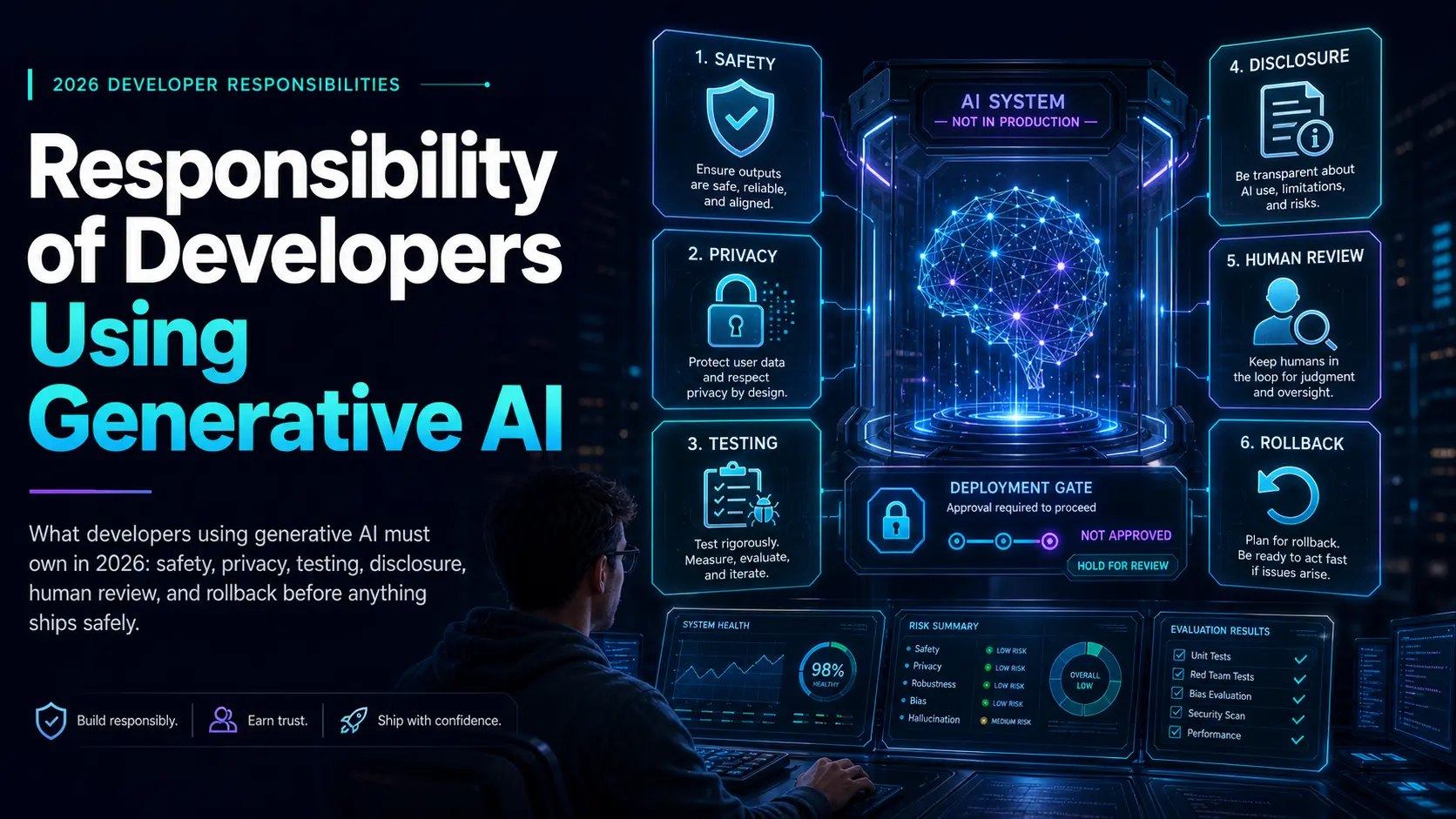
The responsibility of developers using generative AI is to own what ships. Not the model vendor. Not the prompt. Not the demo. If the feature reaches users, the engineering team is responsible for the data it touches, the outputs it produces, the failures it creates, and the recovery path when it gets something wrong.
I reviewed the current public results for this question on May 2, 2026. Most answers list ethics, bias, privacy, transparency, and accountability. That is a decent start, but it is too soft for real engineering work. Developers do not need another moral checklist. They need release gates.
So here is the practical version: what developers must own before using generative AI in production, how to prove it, and where 2026 guidance from NIST, NCSC, OECD, and OWASP changes the bar.
What Is the Responsibility of Developers Using Generative AI?
Developers are responsible for building generative AI systems that are safe enough for their context, honest about their limits, private by design, testable, monitored, and reversible. That means a developer’s job starts before the first prompt and continues after release.
| Responsibility | What it means in practice | Evidence to keep |
|---|---|---|
| Use-case judgment | Decide whether generative AI is the right tool | Risk review, alternatives considered |
| Data protection | Keep sensitive data out of prompts, logs, and training paths | Data map, retention policy, vendor settings |
| Output verification | Treat model output as untrusted until checked | Tests, source checks, human review records |
| Bias and fairness | Test different users, languages, regions, and edge cases | Evaluation set, failure notes, fixes |
| Security | Defend against prompt injection, data leakage, and tool misuse | Threat model, red-team cases, scan results |
| Transparency | Tell users when AI affects their content or decisions | UI copy, user docs, appeal paths |
| Accountability | Assign owners for launch, monitoring, incidents, and rollback | Owner list, runbooks, incident logs |
This is the difference between “we used AI responsibly” and “we can show exactly how this system is controlled.”
Why Developer Responsibility Is Higher in 2026
Generative AI has moved from side tool to product infrastructure. It writes code, summarizes medical notes, drafts legal language, scores support tickets, plans agent actions, and touches customer data.
That shift changes the developer role. You are no longer only writing deterministic software. You are connecting a probabilistic system to a product, a database, a workflow, or a user decision. That means normal software quality is not enough.
NIST’s Generative AI Profile, updated April 8, 2026, frames the work across the AI lifecycle. NCSC’s secure AI system development guidelines split security work across design, development, deployment, and operation. The OECD AI Principles, updated in 2024, put accountability, transparency, fairness, safety, and privacy into an international policy frame.
And for security, OWASP’s Top 10 for LLM Applications 2025 is the list developers should have near their issue tracker. Prompt injection, sensitive information disclosure, supply chain risk, excessive agency, and insecure output handling are not theory anymore. They are failure modes you test for.
1. Decide Whether Generative AI Belongs in the Feature
The first responsibility is saying no when a normal system would work better.
I have seen teams reach for a model when they really needed search, templates, rules, or a better form. That is how you end up with unpredictable output in a workflow that needed precision.
Before building, ask:
- Is the task open-ended enough to need generation?
- Could a wrong answer harm a user?
- Can a human realistically review the output?
- Does the feature touch private or regulated data?
- Can we test success and failure in a repeatable way?
- Can we turn it off without breaking the product?
If the answer to the last two is no, you are not ready to ship.
This is where AI governance needs to meet product planning. Governance cannot wait until the pull request is open. It belongs in the spec.
2. Protect Data Before It Reaches the Model
Privacy problems often start in the prompt.
Developers must know what data enters the model, where it is logged, whether the vendor can train on it, how long it is retained, and who can read traces. If that sounds basic, good. It is basic. It is also where teams keep making mistakes.
Responsible handling looks like this:
- Minimize prompt data. Send only what the task needs.
- Remove direct identifiers where possible.
- Keep secrets, API keys, tokens, and customer credentials out of prompts.
- Turn off vendor training where the product requires it.
- Set retention rules for prompts, outputs, embeddings, and tool traces.
- Restrict access to logs because logs often contain the real sensitive data.
- Document which model, vendor, region, and data-processing terms apply.
For developer tools, this matters even more. Codebases contain secrets, proprietary logic, customer examples, and security context. If you use AI coding agents, treat repo access as privileged access.
3. Treat Every Output as Untrusted
A model answer can look clean and still be wrong.
For text, that means checking facts and sources. For code, it means tests, review, static analysis, dependency checks, and license review. For decisions, it means human appeal and audit logs.
The rule I use is simple: if a junior developer submitted this output, what would I require before merging it? Generative AI does not get a lower bar because it sounds confident.
For AI-generated code, the baseline should include:
- Unit tests for the changed behavior
- Integration tests for the path users hit
- Dependency and license review
- Secret scanning
- Security review for input handling and auth paths
- Human review by someone who understands the area
- A rollback plan
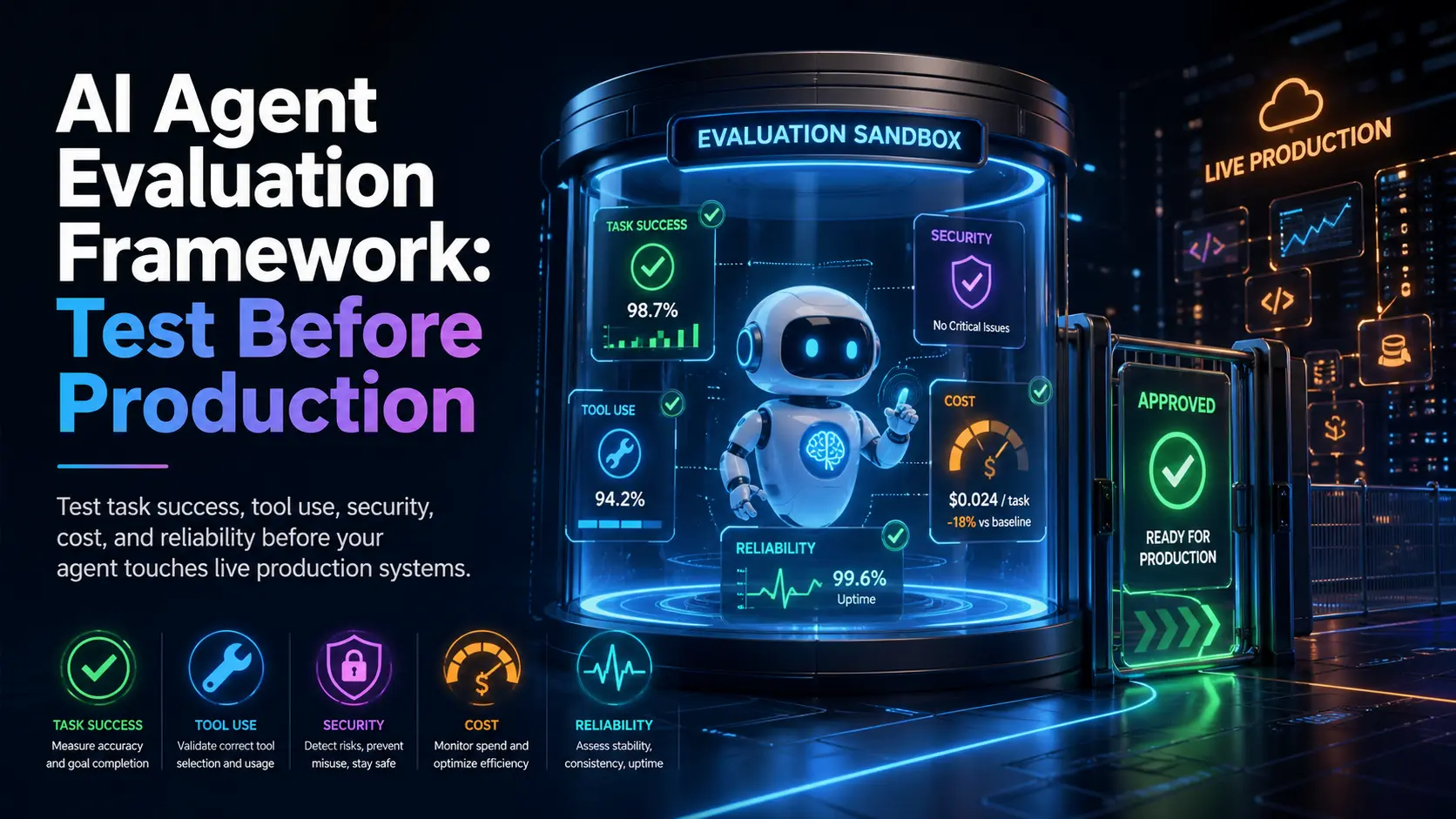
This is why AI agent evaluation matters. You need a repeatable way to check task success, tool use, cost, latency, security, and failure patterns before the system reaches users.
4. Test Bias, Fairness, and Uneven Failure
Bias is not only a training-data issue. It can show up in prompts, retrieval sources, ranking logic, UI defaults, language support, and fallback behavior.
Developers are responsible for testing how the system behaves across user groups and contexts. That does not mean every small feature needs a university-grade fairness study. It means your test set should include the people your product serves.
For a support chatbot, test different languages, accents if voice is involved, angry users, confused users, older users, accessibility needs, and edge cases around refunds or safety. For a hiring tool, the bar is much higher because employment systems are regulated and can materially affect people’s lives.
The OECD principles are useful here because they connect fairness, privacy, human rights, safety, and accountability. That may sound abstract, but the engineering translation is concrete: test different users, record failures, fix the product, and keep evidence.
If your fairness testing lives only in a slide deck, it is not testing.
5. Defend Against Prompt Injection and Tool Misuse
Prompt injection is the generative AI version of “never trust user input.”
If your system reads webpages, email, PDFs, tickets, comments, code, or third-party documents, it can ingest malicious instructions. If the model has tools, those instructions can become actions.
Developers must design boundaries:
- Separate system instructions from retrieved content.
- Treat external content as data, not orders.
- Limit tool permissions by default.
- Require human approval for destructive actions.
- Validate tool inputs server-side.
- Log tool calls with user, time, purpose, and result.
- Test with hostile prompts before release.
For MCP-based systems, the risk expands because the model can discover and call tools. Our MCP security breakdown covers that pattern in more depth, and the Microsoft Agent Governance Toolkit is a useful example of runtime policy enforcement for agent actions.
My default is boring but effective: read-only first, write access later, production access last.
6. Tell Users What the System Is Doing
Transparency does not mean dumping a model card into the footer.
Users need plain information at the point where it matters. If AI drafts an email, label it. If AI summarizes a medical note, make review obvious. If AI affects a decision, explain the role it played and how the user can challenge it.
Good disclosure answers three questions:
- Is AI involved?
- What is it doing?
- What can the user do if it is wrong?
This is also a product quality issue. Users over-trust polished output when the interface gives them no reason to slow down. Developers can reduce that risk with design: confidence labels, source links, review states, edit history, and human handoff.
For regulated sectors, disclosure is not optional. If your feature touches hiring, credit, health, education, finance, or workplace monitoring, bring legal and compliance into the design before implementation.
7. Build Monitoring, Incident Response, and Rollback
Shipping is not the end. It is when the real test starts.
A generative AI system can fail because the model changed, retrieval data changed, user behavior changed, prompts drifted, costs spiked, latency broke the workflow, or attackers found a new path. Developers need monitoring that catches those failures.
At minimum, track:
- Output rejection rate
- User edits and overrides
- Escalations to human review
- Policy violations
- Prompt injection attempts
- Tool-call failures
- Latency and cost per task
- Model and prompt version
- Incidents and rollback events
Then write the runbook. Who gets paged? Who can disable the feature? What counts as a severe incident? How do you notify affected users? How do you preserve logs without leaking more data?
This is the part most “responsible AI” articles skip. Responsibility is not a value statement. It is an on-call path.
How This Applies to AI-Generated Code
The responsibility gets sharper when generative AI writes code because software failures compound quickly.
An AI coding agent can introduce insecure auth logic, hallucinate an API, add a vulnerable dependency, remove validation, or change behavior in a file the reviewer did not notice. The faster the agent works, the more disciplined the review process has to be.
For teams using coding agents in 2026, I would require these controls:
| Control | Why it matters |
|---|---|
| Small task scopes | Large vague tasks hide bad changes |
| Test-first prompts | The agent has an objective signal, not only prose |
| Branch isolation | Bad output stays away from main |
| Mandatory human review | Ownership stays with the team |
| Dependency limits | Prevents casual supply-chain risk |
| Permission scoping | Stops agents from touching systems they do not need |
| Command logging | Gives reviewers a trail of what happened |
| Rollback drills | Proves the team can recover |
The OpenAI Agents SDK sandbox update is part of this shift. Sandboxes, scoped memory, and execution controls are useful. They still do not replace review.
A Practical Checklist Before You Ship
Here is the checklist I would use for a generative AI feature.
- We wrote down the use case and why a model is needed.
- We identified the data entering prompts, retrieval, embeddings, tools, and logs.
- We checked vendor training, retention, region, and access settings.
- We have evals for expected behavior and known failure cases.
- We tested prompt injection and unsafe outputs.
- We tested bias and accessibility for the users we serve.
- We show users when AI is involved and what to do when it is wrong.
- We require human approval for high-impact or destructive actions.
- We log model version, prompt version, tool calls, and review decisions.
- We have monitoring, incident response, and rollback.
- One named owner is accountable after launch.
If a team cannot complete this list, the feature may still be a good prototype. It is not a production system yet.
My Take
Developer responsibility with generative AI is not complicated. It is just uncomfortable.
You own the feature. You own the data path. You own the tests. You own the monitoring. You own the rollback. The model can help, but it cannot be accountable.
The teams that understand this will ship faster because they will not be stopped by last-minute security reviews, privacy surprises, or customer trust problems. The teams that skip it will keep learning the same lesson in public.