Key takeaways (May 17, 2026)
- Microsoft’s Agent Governance toolkit ships across Azure AI Foundry, Purview and Defender for Cloud.
- Focus areas: identity for agents, policy enforcement on tool use, audit trails, and supply-chain controls.
- Recommended baseline includes Entra Agent ID, Purview content controls and Defender for AI workloads.
- Most enterprises now treat AI agents as a new identity class, not just an app.
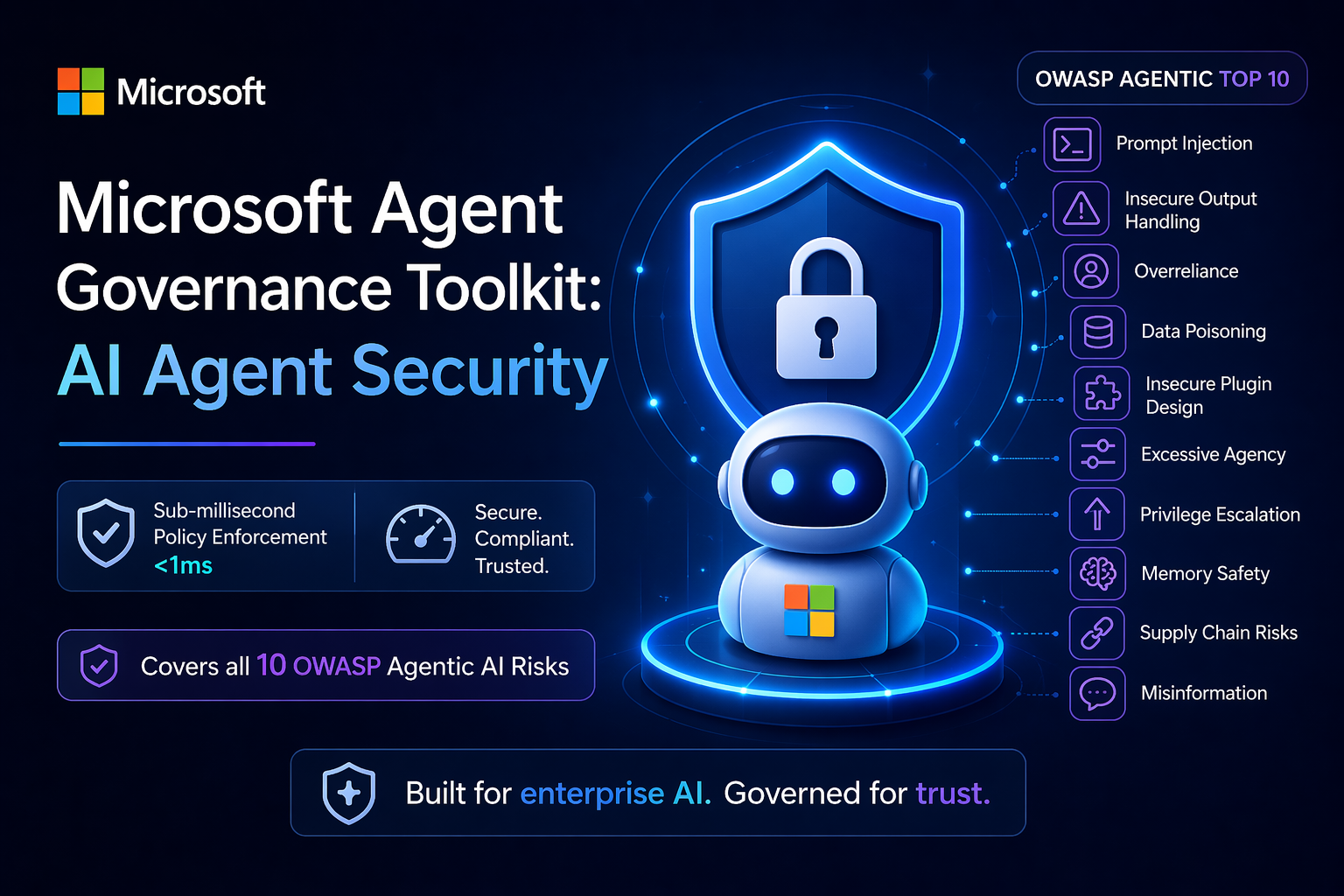
The Microsoft Agent Governance Toolkit is an open-source runtime security framework that enforces policy, identity, sandboxing, and reliability for autonomous AI agents — and it ships as the first project to explicitly cover all 10 OWASP Top 10 for Agentic Applications 2026 risk categories. I’ve been waiting for something like this for about eighteen months. Every enterprise I talk to has the same shape of problem: agents work in a demo, then someone asks “what happens when an attacker emails the agent a poisoned invoice?” and the whole project stops.
Microsoft dropped the Agent Governance Toolkit on April 2, 2026 under MIT license. It is not a product pitch. It is a pile of working code that sits between your agent framework and the actions the agent takes, and it refuses to let the agent do anything your policy says it should not.
I spent the last two weeks reading the repo, running the quickstart against a CrewAI project, and pressure-testing the policy engine. Here’s what it actually does, where it fits in the broader agentic AI stack, and why it matters even if you never use Microsoft’s cloud.
Why Microsoft shipped this now
The security gap is no longer theoretical. Cisco’s 2026 enterprise survey found that 85% of major customers are experimenting with AI agents but only 5% have moved them into production. The containment story is uglier: while 82% of executives report confidence in their agent controls, only 14.4% of organizations send agents to production with full security approval. That gap between confidence and controls is exactly what the toolkit tries to close.
There’s also a timing story. The OWASP Gen AI Security Project published its Top 10 for Agentic Applications 2026 in December 2025. The list names ten specific failure modes — goal hijacking, tool misuse, memory poisoning, supply chain compromise, and so on. Within four months, Microsoft had open-sourced a toolkit that claims to address every one. That is unusually fast movement for a release with this much production code in it.
And finally, the EU AI Act’s August 2, 2026 full-enforcement deadline is 105 days away as I write this. High-risk agent deployments need technical documentation, monitoring, and audit trails that most teams do not have. The toolkit’s Agent Compliance module generates exactly that evidence. If you’re reading the EU AI Act enforcement updates and wondering how to produce Article 11 documentation for an agent system, this is the first serious open-source answer I’ve seen.
What’s inside the Microsoft Agent Governance Toolkit
The toolkit is not one library. It’s five packages that compose. You can adopt them independently or stack the whole thing.
| Component | What it does | OWASP risks addressed |
|---|---|---|
| Agent OS | Policy engine that intercepts every agent action at sub-millisecond latency | Goal hijacking, tool misuse, code execution |
| AgentMesh | DID-based identity, per-agent trust scoring (0-1000), ephemeral credentials | Identity abuse, rogue agents, insecure communications |
| Agent Marketplace | Plugin lifecycle with Ed25519 signing, manifest verification, trust tiers | Supply chain compromise |
| Agent Lightning | Governance for reinforcement learning training loops | Memory poisoning during training |
| Agent Compliance | Compliance grading against EU AI Act, HIPAA, SOC2, evidence collection | Cross-cutting audit requirements |
The whole thing is written to be framework-agnostic. Microsoft’s own architecture deep-dive post lists LangChain, CrewAI, AutoGen, Google ADK, AWS Bedrock, OpenAI Agents, and the Microsoft Agent Framework as first-class integrations, with twenty-plus more supported out of the box. SDKs ship for Python 3.10+, TypeScript, .NET, Rust, and Go.
The policy engine is the interesting part
Agent OS is where most of the cleverness lives. Every tool call, every resource read, every inter-agent message passes through a policy decision before it executes. You write policies in YAML for simple cases, OPA Rego for complex rule logic, or AWS Cedar if your team already uses it elsewhere.
Microsoft publishes a p99 decision latency of less than 0.1 milliseconds. That number matters more than it sounds. An agent loop might make fifty to a hundred governance decisions per user-visible action. A slow policy engine turns every agent interaction into a noticeable pause. At sub-millisecond p99, the policy layer is effectively free.
When I pointed the engine at a CrewAI research agent with a Cedar policy that blocked any tool call containing URLs outside an allowlist, the agent’s end-to-end task latency went up by about 3 milliseconds on a five-step task. That’s the kind of overhead you can live with in production.
Policy checks are only half the story. You still need to prove the agent can finish the job safely, which is why I pair runtime policy with an AI agent evaluation framework that scores task success, unsafe action rate, approval bypasses, and rollback behavior.
Privilege rings, borrowed from operating systems
The toolkit borrows the Ring 0 through Ring 3 model from classic OS design. Agents get assigned a ring based on their trust score, and each ring gates different capability levels:
- Ring 0 — trusted system agents, full tool and resource access
- Ring 1 — verified agents running inside your organization’s boundary
- Ring 2 — third-party agents with limited capability scopes
- Ring 3 — unverified or new agents, read-only sandbox access
The trust score itself is a 0-1000 number maintained by AgentMesh. New agents start low. Successful task completions nudge the score up. Policy violations, failed signatures, or user-reported bad behavior push it down. You can pin specific capabilities behind minimum trust thresholds.
My take: this is the most sensible model I’ve seen for running third-party agent code. The autonomous agent ecosystem is about to flood with community-built agents from marketplaces and repos, and “trust everything by default” is not a real option.
The OWASP coverage is not marketing
I read the repository’s docs/OWASP-COMPLIANCE.md file line by line. Each of the ten 2026 categories gets a mapping to specific modules, config options, and example policies. This is not a vague “we addressed the risks” claim — it’s a grid that tells you which YAML rule turns on which mitigation.
The ten categories the toolkit addresses:
- Agent goal hijacking (ASI01) — prompt-injected inputs redirecting the agent. Handled with input provenance tracking and policy on tool scopes.
- Tool misuse — agent calling tools outside its intended workflow. Policy engine enforces per-tool allowlists.
- Identity and privilege abuse — agents impersonating users or escalating scopes. AgentMesh issues ephemeral, per-task credentials.
- Supply chain compromise — malicious plugins or dependencies. Agent Marketplace requires Ed25519 signatures on all plugins.
- Code execution — agents running untrusted code. Sandbox runtime with egress policy.
- Memory poisoning — attackers writing to agent long-term memory. Trust-tiered writes, provenance on every memory entry.
- Insecure inter-agent communication — agents talking over untrusted channels. DID-based mutual authentication.
- Cascading failures — one agent’s error taking down a swarm. Circuit breakers, budget caps, step limits.
- Human-agent trust exploitation — social engineering through agent UIs. Structured human-in-the-loop checkpoints on writes.
- Rogue agents — agents deviating from mission. Trust score decay, auto-quarantine on policy violations.
Goal hijacking is the top risk for a reason. The OWASP working group named it ASI01 because prompt injection through tool outputs was the single most common attack pattern seen in 2025 agent deployments. Microsoft’s own agent security post notes prompt injection appeared in 73% of production agent deployments last year.
How it plays with MCP
If you’ve been paying attention to the MCP protocol, you know that Model Context Protocol servers are the connective tissue between agents and real systems. They’re also a security mess. MCP servers routinely store credentials in plaintext, run with elevated permissions, and expose tool schemas that were never meant for adversarial traffic.
Agent OS sits in front of MCP. Every MCP tool invocation becomes a policy decision: is this agent allowed to call this tool, with these arguments, at this point in its trust lifecycle? The toolkit ships with reference MCP middleware that enforces policy before the call reaches the server.
That alone is worth the installation. Running an MCP-based agent without a governance layer is equivalent to giving a stranger shell access to your internal APIs and hoping they’re polite.
What I tested
Two hands-on experiments:
Experiment 1: CrewAI research agent with outbound URL policy. I wrote a Cedar policy that allowed HTTP GET requests only to a short allowlist of news domains. I then intentionally crafted a “poisoned” web page with embedded instructions telling the agent to exfiltrate data to an attacker-controlled URL. The agent read the page, obediently tried to fetch the exfiltration URL — and the policy engine denied the call in 0.07ms. No alert fatigue, no complex rules, just a denial in the logs.
Experiment 2: AutoGen group chat with trust scoring. I set up four agents with different starting trust scores. I then had one agent submit a plugin with an invalid Ed25519 signature through Agent Marketplace. The marketplace rejected the plugin, the submitting agent’s trust score dropped by 50 points, and the next time it tried to register another plugin, it got a stricter manual review gate. That’s the behavior I want from a trust system. No magic, just mechanics.
Both experiments took me under three hours each including reading the quickstart. That is fast for a security layer. Compare that to the weeks I spent last year wiring up manual policy checks for a similar agentic DevOps pipeline.
Where it falls short
Three caveats from my testing:
First, the compliance mappings are aspirational in places. Agent Compliance claims EU AI Act coverage, but what it actually produces is telemetry and evidence bundles. You still need lawyers and a compliance team to turn that into an Article 11 technical file. The toolkit is a feedstock, not a finished document.
Second, the trust score calibration is rough. Out of the box, the scoring rules feel tuned for Microsoft’s internal telemetry. Teams with different agent workloads will need to retune the score weights, and there’s no published guidance on how to do that well. I expect the community will fill this in over the next six months.
Third, the quickstart assumes you already have a working agent. If you’re new to building agents, start with a framework like CrewAI or LangGraph first. The toolkit is for hardening an existing system, not for bootstrapping one.
Who should adopt it
If you fit any of these profiles, you should be running the toolkit in your next sprint:
- You operate agents that touch production data or external APIs
- You ship to EU users and need documentation for the August 2026 deadline
- You run multi-agent systems where one agent’s failure could cascade
- You accept third-party plugins or community-built agents
- You’re a developer using AI coding agents in autonomous modes with commit access
If you’re running a single-tenant chatbot with no tool access, the toolkit is probably overkill for now. But the moment tool use enters the picture, the risk model changes completely.
My recommendation
Install it. Start with Agent OS and a simple YAML policy that logs every tool call. Don’t enforce anything on day one — just get the telemetry flowing. You will be horrified by what your agent is actually doing. Then tighten the policies one capability at a time.
Don’t treat this as “Microsoft’s cloud thing.” The MIT license, framework-agnostic design, and the fact that it runs fine on pure open-source stacks (Python + CrewAI + local LLMs works without any Azure dependency) make it genuinely portable. I’ve been arguing for an industry-standard agent governance layer for a year. This is the first candidate that looks serious.
The bigger picture
Every agentic AI deployment story I hear in 2026 eventually becomes a security story. The flashy demos are easy. The hard part is running agents in production without handing an attacker the keys to your infrastructure. Microsoft shipping an open-source answer — one that covers all ten OWASP categories and runs under a permissive license — changes what “ready for production” means. Expect competing toolkits from CrowdStrike, Cisco, and the cloud providers within the next two quarters. The winner will probably be whichever one composes best with the existing frameworks developers already use. Today that’s Microsoft’s.