Key takeaways (May 17, 2026)
- Generative AI now contributes to target identification, candidate generation and protocol drafting at most major pharma labs.
- AlphaFold-class structure prediction is table-stakes; generative chemistry is the active research front.
- Regulatory acceptance still requires traditional wet-lab and clinical validation.
- Cost compression and earlier failure detection are the most-cited benefits as of May 2026.
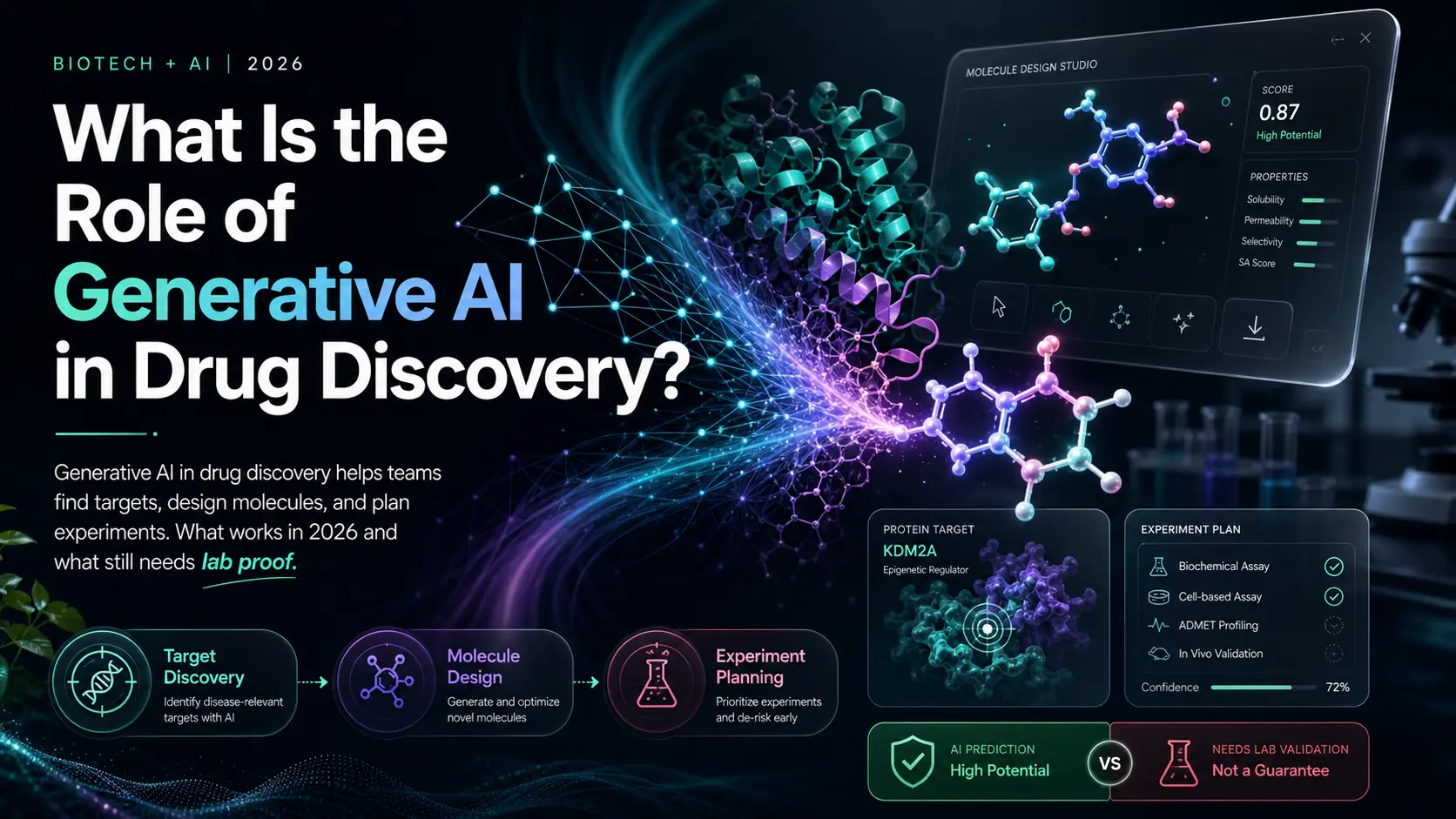
What is the role of generative AI in drug discovery? It helps researchers move faster through the messy early work: finding targets, proposing molecules, ranking compounds, reading papers, and planning the next experiment. That is the useful answer. The more honest answer is that it does not discover a safe drug by itself.
I reviewed the current public sources on May 2, 2026. The basic answer is target identification, molecule design, screening, and optimization. That is not enough anymore. The 2026 version also has to cover GPT-Rosalind, IsoDDE, and FDA’s current position on AI in drug development.
So this article takes the same question and gives you the version I would actually want if I worked at a biotech or wrote about the market: where generative AI fits, where it fails, which 2026 systems matter, and what still needs lab proof.
What Is the Role of Generative AI in Drug Discovery?
Generative AI’s role in drug discovery is to create and test ideas before humans spend money in the lab. It can suggest new molecular structures, search chemical space, predict binding or toxicity signals, summarize literature, and help scientists decide which experiments deserve attention.
That role is strongest before clinical development. Once a candidate reaches serious preclinical or clinical work, the model becomes one piece of evidence, not the decision-maker.
| Discovery stage | What generative AI can do | What still needs humans |
|---|---|---|
| Target identification | Find disease pathways, genes, proteins, and conflicting evidence | Decide whether the biology is real and clinically meaningful |
| Molecule generation | Propose new compounds or biologic sequences with desired properties | Check novelty, synthesis, patent risk, and experimental behavior |
| Virtual screening | Rank large candidate pools before lab assays | Validate hits in physical assays |
| Lead optimization | Suggest changes for potency, selectivity, solubility, and safety | Balance trade-offs medicinal chemists understand better than models |
| Experiment planning | Draft protocols, compare prior studies, and pick tools | Approve protocol design, safety, and lab execution |
| Regulatory evidence | Organize model output and trace assumptions | Produce auditable evidence regulators can trust |
That table is the whole story in plain terms. Generative AI is a search and design accelerator. It is not a replacement for chemistry, biology, toxicology, or regulatory judgment.
Why Drug Discovery Is Such a Good Fit
Drug discovery has always been a giant filtering problem. A team starts with huge biological uncertainty, a target that may or may not matter, and a chemical space too large to search manually. Then the team tries to narrow the field to a few candidates worth testing.
Generative AI fits that shape because it can make proposals, not just classify existing options. A standard predictive model might estimate whether a known molecule binds to a protein. A generative model can propose a new molecule that might bind while also trying to satisfy constraints such as solubility, selectivity, and synthetic access.
The Frontiers in Pharmacology review is still one of the better academic overviews. It explains why de novo design matters: researchers are not only ranking known compounds, they are trying to generate new chemical matter. The review also points out the part people skip in marketing copy. Training data can be tiny in drug discovery. Some target-specific datasets may only have tens to thousands of useful active molecules. That makes transfer learning, expert review, and lab validation unavoidable.
This is why I would not frame generative AI as a magic shortcut. It is a better way to create and rank hypotheses. A hypothesis is not a medicine.
The Five Roles That Matter Most
The useful work clusters into five jobs. If a tool cannot do at least one of these well, I would not call it a serious drug discovery system.
1. Target Identification
Target identification asks a blunt question: what should the drug act on?
Generative AI helps here by reading papers, genetics data, pathway databases, omics datasets, and prior experiments. It can connect signals that are hard for one researcher to hold in working memory. For example, a model might connect a disease phenotype with a pathway, then surface papers that support or weaken the target.
This is where systems like GPT-Rosalind become interesting. OpenAI says GPT-Rosalind supports evidence synthesis, hypothesis generation, experimental planning, and multi-step research tasks across biology, drug discovery, and translational medicine. That is a target-research workflow as much as a molecule-design workflow.
My take: this is the least flashy role, but probably the most valuable. A bad target wastes years. A better shortlist of targets compounds through every later stage.
2. De Novo Molecule Design
De novo design is the part most people imagine first: ask the system for a molecule with certain properties, then get candidate structures back.
The model may represent molecules as SMILES strings, graphs, 3D structures, or learned embeddings. It then proposes candidates that fit desired constraints. Those constraints might include potency, selectivity, molecular weight, lipophilicity, predicted toxicity, or binding to a target pocket.
The hard part is not generating a molecule. It is generating a molecule that is chemically valid, synthesizable, novel enough to matter, safe enough to test, and useful in a biological system. A model can satisfy a benchmark and still hand a chemist a compound nobody wants to make.
This is where many older articles overstate the case. They say generative AI can create new drugs. More precisely, it can create new candidate molecules. A candidate has to survive a lot of reality before anyone should call it a drug.
3. Virtual Screening
Virtual screening uses computation to rank candidates before a lab runs physical assays.
Generative AI improves this stage in two ways. First, it can expand the candidate pool beyond a fixed library. Second, it can rank or refine candidates against multiple goals instead of chasing one score.
The problem is that screening models inherit the limits of their data. If the training set is narrow, the model may score familiar chemical families well and miss strange but useful candidates. If the assay data is noisy, the ranking will be noisy too.
I would use virtual screening results as a triage tool, not a verdict. The value is in cutting a huge pool down to a testable set. The value is not in pretending the lab has become optional.
4. Lead Optimization
Lead optimization is where the real trade-offs begin. A molecule may bind well but dissolve poorly. It may look potent but hit the wrong target. It may work in a cell assay but fail on toxicity.
Generative AI can suggest structural changes and predict how those changes may affect potency, selectivity, ADMET properties, and synthesis. This can shorten the loop between idea and experiment.
But optimization is full of traps. Improve one property and another gets worse. A model might optimize toward a proxy that looks clean on paper but fails in a messy biological context. Medicinal chemists still matter because they understand trade-offs, not only scores.
The best use is collaborative. Let the model generate options. Let chemists reject bad ideas quickly. Let lab data close the loop.
5. Literature and Experiment Planning
This is the role I think gets undersold. Researchers lose huge amounts of time moving between papers, databases, protocols, and internal notes.
OpenAI’s GPT-Rosalind launch is aimed directly at that pain. OpenAI says the model is built for scientific workflows across literature, data, tools, and experiments. It also released a Life Sciences research plugin for Codex that connects to more than 50 scientific tools and data sources.
That matters because discovery work is not one prompt. It is a chain:
- What do we know about this target?
- Which papers disagree?
- Which assays have been used?
- Which structure tool should we call?
- What experiment would test the next assumption?
This is closer to agentic AI than old search. The model is not only answering. It is choosing tools, reading outputs, and proposing the next step. That is also why governance matters.
What Changed by May 2, 2026
The short answer: the field moved from generic chatbots toward specialist systems.
OpenAI launched GPT-Rosalind for life sciences research on April 16, 2026. It is available as a research preview in ChatGPT, Codex, and the API for qualified customers through trusted access. OpenAI says it scored at the top of published BixBench results, beat GPT-5.4 on six of eleven LABBench2 tasks, and ranked above the 95th percentile of human experts on an unpublished RNA sequence-to-function prediction task when using best-of-ten submissions.
Isomorphic Labs previewed IsoDDE on February 10, 2026. The company says IsoDDE more than doubles AlphaFold 3 accuracy on a difficult protein-ligand generalization benchmark and outperforms AlphaFold 3 by 2.3x in a high-fidelity antibody-antigen test set.
AlphaFold 3 still matters because it changed the baseline for biomolecular interaction prediction. The 2024 Nature paper on AlphaFold 3 describes structure prediction across proteins, nucleic acids, small molecules, ions, and modified residues. That is the foundation many later drug design systems build around.
FDA’s position also got more concrete. FDA’s Artificial Intelligence for Drug Development page is current as of May 1, 2026. It says CDER has seen a significant increase in drug submissions using AI components and cites more than 500 submissions with AI components from 2016 to 2023. FDA also issued draft guidance in January 2025 on AI used to support regulatory decision-making for drugs and biologics.
That combination changes the answer to the keyword. In 2024, generative AI in drug discovery was mostly an emerging method. In 2026, it is becoming a regulated, tool-heavy workflow.
Where Generative AI Fits Next to AlphaFold, IsoDDE, and GPT-Rosalind
It helps to separate the tools by job.
| System type | Main job | Example |
|---|---|---|
| Structure prediction | Predict how biomolecules interact in 3D | AlphaFold 3 |
| Drug design engine | Predict binding, pockets, and optimized candidates | IsoDDE |
| Scientific reasoning model | Read evidence, plan work, call tools, and synthesize results | GPT-Rosalind |
| Governance and regulatory workflow | Track evidence, risk, validation, and auditability | FDA guidance, internal quality systems |
The mistake is treating these as interchangeable. They are not.
AlphaFold 3 is closer to a structure engine. IsoDDE is closer to a drug design engine. GPT-Rosalind is closer to a reasoning and orchestration layer. A serious drug discovery workflow can use all three shapes: one model to reason, one to predict structure or binding, and humans to validate the science.
That is the same pattern I keep seeing in multi-agent AI systems. One agent or model rarely owns the full workflow. The stronger design is a chain of specialist tools with clear review points.
What Generative AI Still Cannot Do
The fastest way to get this topic wrong is to ignore the failures.
Generative AI cannot prove that a target causes disease. It cannot prove a molecule is safe. It cannot guarantee synthesis. It cannot remove the need for animal studies or clinical trials. It cannot turn weak assay data into strong biology.
It also creates new risks:
- False confidence from polished explanations
- Molecules optimized for proxy scores instead of biology
- Training data gaps around rare targets or novel modalities
- Hidden toxicity and off-target effects
- IP uncertainty around generated molecules and source data
- Biosecurity risk in protein engineering and pathogen-adjacent work
- Audit gaps when teams cannot explain why a model suggested a candidate
The FDA’s January 2025 draft guidance is relevant here because it focuses on credibility in a specific context of use. That phrase matters. A model is not credible in the abstract. It is credible for a defined decision, using defined data, with defined validation.
If your model is only helping a scientist write a literature summary, the evidence bar is different. If the model output supports a regulatory decision about safety, quality, or effectiveness, the bar is much higher.
How I Would Use It in a Real Research Workflow
If I were advising a small biotech, I would not start by buying the most expensive model. I would start with the workflow.
First, map the decisions. Which choices are expensive if wrong? Target selection, lead series selection, and assay design deserve the most scrutiny.
Second, separate generation from validation. Let the model propose targets, molecules, papers, and experiments. Then require a human owner and a validation method before any output changes the program.
Third, keep records. Store prompts, retrieved sources, model versions, tool calls, assay results, and human sign-offs. If you cannot reconstruct the path from model suggestion to lab decision, you do not have a scientific workflow. You have a chat log.
Fourth, use specialist tools where they actually fit. A general assistant is fine for a first-pass literature map. A drug design engine is better for binding and pocket prediction. A governed domain model like GPT-Rosalind is better for long, tool-heavy research tasks.
Fifth, put governance around the whole thing. The same discipline I recommend in the AI governance framework guide applies here: ownership, evidence, monitoring, review, and rollback.
My Take
Generative AI will not make drug discovery easy. Biology is too weird for that.
But it can make the early stages less wasteful. Better target shortlists, better candidate pools, faster literature synthesis, and tighter experiment planning are real advantages. The winners will be the teams that treat models as research infrastructure, not as oracles.
The next step is not asking whether generative AI can discover a drug. The better question is: which decisions in your discovery workflow are slow, evidence-heavy, and reversible enough for a model to help with? Start there. Keep humans in the loop. Keep the lab as the judge.