Key takeaways (May 17, 2026)
- The EU AI Act treats workplace AI as high-risk in many use cases — including hiring, promotion and termination.
- Employers must run impact assessments and inform worker representatives before deploying.
- August 2, 2026 enforcement applies to GPAI; high-risk obligations follow on August 2, 2027.
- Real-world job displacement data still varies widely by sector as of May 2026.
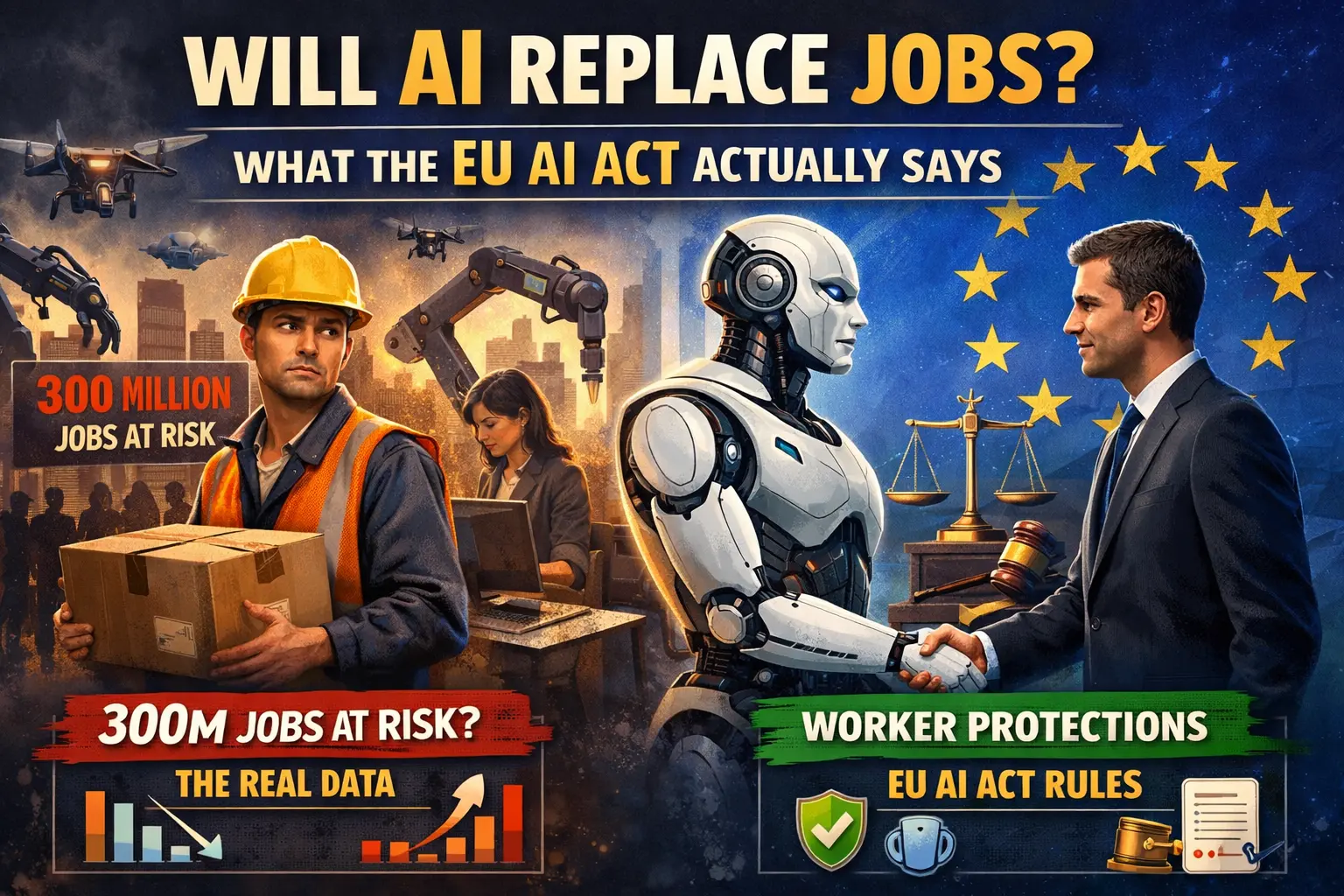
Will AI replace jobs? Goldman Sachs says 300 million jobs globally are exposed to automation. McKinsey estimates 30% of all work hours could be automated by 2030. The WEF’s Future of Jobs Report puts it at 92 million jobs displaced. These numbers are real, and they’re frightening enough to keep anyone up at night.
But here’s what gets lost in the panic: the EU AI Act — the world’s first comprehensive AI regulation — has specific worker protections that most people don’t know exist. Starting August 2, 2026, every AI system used in hiring, performance evaluation, or task allocation within the EU falls under high-risk obligations that fundamentally change how companies can deploy AI in the workplace.
I’ve been covering AI regulation for the past year, and the gap between what people fear about AI job loss and what the actual legal framework says is enormous. The data tells a more complicated story than “AI is coming for your job.” And the law tells a different story than most people realize.
The Real Numbers on AI Job Displacement
Let me lay out what the major reports actually say, because the headlines tend to cherry-pick the scariest number from each one.
Goldman Sachs estimates that 300 million jobs globally are “exposed” to AI automation. But “exposed” doesn’t mean “eliminated.” Their base case is that 6-7% of workers will actually be displaced during the transition period, with the timeline for widespread adoption at roughly 10 years. In the US specifically, AI could automate 25% of all work hours — meaning three-quarters of what people do still requires a human.
The WEF Future of Jobs Report 2025 estimates 92 million jobs displaced by 2030. But the same report projects 170 million new roles created, for a net increase of 78 million jobs. That’s not a small number. The problem isn’t total job loss — it’s the timing mismatch. The people losing jobs in 2026 aren’t necessarily the ones qualified for the roles being created in 2028.
McKinsey’s research frames it differently: up to 70% of office tasks could be automated, but 30% of work hours — not 30% of jobs. That distinction matters. A job with 30% automatable tasks doesn’t disappear. The person doing that job spends less time on repetitive work and more time on judgment, communication, and problem-solving.
| Source | Headline Number | What It Actually Means |
|---|---|---|
| Goldman Sachs | 300M jobs exposed | 6-7% of workers actually displaced over 10 years |
| WEF 2025 | 92M jobs displaced | Net gain of 78M jobs after 170M new roles created |
| McKinsey | 30% of work hours | Tasks automated, not jobs eliminated |
| Dallas Fed | Hiring suppression | Employers add AI instead of headcount, not firing existing staff |
The Dallas Federal Reserve research adds another angle: AI appears to be suppressing new hiring more than destroying existing jobs. Companies are integrating AI to avoid adding headcount rather than firing current employees. That’s a meaningful difference if you already have a job — and a real problem if you’re entering the workforce.
Which Jobs Are Actually at Risk?
Not every job faces the same level of exposure. The data breaks down by task type, not job title — and that distinction changes the conversation.
The industries with highest automation exposure, according to Goldman Sachs:
- Office and administrative support: 46% of tasks automatable
- Legal work: 44%
- Financial analysis: 37%
- Customer service: 41%
- Data processing: 38%
These are knowledge work categories where AI can read, summarize, draft, and analyze faster than humans. But “faster” doesn’t always mean “better.” Legal work involves judgment about ambiguity. Financial analysis involves interpreting context that changes by the hour. Customer service at its best requires empathy that AI demonstrably lacks.
Will AI Replace Accountants?
This question comes up constantly, so let me address it directly. The short answer: no, but the job is changing fast.
The Bureau of Labor Statistics projects 5% employment growth for accountants through 2034 — that’s 72,800 new positions plus 124,200 annual openings from retirements. Those aren’t numbers you’d see for a dying profession.
What is happening is task automation. According to Intuit QuickBooks, 98% of US accountants and bookkeepers reported using AI in their practice in 2024. The tasks being automated — data entry, invoice processing, reconciliations, basic reporting — are the ones most accountants describe as tedious anyway.
The measurable result: accounting firms using AI finish monthly statements 7.5 days faster and spend 8.5% less time on routine processing. Firms using generative AI saw a 12% rise in reporting granularity, according to Stanford GSB research. The job isn’t disappearing — it’s shifting toward advisory work, compliance interpretation, and strategic planning while AI handles the grunt work.
My honest take: if you’re an accountant who does nothing but data entry, you should be worried. If you’re an accountant who advises clients, interprets regulations, and makes judgment calls, AI just made you more productive.
What Jobs Are Safe From AI?
The roles most resistant to AI automation share common traits: they require physical presence, emotional intelligence, complex problem-solving in unpredictable environments, or some combination of all three.
Healthcare is the clearest safe zone. Nurse practitioners are projected to grow 45.7% by 2032 — the fastest growth rate of any major occupation. Doctors, therapists, and counselors all require human judgment in high-stakes situations where AI errors carry life-or-death consequences.
Skilled trades are growing 6% between 2022-2032, outpacing the overall labor market. Electricians, plumbers, and HVAC technicians work in physical environments that change constantly. An AI can design a wiring diagram, but it can’t crawl through an attic to install it. The aging infrastructure in the US and Europe and a growing shortage of skilled workers are actually making these roles more valuable, not less.
Education stays protected because teaching involves reading a room, adapting to individual students, and building relationships — tasks that current AI handles poorly. The same goes for counseling, social work, and personal coaching.
Creative work is more nuanced. AI can generate images, write copy, and compose music. But creative professionals who bring taste, cultural context, and a specific point of view aren’t easily replaced. The threat is to commodity creative work (stock photos, generic blog posts, template designs), not to work that requires genuine creative judgment.
| Risk Level | Roles | Why |
|---|---|---|
| Low risk | Nurses, therapists, skilled trades, teachers | Physical presence, emotional intelligence, unpredictable environments |
| Medium risk | Software developers, designers, managers | Augmented by AI but still need human judgment |
| Higher risk | Data entry, basic customer service, routine reporting | Repetitive cognitive tasks AI handles well |
What the EU AI Act Actually Says About Worker Protections
Here’s where this gets interesting and where most coverage falls short. The EU AI Act doesn’t just regulate chatbots and facial recognition. It classifies AI used in employment decisions as high-risk, and that classification triggers specific protections that take effect on August 2, 2026.
According to Crowell & Moring’s legal analysis, here’s what employers must do when deploying AI in the workplace:
First, worker notification is mandatory. Before implementing any high-risk AI system in the workplace — whether it’s a screening tool for hiring, a performance evaluator, or a task allocation system — employers must inform workers and their representatives. You can’t quietly introduce AI and tell people after the fact.
Second, human oversight has to be real, not performative. The law requires that humans with “appropriate competence, training, authority, and support” oversee high-risk AI systems. They need the actual ability to intervene and override AI outputs. A rubber stamp process where someone clicks “approve” on every AI recommendation without review doesn’t satisfy this requirement.
Third, discrimination monitoring is required. Employers must actively monitor for bias and adverse impacts. If issues arise, they’re obligated to suspend the AI system and notify the relevant authorities. This matters especially for AI hiring tools, which multiple studies have shown can amplify existing biases in training data.
And finally, employee consultation isn’t optional. Article 26(7) of the AI Act requires that employee representatives be consulted before AI systems are introduced in the workplace. In most EU member states, this means works councils and unions get a formal say in whether and how AI gets deployed.
The August 2026 Deadline: What Changes
By August 2, 2026, every AI system classified as high-risk in the employment context must have:
- Mandatory risk assessments documenting potential impacts on workers
- Technical documentation explaining how the AI makes decisions
- Bias testing conducted before and during deployment
- Human oversight protocols with actual authority to override
- Transparency disclosures telling affected workers how AI is being used
- Continuous monitoring with documented processes for issue response
This applies to AI used in recruitment and hiring, performance evaluation, promotion decisions, task allocation and workload management, and termination decisions.
Companies that don’t comply face fines of up to €35 million or 7% of global annual revenue — whichever is higher. For a company like Amazon or Google, that’s billions.
What the EU AI Act Doesn’t Cover
I should be honest about the gaps. The Next Web’s analysis points out that the AI Act doesn’t directly address job displacement itself. It regulates how AI is used in employment decisions, but it doesn’t mandate retraining programs, require companies to keep employees whose roles are automated, or set limits on how much of a workforce can be replaced by AI.
The law protects workers from unfair AI-driven decisions. It doesn’t protect workers from AI making their roles redundant. Those are different problems requiring different solutions. Future amendments may address workforce displacement more directly, but that’s unlikely to happen before 2028 at the earliest.
The Digital Omnibus could also push some high-risk deadlines to 2027, creating more uncertainty for companies trying to plan their compliance timelines.
What You Should Actually Do
Whether you’re a worker worried about AI replacing your job or a business figuring out compliance, here’s what the data supports:
For individual workers, focus on the tasks AI can’t do well — complex judgment, relationship building, creative problem-solving, and work that requires physical presence. The BLS data shows that roles combining these skills are growing, not shrinking. If 30% of your current tasks are repetitive cognitive work, learn to use AI tools to automate those tasks yourself before someone decides to automate your entire role.
If you’re in accounting or finance, you’re not being replaced. But the accountant who uses AI to process data in minutes instead of hours will outcompete the one who doesn’t. Get comfortable with AI tools now. The profession is shifting from compliance processing to strategic advisory, and the firms that move fastest will capture the most value.
For EU employers, August 2, 2026 is four months away. If you’re using AI in any employment decision — and most large companies are, even if they don’t realize it — you need risk assessments, documentation, and oversight protocols in place. The AI governance framework isn’t optional anymore.
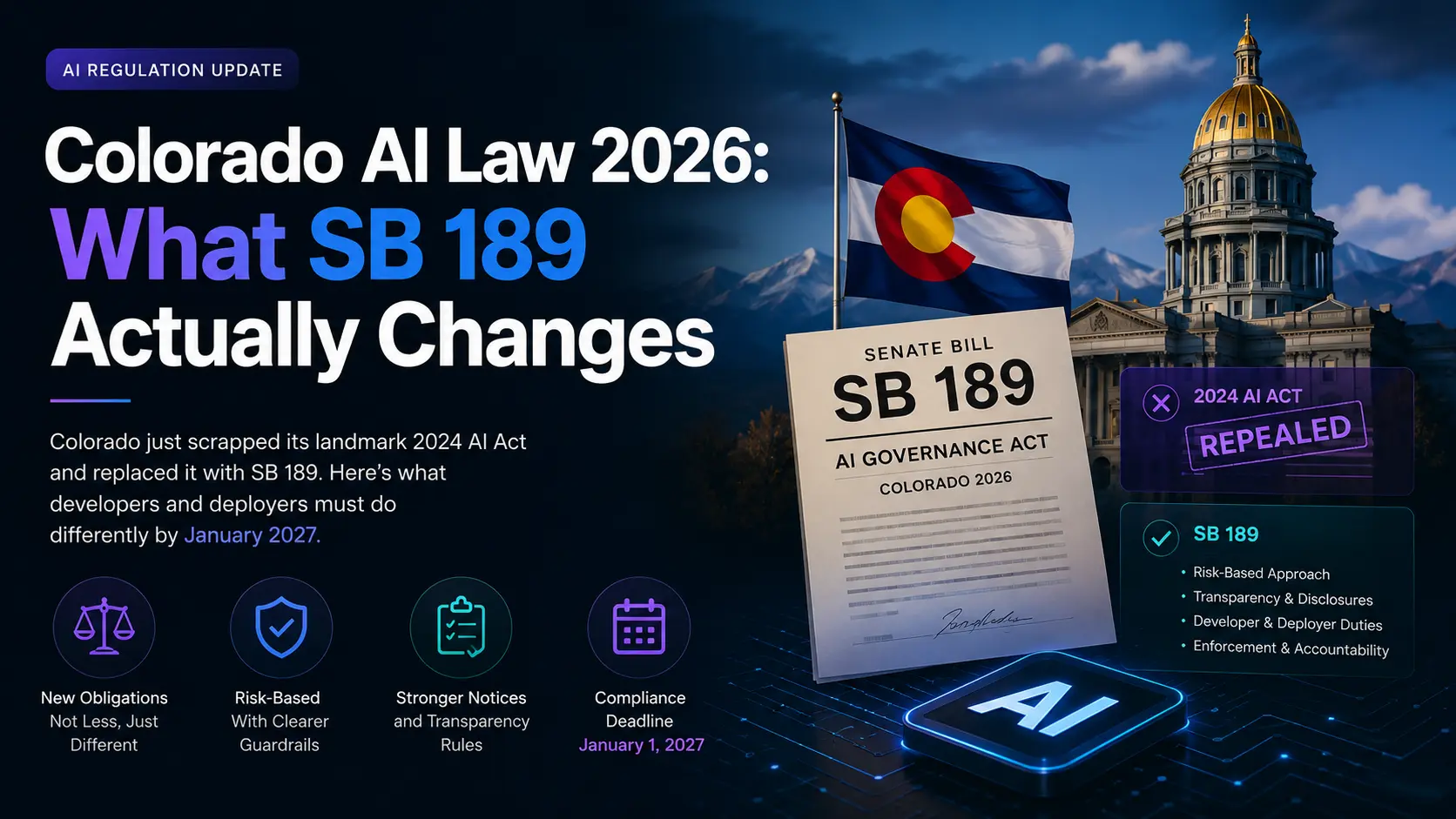
And if you’re outside the EU, the AI Act still affects you if you serve EU customers or have EU employees. Japan is moving toward similar regulation, with the US moving faster at state level than federally. Connecticut just passed one of the most comprehensive US state AI laws, with employer obligations for AI hiring tools starting October 1, 2026. Building compliant AI practices now saves you from scrambling later.
The Bottom Line
The fear that AI will replace all jobs is overblown. The dismissal that AI won’t change anything is naive. The truth is uncomfortable because it’s specific: AI will automate 25-30% of tasks across most knowledge work roles, it will make some roles redundant while creating others, and the transition will be painful for people who can’t or don’t reskill.
The EU AI Act gives workers in Europe a floor of protection that doesn’t exist anywhere else. Whether you think those protections go far enough depends on your perspective, but they’re a starting point — and they’re enforceable starting August 2, 2026.
I keep coming back to the Dallas Fed research because it frames the near-term reality most accurately: companies are using AI to avoid hiring, not to fire people. If you’re employed, you have time to adapt. If you’re entering the workforce, you need to target roles that combine human judgment with AI fluency. And if you’re running a business, the compliance clock is ticking.