Key takeaways (May 17, 2026)
- Connecticut SB 5 is the state’s flagship AI legislation, modelled in part on Colorado’s framework.
- As of May 2026, compliance preparation focuses on impact assessments and consumer notice for consequential decisions.
- Penalty exposure runs through the Attorney General’s office under the Connecticut Unfair Trade Practices Act.
- Vendors selling to CT-based businesses should expect contractual flow-down of obligations.
Connecticut just passed one of the most comprehensive AI laws in the United States. The Connecticut Artificial Intelligence Responsibility and Transparency Act — Senate Bill 5 — cleared the state legislature on May 5, 2026, with margins that signal genuine bipartisan consensus: 131–17 in the House, 32–4 in the Senate. Governor Ned Lamont has confirmed he plans to sign it.
What I find most significant about SB 5 is not any single provision, but the scope. Most US state AI bills pick one target — hiring algorithms, deepfakes, chatbot disclosures. Connecticut did all of them in one package, then added frontier model safety requirements that push into EU AI Act territory. If you build, deploy, or use AI in employment contexts, this law almost certainly touches you.
Here is what every developer and enterprise team needs to understand before October 1, 2026.
What Connecticut Actually Passed
The bill’s formal name — the Artificial Intelligence Responsibility and Transparency Act — telegraphs its two core pillars: responsibility for how AI systems are used, and transparency about when they are being used at all.
According to the Connecticut General Assembly’s bill record, SB 5 covers five distinct areas:
- Automated employment decision technology — covering hiring, promotion, discipline, and termination
- Synthetic content provenance requirements for large generative AI providers
- Safety obligations for frontier model developers training above the 10²⁶ floating-point operations threshold
- Disclosure requirements for subscription-based AI services
- Rules for AI companion applications, including risk detection for vulnerable users
The law also creates two new state institutions: an Artificial Intelligence Policy Office and an AI Learning Laboratory Program. The laboratory functions as a regulatory sandbox — companies can test new AI products in a controlled environment without immediately triggering full compliance obligations.
This is not a narrow chatbot disclosure bill. I have spent time working through the EU AI Act compliance literature, and SB 5’s structural similarities to that framework are deliberate. Connecticut is the closest thing the US has to a state-level risk-based AI framework, and it took effect faster than the EU ever moved.
The Employment AI Provisions: Highest Stakes for Most Businesses
The employment section of SB 5 will affect the widest range of organizations. If you use software to screen job applications, rank candidates, evaluate performance, or inform promotion, discipline, or termination decisions, you are in scope.
What Developers Owe Deployers
If you build AI tools that might be used in employment decisions, SB 5 places specific obligations on you before deployers — the employers using your product — can fulfill their own obligations. Freshfields’ analysis of SB 5 notes that developers must provide deployers with sufficient information to meet their compliance requirements, unless the tool was not marketed or intended to materially influence employment decisions.
Specifically, developers must share:
- What the tool does and how it is intended to be used
- What data categories the tool uses
- Known limitations and inappropriate use cases
- Training data information
Developers and employers can contractually allocate these compliance responsibilities, but those allocations must be in writing. Verbal agreements do not satisfy the law.
What Deployers Owe Employees and Applicants
On the employer side, the obligations are disclosure-heavy. Where an AI tool is used as a “substantial factor” in a hiring, promotion, discipline, or termination decision, the employer must:
- Notify the affected person that AI was used
- Explain the purpose of the tool
- Identify what data categories and sources the tool drew on
- Provide information on how to appeal if discrimination is suspected
The provision that most legal teams will want to flag immediately: using an AI tool is explicitly not a defense against employment discrimination claims. If your hiring algorithm screens out protected-class members at disproportionate rates, the fact that a machine made the call does not reduce liability. Connecticut’s anti-discrimination statutes are amended directly to state this.
Developer disclosure obligations begin October 1, 2026. Deployer notice obligations to employees begin one year later, on October 1, 2027 — a deliberate lag to give employers time to build the required processes. But do not read the 2027 deployer date as permission to start preparation late. The developer-facing obligations in 2026 will require your documentation to be ready before the product ships.
Synthetic Content Watermarking
Any generative AI provider with more than one million monthly users must embed provenance data into audio, image, or video content their systems generate or materially alter. This applies to any content that could be mistaken for authentic human-created material.
The watermarking requirement creates a machine-readable record of origin — a technical disclosure rather than a consumer-visible label. The CT Mirror’s reporting on SB 5’s passage notes this aligns Connecticut with the EU AI Act’s transparency obligations for AI-generated content, which require disclosures when AI systems produce material that could deceive users about its origin.
The one-million user threshold matters. Small generative AI startups are not immediately in scope. But any company operating a major consumer AI product in the US — image generators, AI video tools, voice synthesis platforms — will almost certainly clear it.
Building machine-readable content provenance into a production pipeline at scale is a non-trivial engineering project. Teams that are just beginning that work now are already behind for the eventual effective date.
Frontier Model Safety Rules
This provision drew the most attention from the AI researchers and legal teams I spoke with while covering this story. SB 5 targets developers training foundation models using more than 10²⁶ floating-point operations — a compute threshold that currently applies to only a handful of organizations globally.
These frontier developers must:
- Protect employees who report concerns that the model may contribute to catastrophic risk
- Establish an anonymous internal reporting process by January 1, 2027
- Operate under a definition of catastrophic risk that specifies events causing death or serious injury to 50 or more people, or $1 billion or more in property damage, triggered by CBRN assistance, autonomous cyberattacks, or autonomous criminal conduct
The whistleblower protections here echo provisions in the EU AI Act for general-purpose AI models with systemic risk — the logic being that the people closest to a model’s development have the clearest view of its potential for harm. Connecticut is codifying into state law what safety researchers have argued for years should be standard practice inside frontier labs.
If you are tracking this against the EU AI Act’s GPAI provisions, note the threshold difference. The EU baseline for general-purpose AI documentation is 10²⁵ FLOP. Connecticut’s threshold is one order of magnitude higher, effectively limiting the frontier provision to the very top tier of labs. That narrowing was probably deliberate — it reduces industry opposition while still addressing the highest-risk systems.
AI Companion Restrictions
SB 5 includes specific rules for AI companion applications — conversational AI systems designed to form ongoing relationships with users rather than complete discrete tasks. According to legal analysis from Shipman & Goodwin LLP, the companion restrictions have two main components:
Mental health detection: AI companion providers must implement processes to detect users who may be at risk of suicide or self-harm, and must provide appropriate resources or referrals.
Minor protections: There are restrictions on AI companions interacting with minors, including disclosure requirements and content limitations.
The context here is a growing body of litigation around AI companion applications and documented mental health harms. Connecticut is not banning these products. It is requiring that developers who build them accept duty-of-care obligations toward vulnerable users — a meaningful shift in how the law treats AI systems that form emotional relationships.
Key Dates: When Each Provision Hits
| Provision | Effective Date |
|---|---|
| Developer disclosure obligations for employment AI | October 1, 2026 |
| Frontier developer whistleblower protections | October 1, 2026 |
| WARN Act AI/technology-change disclosure requirement | October 1, 2026 |
| ”AI is not a defense” amendments to anti-discrimination statutes | October 1, 2026 |
| Deployer notice obligations to employees/applicants | October 1, 2027 |
| Frontier developer anonymous internal reporting process | January 1, 2027 |
| AG 60-day cure period ends | December 31, 2027 |
October 1, 2026 is less than five months away. That is tight for companies that have not already started documentation processes for their AI hiring tools.
How Connecticut Compares to Other State AI Laws
SB 5 does not exist in isolation. At least a dozen US states are advancing AI legislation in 2026, each with different scope and emphasis. Here is where the major active efforts stand:
| State | Law/Bill | Primary Focus | Status (as of May 7, 2026) |
|---|---|---|---|
| Connecticut | SB 5 (AIRT Act) | Employment, synthetic content, frontier models, AI companions | Passed legislature, awaiting signature |
| Colorado | SB 205 + SB 189 | High-risk AI in consequential decisions | SB 189 pushes SB 205 start to Jan 2027; replacement bill under debate |
| Oklahoma | SB 1521 | AI chatbot disclosures | Passed House, returning to Senate for concurrence |
| Hawaii | SB 3001 | Employment and healthcare AI | Conference committee agreed, chambers voting |
| Michigan | SB 760 | Deepfakes, election integrity | Passed Senate 20–17 |
| New York | S 9051, S 8623 | Automated employment decisions; algorithmic pricing | In committee |
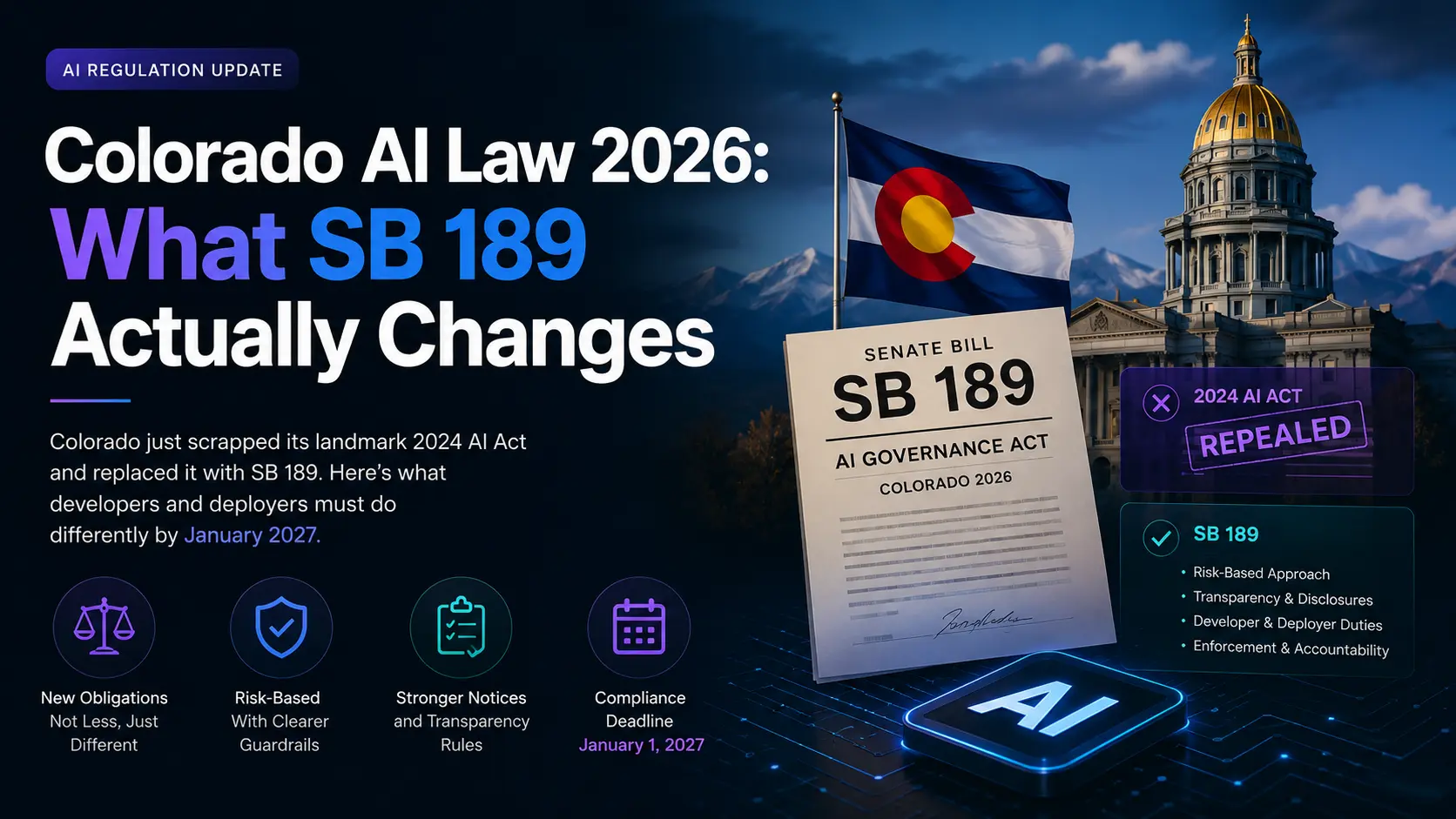
Colorado’s trajectory is the most instructive comparison. Colorado SB 205 — passed in 2024 — was one of the first comprehensive US AI frameworks, imposing broad risk management and impact assessment obligations. It faced sustained industry opposition, a lawsuit from xAI, and DOJ involvement, and in May 2026 the legislature passed SB 189, a replacement law that strips out duty-of-care and impact assessments entirely in favor of a simple disclosure-only regime. Connecticut’s drafters learned from that experience: SB 5 is more targeted, with clearer thresholds and phased rollout dates that give companies time to adapt.
The bipartisan margins in Connecticut — no small thing in 2026 — suggest that its drafters found a balance the tech industry was willing to live with. Colorado never achieved that.
What I’m Telling Clients Right Now
The most common question I get when a new AI law passes is: “Does this apply to us?” Here is my working framework for SB 5:
If you sell AI hiring tools: Begin your developer disclosure package now. You need documentation covering tool purpose, data categories, known limitations, and intended use cases — all in writing, available to deployers by October 1, 2026. Six months sounds like plenty of time until you account for legal review cycles.
If you use AI in HR decisions: Audit every tool in your stack that touches hiring, promotion, discipline, or termination. If any are “substantially influencing” those decisions, you need a disclosure process in place by October 1, 2026 and a full employee-facing notice process by October 1, 2027. Start the audit before legal spends three months debating whether specific tools qualify.
If you train frontier models above 10²⁶ FLOP: The threshold almost certainly does not apply to your organization unless you are one of five or six labs globally. But the whistleblower protection provisions are worth reviewing as internal policy regardless — they reflect what good governance looks like for any serious AI development program.
If you run a consumer generative AI platform: If you are near or above one million monthly users, start the provenance and watermarking engineering work. The content provenance requirement is technically demanding at scale — it is not a configuration change.
The AG’s 60-day cure period through December 2027 provides some breathing room on enforcement. Relying on that as your compliance plan is a mistake. The cure period is discretionary, not guaranteed, and the reputational cost of an AG investigation in a US state is its own problem independent of whether you ultimately face a fine.
For teams tracking parallel international obligations, the EU AI Act 2026 enforcement update covers how European regulators are approaching their first compliance wave — the patterns are instructive even for US-focused teams. If you operate in both markets, the EU AI Act Digital Omnibus delay matters here: Connecticut’s October 2026 date may arrive before several revised EU timelines.
Broader AI governance strategy — the kind that makes compliance documentation less painful because the underlying processes already exist — is covered in the seven-strategy AI governance framework. The SB 5 compliance requirements map almost directly to what good governance looks like anyway. If you are building that infrastructure in response to this law, you are building it right.
The developer-specific obligations under SB 5 also connect to a broader ethical and legal framing covered in our piece on developer responsibility in generative AI. And if you are tracking how AI intersects with employment and labor law more broadly, what the EU AI Act says about worker protections gives useful comparative context for what Connecticut is attempting at the state level.
What Comes Next
Connecticut SB 5 will not be the last comprehensive US state AI law to pass in 2026. The bipartisan margins — 131–17 in the House — signal that AI regulation is becoming politically popular, not just technically necessary.
The federal picture remains murkier. The White House signaled intent to act on AI regulation on May 3, but federal AI legislation has stalled repeatedly over two years. State laws are filling that vacuum.
My read: Connecticut’s employment AI framework is replicable and will be copied. Developer disclosure to deployer, deployer disclosure to employee, AG enforcement with cure period — that structure is clean enough that other states will adopt it. I expect New York and New Jersey to move similar frameworks within 18 months.
The question is not whether AI compliance obligations are coming. It is whether your documentation, disclosure, and governance infrastructure is ready when they arrive.
Related AI Insights
- EU AI Act 2026: Enforcement Updates and Compliance Deadlines
- Japan AI Regulation 2026: What the Policy Shift Means for Developers
- 7 Strategies for an Effective AI Governance Framework in 2026
- Will AI Replace Jobs? What EU AI Act Worker Protections Actually Say
- UK AI Regulation News Today
- Colorado AI Law 2026: What SB 189 Actually Changes