Key takeaways (May 17, 2026)
- By May 2026, leading platforms (GitHub Actions, GitLab Duo, CircleCI) ship native AI agents for CI/CD triage and remediation.
- Autonomous merge bots still require gated approval policies — most production teams cap autonomy at PR drafting and test repair.
- Anthropic Claude and OpenAI Codex remain the most-used backend models for code-aware CI agents as of May 2026.
- The practical bottleneck is observability and rollback, not model capability.
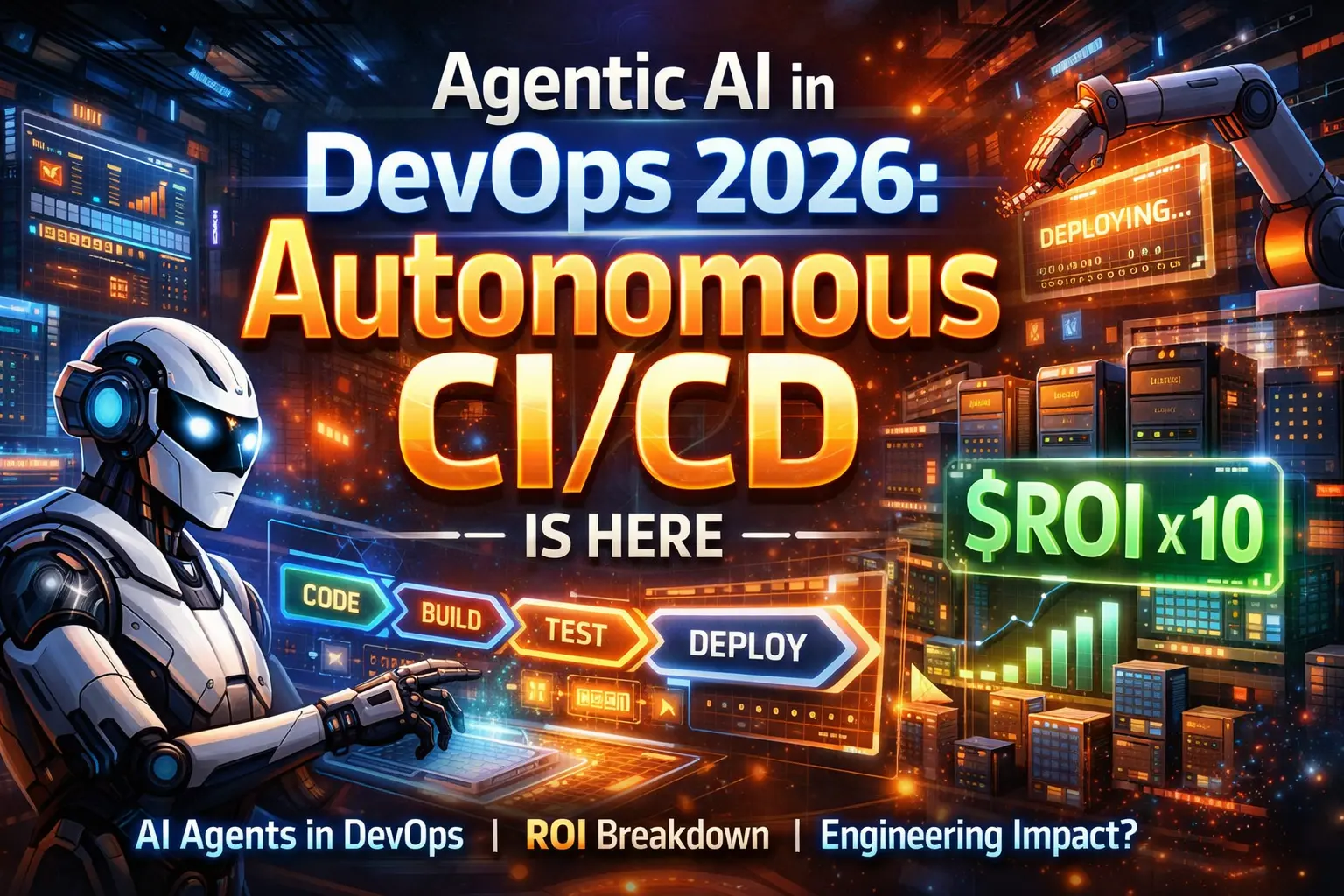
Agentic AI in DevOps is no longer a conference-talk concept. In 2026, autonomous agents are making real deployment decisions, triaging production incidents in under four minutes, and reviewing infrastructure-as-code changes before any human clicks “approve.” I’ve spent the past several months watching this shift happen across engineering orgs of varying sizes, and the gap between teams that adopted agent-driven pipelines and those still running static YAML is getting uncomfortable.
This isn’t about adding a chatbot to your Slack channel that summarizes alerts. It’s about agents that receive a PagerDuty alert at 2am, pull the relevant logs from Datadog, identify DynamoDB write throttling as the root cause, and roll back the offending deployment — all while you sleep. AWS demonstrated exactly this scenario with their DevOps Agent in early 2026.
Let me walk through what’s actually working, what’s hype, and what engineering leaders need to know.
Why DevOps is the perfect target for agentic AI
DevOps was always about automation. But there’s a difference between automation and autonomy. Traditional CI/CD pipelines execute a static sequence: build, test, deploy. The pipeline doesn’t care if your staging environment is on fire or if the last three canary deployments failed. It follows the YAML.
Agentic AI adds a decision layer that traditional pipelines never had. An agent evaluates test results, checks production metrics, considers deployment risk, and then decides whether to proceed, pause, or roll back. It can switch between canary, blue-green, or rolling update strategies based on real-time system health — not a hardcoded config file someone wrote six months ago. OpenAI’s planned Ona acquisition shows why persistent, policy-controlled environments matter for long-running coding agents.
Gartner put a number on this shift: 40% of enterprise applications will include task-specific AI agents by the end of 2026, up from less than 5% in 2025. For infrastructure operations specifically, Gartner projects 70% enterprise deployment of agentic AI by 2029.
The numbers are moving fast. And DevOps, with its well-defined workflows and measurable outcomes, was always going to be first.
The three use cases that actually work in production
I keep hearing about dozens of agentic DevOps use cases, but in my observation, three are generating real production value right now. Everything else is still mostly proof-of-concept.
1. Autonomous incident response
This is the killer app. An agent receives an alert, analyzes logs, identifies the root cause, and triggers countermeasures — pod restarts, config rollbacks, scaling adjustments. AWS’s DevOps Agent demonstrated autonomous diagnosis of a production incident in four minutes flat, without human intervention.
Enterprises running agentic AIOps report 3x faster mean time to resolution (MTTR) and roughly 30% savings on SRE headcount. When I talked to an SRE lead at a mid-size fintech company last month, she told me their agent handles about 60% of P3/P4 incidents end-to-end now. P1 and P2 still go to humans, but the agent does the initial triage and suggests a remediation path.
That’s the pattern I see everywhere: agents handling the routine so humans can focus on the complex.
2. AI-powered code review and IaC analysis
Agents checking Terraform plans for security risks, cost implications, and best-practice deviations before a human triggers the apply. This isn’t a linter. It’s an agent that understands context — it knows your team’s previous decisions, your compliance requirements, and your cost targets.
I set up a CrewAI-based review agent for a side project’s Terraform configs, and it caught an overly permissive IAM policy that my manual review missed entirely. Small sample size, sure, but it tracked with what I’m hearing from larger teams.
3. Self-healing infrastructure
Agentic systems that predict issues, prevent failures, and self-heal — handling scaling, optimization, patching, and configuration through predictive analytics. The distinction from traditional auto-scaling is that these agents learn from historical patterns. They don’t just react to CPU hitting 80%; they predict the traffic spike based on last Tuesday’s pattern and pre-scale fifteen minutes before it happens.
Agentic AI in DevOps: the enterprise adoption reality
The adoption statistics paint a complicated picture. On one hand, 72-79% of enterprises are testing or deploying agentic AI systems. On the other, only about one in nine actually runs them in production. That gap tells you something important: most organizations are still figuring out governance, not technology.
Deloitte’s research found that 84% of organizations investing in AI report gaining ROI, and over 95% expect moderate to significant value increases. But IBM’s 2025 CEO Study offered a reality check: only 25% of AI initiatives delivered the expected ROI. The truth sits somewhere between the optimists and the skeptics.
Here’s the number that gets CFOs to pay attention: enterprises deploying agentic AI in DevOps report an average ROI of 171%, roughly three times that of traditional automation. US enterprises reach up to 192%. That’s not a hypothetical projection — it comes from production deployments where agent-driven incident response and code review reduced downtime and caught issues that would have cost real money.
But there’s a catch. Gartner warns that over 40% of agentic AI projects risk cancellation by the end of 2027 if governance, observability, and ROI clarity aren’t established. Deloitte’s 2026 report found that only 1 in 5 companies has a mature governance model for autonomous agents. That means 80% are deploying agents without the infrastructure to manage them safely at scale.
Bounded autonomy: the model that’s actually working
Every successful production deployment I’ve seen follows the same pattern: bounded autonomy. The agent operates within clearly defined guardrails, with automatic escalation for novel or high-stakes decisions.
Here’s what that looks like in practice:
- Sandbox-first execution: the agent proves a fix in a twin environment before touching production
- Allowlisted tools: the agent can only call specific APIs and execute specific actions
- Step and cost caps: reasoning loops have hard limits on iterations and API spend
- RBAC and audit logs: every action is logged, every decision is traceable
- Human checkpoints: critical changes (production deployments, data migrations, security-sensitive operations) require human approval
The World Economic Forum emphasized this approach in their March 2026 governance guidelines: governance is key for AI agents. Forrester predicts 60% of Fortune 100 companies will appoint a dedicated head of AI governance in 2026.
I think of it this way: the agent is a junior contractor with a clearly scoped task. You don’t give a junior contractor the root password and say “fix everything.” You give them specific access, specific goals, and check their work. Same principle applies here.
Frameworks powering agentic DevOps in 2026
Three framework categories dominate production deployments: orchestration frameworks, the Model Context Protocol, and cloud-native agent platforms. Here’s how they compare.
Agentic AI DevOps framework comparison
| Framework | Architecture | DevOps strength | Setup complexity | MCP support | Production readiness |
|---|---|---|---|---|---|
| LangGraph | Directed graph with conditional edges | Fine-grained pipeline control, complex workflows | High (~60+ lines for basic agent) | Mature | High — used in enterprise pipelines |
| CrewAI | Role-based crews with process types | Fast multi-agent setup, incident response teams | Low (~20 lines) | Native (v1.10+) | High — 12M+ daily executions |
| AutoGen | Multi-agent conversation | Complex reasoning chains, code generation | Medium | Growing | Medium — strong for research |
| AWS Bedrock Agents | Managed cloud service | Native AWS integration, incident response | Low | Via tooling | High — production-grade |
| Azure AI Foundry | Managed cloud service | Azure/GitHub ecosystem integration | Low | Via tooling | High — enterprise SLAs |
| Google Vertex AI Agents | Managed cloud service | GCP-native, BigQuery integration | Low | Via tooling | High — enterprise SLAs |
LangGraph: maximum control for complex pipelines
LangGraph uses a bottom-up state machine model. You define nodes (functions that transform state), edges (including conditional edges), and a typed state object. It gives you explicit control over every state transition in your pipeline.
For DevOps, this means you can build an agent that routes differently based on incident severity, test results, or deployment environment — all as explicit graph logic rather than prompt engineering. The tradeoff is verbosity: roughly 60+ lines of code for a basic agent versus CrewAI’s 20.
CrewAI: rapid multi-agent orchestration
CrewAI takes a different approach. You define agents with roles (“incident responder,” “code reviewer,” “deployment manager”), assign them tasks, and let the framework handle coordination. As of March 2026, CrewAI sits at 45,900+ GitHub stars and v1.10.1, with native MCP and A2A (Agent-to-Agent) communication support.
I’ve found CrewAI faster to prototype with, especially for incident response scenarios where you want multiple specialized agents working in parallel. The role-based abstraction maps naturally onto DevOps team structures.
Model Context Protocol: the connector layer
MCP isn’t an orchestration framework — it’s the standardized protocol that lets agents connect to external tools. Think of it as USB-C for AI agents. Instead of writing custom integrations for every monitoring tool, every cloud provider, and every CI system, you implement MCP once and any MCP-compatible agent can use your tools.
All major orchestration frameworks added MCP support in 2026, with LangGraph and AutoGen having the most mature implementations. Anthropic’s design decision to make MCP an open protocol was smart — it removed the vendor lock-in fear that was slowing enterprise adoption.
Multi-agent orchestration: the 2026 pattern
The single-agent model is already giving way to multi-agent systems. Both Forrester and Gartner see 2026 as the breakthrough year for multi-agent coordination, where specialized agents collaborate under central orchestration.
In DevOps, this looks like:
- A monitoring agent watches production metrics and detects anomalies
- A triage agent receives alerts and performs root cause analysis
- A remediation agent executes fixes within its bounded permissions
- A communication agent updates Slack, creates tickets, and notifies on-call engineers
- A review agent checks that the fix didn’t introduce new issues
Each agent has scoped access and scoped responsibility. The orchestrator (typically LangGraph or CrewAI) manages handoffs between them. When something exceeds any agent’s scope, it escalates to a human.
This mirrors how high-performing DevOps teams already work. Specialists with clear ownership areas, well-defined handoff protocols, and escalation paths. The multi-agent approach just automates the coordination layer.
What I’m actually worried about
I’ve been following agentic AI closely throughout 2026, and a few things keep me up at night.
The governance gap is real. Only 20% of companies deploying agents have mature governance models. That other 80% is flying blind. When an agent makes a bad deployment decision at 3am, who’s accountable? If the audit log is incomplete, how do you do a post-mortem?
Agent sprawl is coming. We went from one chatbot to dozens of agents across different teams, each with different frameworks, different permission models, and different logging standards. This is the microservices complexity problem all over again, except the services make their own decisions.
Testing is hard. How do you test an agent that makes context-dependent decisions? Unit tests check deterministic outputs. Agent behavior is stochastic. I’ve seen teams build elaborate simulation environments just to validate their incident response agents, and even then, production surprises happen.
Cost management is tricky. Reasoning loops burn tokens. An agent stuck in a diagnostic loop at 2am can rack up serious API costs before anyone notices. Hard caps help, but they also risk killing the agent mid-diagnosis during a real incident. This is exactly why GitHub Copilot’s June 2026 token billing switch is such a wake-up call — it makes per-session compute costs visible in a way flat subscriptions never did.
How to get started without getting burned
If you’re an engineering leader considering agentic DevOps, here’s the path I’d recommend based on what I’ve seen work:
Start with incident triage, not deployment. Log analysis and root cause identification are ideal first agent tasks. The failure domain is manageable, the agent doesn’t execute destructive actions, and the value is immediately measurable (reduced MTTR).
Pick one framework and commit. If you need maximum control, go with LangGraph. If you want speed, start with CrewAI. Don’t try to evaluate all six options simultaneously — analysis paralysis is the biggest blocker I see.
Implement bounded autonomy from day one. Sandbox environments, allowlisted tools, step caps, and human approval for anything touching production. This isn’t optional.
Measure everything. Track MTTR before and after. Track false positive rates. Track cost per agent action. Without data, you can’t justify continued investment — and remember that 40% cancellation rate.
Invest in AI coding agents for your DevOps tooling itself. The meta-move: use AI coding agents to build and iterate on your DevOps agents faster.
What comes next
By late 2026, I expect the production adoption gap to close significantly. Cloud-native platforms (AWS Bedrock, Azure AI Foundry, Google Vertex) are eliminating the infrastructure complexity that kept smaller teams out. MCP adoption is reducing the integration burden. And the governance frameworks are maturing, with CIO leaders and Forrester pushing for dedicated AI governance roles.
The shift from “do what I say” to “decide what’s best” is happening. The engineering teams that figure out bounded autonomy — clear guardrails, measurable outcomes, human oversight for the critical path — will pull ahead. The ones that either over-trust their agents or refuse to deploy them at all will fall behind.
DevOps has always been about reducing the friction between writing code and running code. Agentic AI is the next layer of that reduction. Just don’t mistake it for magic. It’s a junior contractor with excellent pattern recognition and zero institutional knowledge. Treat it accordingly.