Key takeaways (May 17, 2026)
- The UK maintains a sector-led, principles-first approach as of May 2026 rather than EU-style horizontal law.
- The AI Safety Institute is the central evaluation body; sector regulators (Ofcom, FCA, ICO) implement.
- Voluntary commitments from frontier-model providers remain the main framework.
- A statutory bill remains under discussion; expected to be lighter-touch than the EU AI Act.
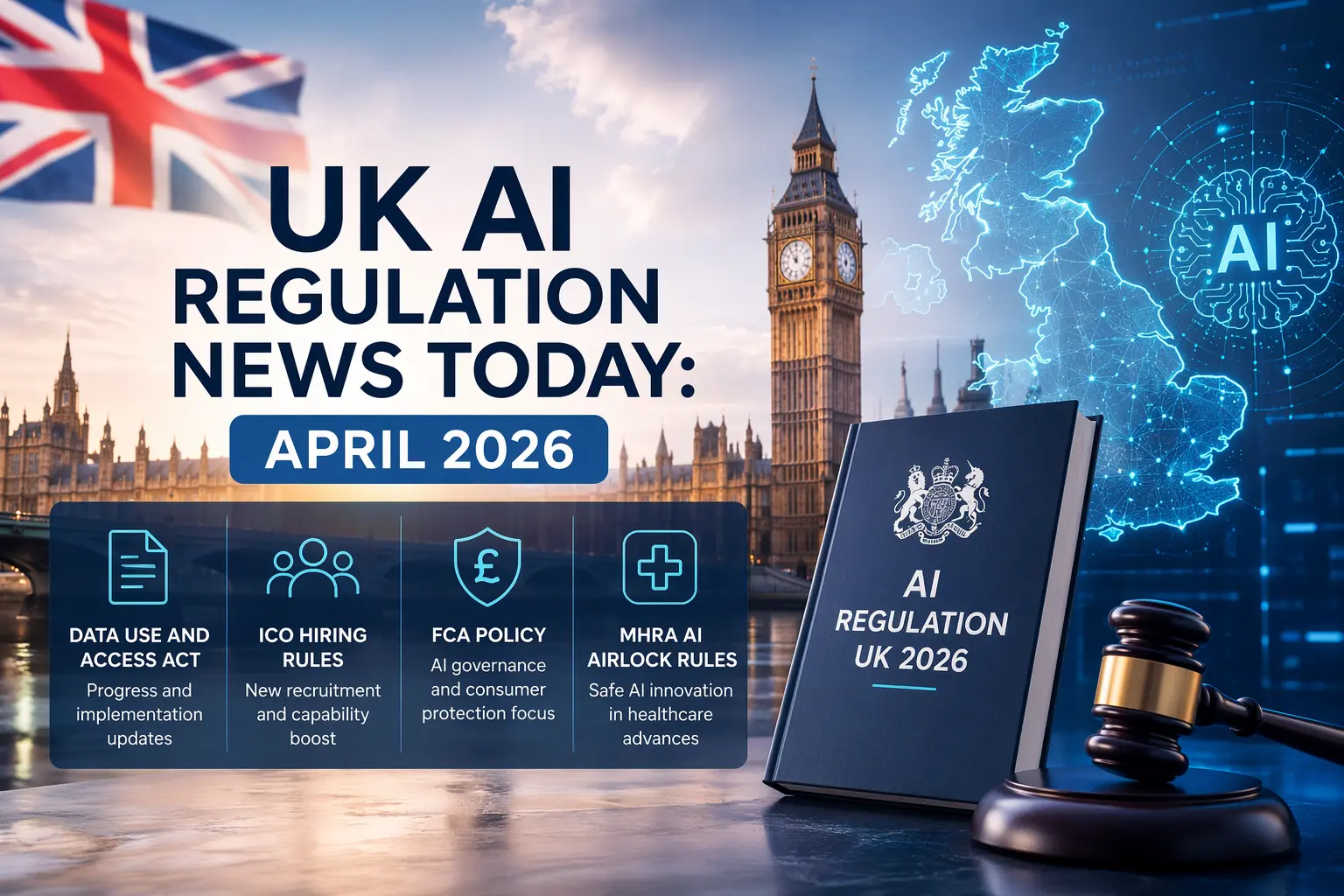
UK AI regulation news today starts with one fact a lot of people still miss: as of April 20, 2026, the UK still does not have a single, EU-style AI Act. What it has instead is a live patchwork of regulator action, data-law changes, healthcare sandbox work, and government industrial policy that is moving faster than the headlines suggest.
I’ve spent the last few hours going through the official updates, not recycled summaries, and the picture is pretty clear. Britain is still backing a regulator-led model. That means the story is not “Parliament passed a giant AI law.” The story is that the Data Use and Access Act 2025 changed the rules around automated decisions, the ICO is tightening expectations for AI hiring tools, the FCA is sticking to existing financial rules instead of new AI ones, and the MHRA is putting more money into regulated testing for AI medical devices.
If you’re trying to understand what is actually enforced in the UK right now, what changed recently, and what to do next, this is the version worth reading.
The short answer on UK AI regulation
The UK is still using the same broad model it laid out in its 2023 white paper: a principles-led, pro-innovation approach enforced through existing regulators rather than a brand-new AI regulator or one cross-economy AI statute. The government repeated that position in its May 1, 2024 regulators’ strategic approaches to AI update, which says the framework is being delivered through the UK’s existing regulators.
That sounds abstract, so here’s the practical version.
| Area | Latest official position | What it means for companies |
|---|---|---|
| Cross-economy policy | No UK AI Act yet | You cannot wait for one master law to tell you what to do |
| Data and automated decisions | DUAA changed UK GDPR rules | Automated decisions are easier to run, but only with safeguards |
| Hiring and workplace tools | ICO is actively warning employers | AI recruitment systems are a live compliance risk now |
| Financial services | FCA will use existing rules | Firms still face scrutiny, just through current conduct frameworks |
| Healthcare | MHRA is expanding AI Airlock | Medical AI is getting more regulator attention, not less |
| Frontier model safety | AI Security Institute remains active | The UK still treats advanced-model risk as a policy priority |
If you’ve read our EU AI Act deadline tracker or the deeper breakdown of EU AI Act enforcement in 2026, the contrast is obvious. Brussels built a central statute with named risk classes and direct penalties. London is still letting sector regulators do the heavy lifting.
What changed most recently
Three recent developments matter more than the rest.
First, the government used its January 29, 2026 progress report on the AI Opportunities Action Plan: One Year On to show how much of the UK’s AI agenda is now tied to industrial policy, not just risk management. That report says the government has met 38 of the plan’s 50 actions. It also says the UK has designated five AI Growth Zones, generated £28.2 billion in investment, created more than 15,000 jobs, and will launch the next phase of the Sovereign AI Unit in April 2026 backed by up to £500 million.
Second, the data law side moved from theory to operational reality. The Data Use and Access Act 2025 commencement plan shows that the majority of the Act’s Part 5 data protection provisions came into force on February 5, 2026. That matters because these are the rules that now shape how UK organisations can use automated decision-making.
Third, regulators have stopped being vague. On March 31, 2026, the ICO published a clear warning on automated hiring decisions. On April 8, 2026, the MHRA announced new long-term funding for AI Airlock. And the FCA’s February 13, 2026 update says outright that it does not plan extra AI regulations and will instead rely on existing frameworks. That is not a placeholder position anymore. That is the live model.
The Data Use and Access Act is the most important legal update
If you only follow one legal development in UK AI policy right now, make it the Data Use and Access Act 2025.
The Act received Royal Assent on June 19, 2025. The official government guidance says it creates “a more permissive framework” under the UK GDPR for decisions based solely on automated processing that have legal or similarly significant effects on individuals. But there is a catch, and it is a big one. Those decisions still require safeguards.
The government’s own guidance lists those safeguards clearly:
- give people information about significant decisions made about them
- let them make representations and challenge those decisions
- give them access to human intervention
That is the part too many teams will gloss over. They will hear “more permissive framework” and think the UK just opened the floodgates for automated decisions. It didn’t. It gave companies more room to use automation if they can explain it, contest it, and review it.
I’ve seen this pattern before with AI policy. The market hears the pro-growth message and ignores the operational fine print. Then a regulator shows up and asks for the exact process a rejected candidate should use to challenge a machine-made decision. That is when the optimism drains out of the room.
For anyone building AI-heavy decision systems, especially in hiring, lending, insurance, and customer triage, this is not background noise. It is product work.
The ICO is treating AI hiring as a live problem
The clearest sign of where the UK is heading came from the ICO on March 31, 2026.
In its news update on automated recruitment decisions, the ICO says firms can take advantage of the new law only if “proper safeguards must be in place” so automated decisions are transparent, fair, and easy to understand. The same day, the ICO also told jobseekers what to watch for in automated hiring systems and signaled that recruitment is a priority use case.
That lines up with the ICO’s March 2026 AI and biometrics strategy update, which says draft guidance on automated decision-making and profiling will be published for consultation “in the coming months.” It also says that work will feed into an AI and ADM code of practice.
So where does that leave employers and HR software vendors?
Right in the firing line.
If your product screens CVs, ranks applicants, scores video interviews, or filters candidates before a human sees them, you should assume the ICO will expect:
- a clear lawful basis for the processing
- a clear explanation of what the system is doing
- a way for people to challenge outcomes
- actual human review, not fake human review
That last point matters. A lot of teams treat “human in the loop” like a checkbox. In practice, regulators care whether the human reviewer can change the result, understands the system’s limits, and has enough information to do more than rubber-stamp the output.
This also overlaps with broader governance work. If you’re already trying to harden your internal controls, our piece on AI governance strategies for 2026 fits neatly here because the operational controls are becoming more important than the policy slogans.
The FCA is staying light on AI-specific rules
Financial services firms hoping for a separate FCA AI rulebook should stop waiting.
The FCA’s AI and the FCA: our approach page, last updated on February 13, 2026, says two things plainly. Its approach is “principles-based and focused on outcomes,” and it “do[es] not plan to introduce extra regulations for AI.” Instead, it will rely on existing frameworks.
I think this is one of the clearest examples of the UK’s overall approach.
In the EU, the instinct has been to define new AI categories and attach formal obligations. In the UK, the instinct is still to say: we already have conduct, governance, consumer, and accountability rules, so use those first. That gives firms more flexibility, but it also means more interpretation risk. You do not get a neat AI-only checklist. You get a regulator asking whether your AI system breaches duties that were originally written without generative models in mind.
For firms in finance, that means AI projects still have to line up with:
- Consumer Duty
- accountability and governance requirements
- operational resilience expectations
- data and model risk controls
There is an upside to this approach. If you already have strong governance, the UK model can be easier to work with than the EU’s layered documentation regime. There is also a downside. Flexibility sounds friendly until you are the one trying to prove your AI pricing model was fair, explainable, and properly overseen.
Healthcare is where the UK is getting more hands-on
The UK is not writing one AI law, but it is getting more concrete in healthcare.
On April 8, 2026, the MHRA said it secured a £3.6 million funding boost over three years for AI Airlock, which it describes as the UK’s first regulatory sandbox for AI as a Medical Device. The release says the programme will receive £1.2 million per year across three financial years (2026/27 to 2028/29) and that phase two has already been looking at large language models, voice tools, cancer diagnostics, and rare-disease tools.
That tells you two things.
One, the government sees AI medical regulation as a place where real-world testing with regulators is worth funding for multiple years.
Two, medical AI is becoming one of the most practical examples of the UK’s regulator-led model. Instead of writing a giant cross-economy AI statute, the UK is giving the sector regulator more tools, more money, and more room to shape practice through sandbox work.
If you build health products, I would not read that as a soft touch. I would read it as early warning. Regulators are gathering evidence now so they can move with more confidence later.
The same pattern shows up in broader healthcare policy too. The MHRA said on April 15, 2026 that it is strengthening its work on adaptive AI, pre-market evaluation, and post-market surveillance. That is not language you use if you plan to sit back and watch.
AI Growth Zones and the industrial side of UK AI policy
One reason people get confused about UK AI regulation is that the policy story keeps mixing growth policy with risk policy.
The January 29, 2026 AI Opportunities Action Plan progress report spends a lot of time on compute, infrastructure, public-sector adoption, and sovereign capability. It says the government has:
- met 38 of 50 action-plan commitments
- designated five AI Growth Zones
- generated £28.2 billion in investment through those zones
- created more than 15,000 jobs
- established up to £500 million of backing for the Sovereign AI Unit
That matters for regulation because it tells you where the political energy is going. The UK is trying to make itself a place where AI companies build, train, test, and deploy systems at scale. That creates a constant tension. Ministers want fewer bottlenecks. Regulators still need enough control to stop harmful use.
I do not think this tension goes away. If anything, it gets sharper.
The AI Growth Zones collection shows how serious the buildout side has become. And once you are pouring money into compute, data-centre access, public-sector deployment, and sovereign AI funding, you need a regulatory model that does not scare away investment but still keeps enough public trust to avoid political blowback.
That is probably the best way to understand the UK stance in 2026. It is not anti-regulation. It is regulation designed not to look like a brake pedal.
The AI Security Institute is still central
Another thing that changed and still gets missed: the UK’s AI Safety Institute became the AI Security Institute on February 14, 2025.
That rename was not cosmetic. The government said the new name reflects a stronger focus on risks tied to national security, cyber attacks, crime, and misuse. By early 2026, the institute was still getting public backing and international visibility, including alignment research work with industry funding.
Why does that matter for UK AI regulation news today?
Because it shows the UK is splitting its AI policy into two tracks:
- everyday deployment is mostly handled by existing sector regulators
- frontier and national-security risk is handled through a specialist institute and central government coordination
That is a different architecture from the EU. It is also different from a lot of people expected after the Bletchley Park summit era. The UK did not stop caring about advanced-model risk. It just reframed it through security.
If you work on foundation models, agentic systems, or high-capability tools, this is worth watching even if you are not regulated by the ICO or MHRA day to day. It shapes the political mood around what kinds of AI controls the UK may support next.
UK versus EU: the cleanest comparison
Most readers searching for uk ai regulation news today are really asking a comparison question: is Britain moving toward the EU AI Act model or away from it?
As of April 20, 2026, the answer is away from it.
| Question | UK | EU |
|---|---|---|
| Single AI law? | No | Yes |
| Main enforcement model | Existing regulators | Central statute plus national authorities |
| Automated decisions | Loosened in some cases, but with safeguards | Tightened for high-risk use cases |
| Financial-sector stance | FCA will use current rules | AI Act overlays existing sector law |
| Healthcare approach | Sandbox and regulator guidance | Formal product and high-risk obligations |
| Political framing | Growth, adoption, competitiveness | Rights, safety, compliance |
That does not mean the UK is unregulated. It means the burden of interpretation falls more heavily on companies.
And honestly, that can be harder in practice.
A messy principles-led system often gives you fewer bright lines. You have to read the data law, the regulator statements, the sector rules, and the new guidance together. I would take that complexity seriously, especially if your business operates in both the UK and the EU. Our article on Japan’s AI policy shift in 2026 is useful here too, because Japan is another example of a system trying to stay more flexible than Brussels.
What I would do if I were shipping into the UK right now
I would not spend the next three months waiting for a UK AI bill.
I would do five specific things instead.
- Map where your system makes or supports significant decisions. Hiring, pricing, fraud, health, claims, moderation, customer eligibility. Those are the pressure points.
- Review your challenge and review flows. If a person gets a bad outcome, can they understand it, contest it, and reach a human who can actually change it?
- Check the sector regulator, not just DSIT. For finance, read the FCA. For hiring and consumer data, read the ICO. For medical devices, read the MHRA.
- Write down your human-oversight model. Not a slogan. A real process with owners, escalation, and records.
- Track UK and EU divergence together. If you sell cross-border, your safest play is usually to design to the stricter requirement and then adapt downward only where that makes sense.
That is the part too many teams avoid because it is less exciting than arguing about whether the UK should copy the EU. But that operational work is where the actual risk lives.
My take on where this goes next
I do not think the UK will stay exactly where it is.
I think the near-term path is more guidance, more targeted enforcement, more sandboxing, and more sector-specific expectations rather than one giant AI law. The DUAA changes, the ICO’s recruitment push, the FCA’s refusal to create AI-specific rules, and the MHRA’s Airlock funding all point in the same direction. Keep the overall framework flexible. Push responsibility into sector regulators. Tighten around the highest-risk uses as evidence builds.
That is a workable model if regulators stay coordinated and companies take the existing rules seriously. It becomes a messy model if businesses hear only the pro-growth rhetoric and ignore the obligations that are already live.
If I had to bet, the next real pressure point will be automated decisions in employment and other consumer-facing systems. Not because those are the only risky uses, but because they are easier to explain to the public, easier for regulators to test, and easier for politicians to act on if something goes wrong.
So if you came here looking for one sentence to take back to your team, use this one: UK AI regulation in April 2026 is not waiting for a future law. It is already happening through the rules and regulators you have today.