Key takeaways (May 17, 2026)
- GPT Rosalind is OpenAI’s life-sciences-focused initiative, distinct from general ChatGPT models.
- Use cases discussed publicly include literature synthesis, candidate screening and protocol drafting.
- Clinical claims should still be validated against peer-reviewed sources — the model is not a regulator-approved device.
- Partnerships with pharma labs and academic centres are the dominant access path as of May 2026.
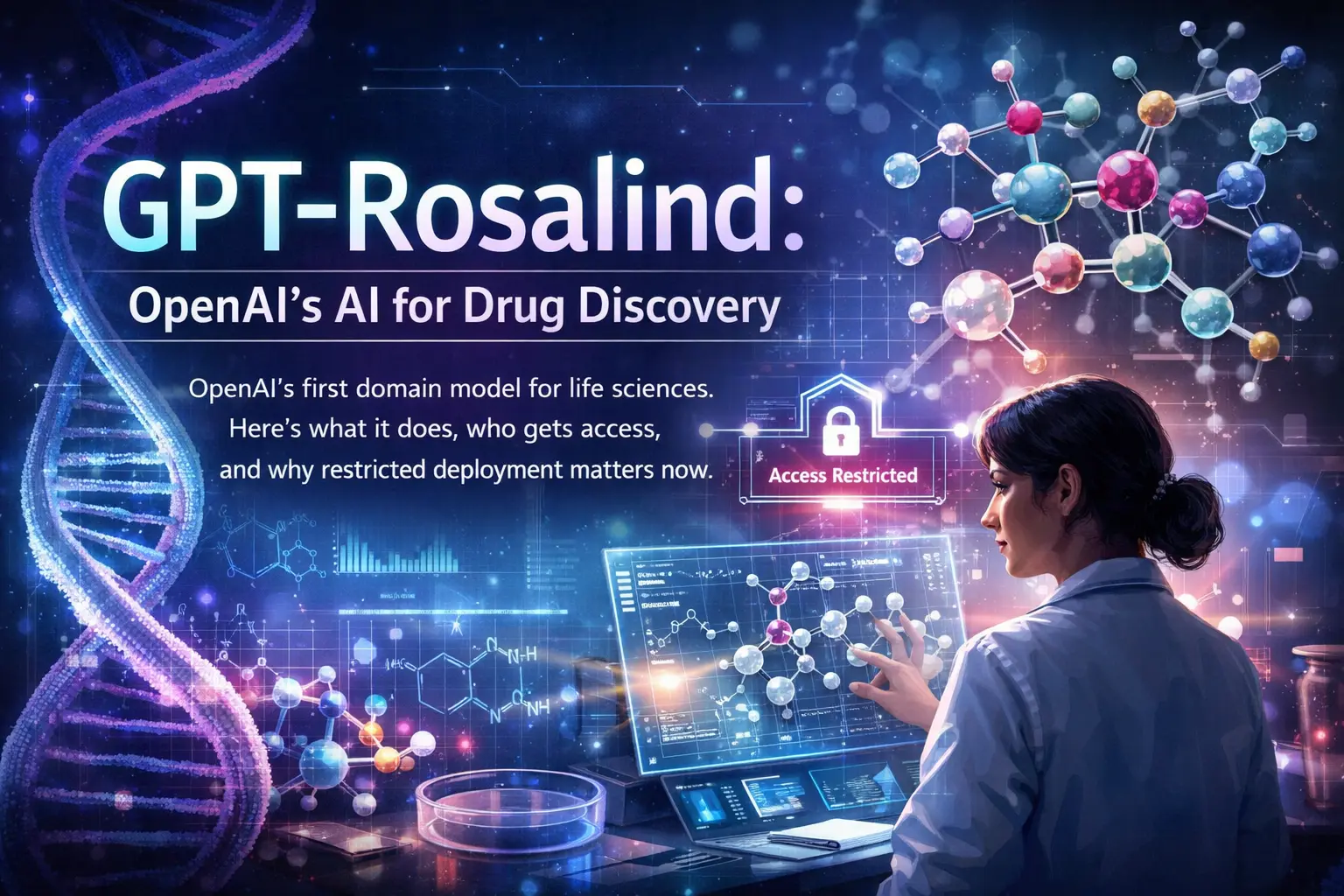
GPT-Rosalind is OpenAI’s first purpose-built, domain-specific frontier model — released on April 16, 2026 as a research preview for life sciences, and locked behind a vetted-access program for a small group of pharma, biotech, and research partners. It is a genuinely different kind of OpenAI launch, and the shape of it says more about where frontier AI is going than the benchmark numbers do.
I’ve been watching general-purpose models inch into regulated science for about two years. They get most things right, get some things catastrophically wrong, and nobody wants to sign a pharma contract that says “the chatbot told us to try this target.” GPT-Rosalind is the first serious OpenAI attempt to ship a model that a drug company can actually wire into a workflow — and the first time they’ve told almost everyone “no, you cannot have it.”
Here’s what GPT-Rosalind actually does, how it performs, who is getting access, and why the restricted rollout is the most interesting part of the story.
What GPT-Rosalind is, in one paragraph
GPT-Rosalind is a frontier reasoning model tuned for biology. It reads scientific literature, synthesizes evidence, generates and refines hypotheses, plans experiments, and executes multi-step workflows across biochemistry, genomics and protein engineering. OpenAI named it after Rosalind Franklin, the chemist whose X-ray diffraction work was central to the discovery of DNA’s structure and whose contribution was famously underplayed for decades. The launch post describes it as the start of a model series, not a one-off release.
Two things matter about the product framing. First, Rosalind is positioned as a reasoning layer on top of specialist tools, not a replacement for them. It calls out to structure predictors, genomics databases, and lab-planning systems via a new Life Sciences research plugin wired to more than 50 scientific tools and datasets. Second, it ships as a research preview inside ChatGPT, Codex, and the API — meaning it plugs directly into the workflows scientists already have.
If you came here looking for a link to try it yourself, you’re not going to get one. I’ll get to why in a moment.
Why this launch actually matters
Most frontier model launches are competitive theater. A new benchmark topper, a bigger context window, marginally better tool use. GPT-Rosalind is different for three reasons that compound.
It’s the first domain-specific model series from OpenAI. Until now, OpenAI’s bet was that a single general model could be the best doctor, lawyer, coder, and scientist. Rosalind is an explicit retreat from that bet for at least one domain. VentureBeat frames it as the start of a series of specialty models, and OpenAI itself is calling Rosalind the first of a family.
It’s the first time OpenAI has launched a model nobody can buy. Access goes to a trusted set of enterprise customers in the United States, under governance terms that most startups could not meet if they wanted to. Decrypt’s reporting put it plainly — the model could shave years off drug discovery, and you probably cannot use it.
It lands in a market that is already crowded. Isomorphic Labs shipped IsoDDE earlier this year. DeepMind has AlphaFold 3 and its successors. Recursion, Insitro and a dozen others each have their own stack. What OpenAI is betting is that a reasoning model that can orchestrate those specialist tools is more valuable than another structure predictor. That’s a different slice of the value chain, and if they’re right, it’s the bigger slice.
The benchmark numbers, and how much to trust them
Benchmark results on domain-specific models are usually noisy. I was cautious reading these, and most of them held up.
| Benchmark | GPT-Rosalind | Notes |
|---|---|---|
| BixBench (bioinformatics) | 0.751 | Highest published score |
| LABBench2 | Beat GPT-5.4 on 6 of 11 tasks | Head-to-head against general model |
| RNA sequence-to-function (prediction) | >95th percentile vs human experts | Unpublished RNA set, best-of-10 |
| RNA sequence-to-function (generation) | ~84th percentile vs human experts | Unpublished RNA set, best-of-10 |
The RNA test is the one I pay most attention to. OpenAI used unpublished sequences specifically so the model could not have memorized the answers from training. That’s the right move. Pharmaphorum’s write-up and Fierce Biotech’s coverage both flag the contamination-resistant methodology as unusually rigorous for a launch benchmark.
The BixBench number matters less. Any top-of-leaderboard claim on a public benchmark deserves skepticism about data leakage. What it tells you is that Rosalind is at least on the frontier for bioinformatics-style tasks, not whether it’s qualitatively different.
What I’d actually want to see — and what we will not see for months — is head-to-head comparison on real pharmaceutical workflows. How often does it propose viable targets? How often does it suggest an experiment that a wet-lab team would actually run? Those are the numbers that decide whether Rosalind is a scientific tool or a fancy literature search engine. My recommendation for anyone tracking this: ignore launch benchmarks and wait for the partner case studies that will show up in Q3 and Q4.
Who gets access — and who doesn’t
Launch partners, per OpenAI’s announcement, include:
- Amgen, Moderna, Novo Nordisk, and Thermo Fisher Scientific on the pharma and biotech side
- Oracle Health and Life Sciences as the data and infrastructure partner
- NVIDIA on the compute side
- Benchling for lab-workflow integration
- The Allen Institute and UCSF School of Pharmacy on the academic side
- Los Alamos National Laboratory for protein and catalyst design
Axios reporting notes the Novo Nordisk partnership was announced just two days before the Rosalind launch, on April 14, as part of the broader commercial rollout. That’s a tell — these partnerships were being lined up well before public launch, which is typical for any model that carries dual-use risk.
Everybody else is locked out. OpenAI’s three-principle framing — beneficial use, strong governance, controlled access — is the biosecurity fence. Participating organizations must be doing legitimate research, maintain compliance and misuse-prevention controls, and restrict access to approved users in secure environments. If you’re a solo researcher or small biotech, you are not on that list and will not be soon.
This is not a commercial moat. This is the dual-use problem showing up in product design. A model that can reason fluently about protein engineering is, by construction, a model that can reason fluently about pathogen engineering. The access gate is doing the same work that restricted-access gene synthesis screening does for oligo suppliers. I think it’s the right call, and I think more domain models in high-risk areas will launch this way.
How GPT-Rosalind fits with existing drug discovery AI
Drug discovery AI in 2026 is a three-layer cake. For the broader pipeline view, I wrote a separate explainer on the role of generative AI in drug discovery that covers target identification, molecule design, screening, and validation.
Layer 1 — structure and binding predictors. AlphaFold 3, IsoDDE, Boltz-2. These predict how a molecule binds to a target. IsoDDE doubled AlphaFold 3’s accuracy on difficult protein-ligand cases, per Isomorphic Labs’ own writeup, and now defines the state of the art.
Layer 2 — specialized ML for specific tasks. ADMET predictors, toxicity models, synthesis-route planners, antibody-design systems. Narrow, deeply-tuned, not general.
Layer 3 — reasoning and orchestration. GPT-Rosalind lives here. It reads the literature, decides which Layer 1 and Layer 2 tool to call, interprets their outputs, plans the next experiment, flags conflicting evidence.
This is the layer that has been missing. Scientists have spent the last three years either doing this orchestration by hand or piping a general GPT into bespoke tooling and hoping for the best. What I’ve seen in biotech communities is that the orchestration layer is where most of the research time actually goes — literature review, cross-database reconciliation, figuring out what to run next. Rosalind is aimed at that, not at replacing the structure oracles.
That design choice is what makes Rosalind interesting to people already running agentic AI systems. The pattern — a reasoning model orchestrating a fleet of specialist tools via a protocol — is the same pattern that shows up in multi-agent frameworks and in the Model Context Protocol ecosystem that underpins most 2026 agent stacks. Rosalind is essentially a domain-tuned agent with access to a curated tool garden.
The regulatory problem nobody is talking about
Drug discovery is not just a biosecurity problem. It is a regulated industry, and the regulatory surface for AI in clinical work is still being written.
Two things are worth tracking. First, the EU AI Act brings high-risk AI systems under formal technical documentation, monitoring, and audit requirements starting in August 2026. A model that generates hypotheses eventually feeding into clinical protocols sits in a grey zone the Act has not fully resolved. Second, the UK’s MHRA AI Airlock program is actively testing AI in medical device regulation, and Japan is moving fast on its own AI framework for healthcare applications.
GPT-Rosalind itself is not a medical device. But the outputs feeding downstream decisions — drug targets, experimental designs, literature synthesis for grant applications — will increasingly come under scrutiny as regulators work out what “human oversight” means in AI-assisted science. I’d expect pharma legal teams at the launch partners to be spending real time on documentation and audit logs right now.
What this signals for the rest of the model market
One launch does not make a pattern, but put Rosalind next to a few other 2026 moves — IsoDDE, specialized medical models, finance-tuned frontier systems, the new generation of coding-specialized agents — and a trajectory comes into focus.
General frontier models are not getting replaced. They are getting supplemented. The winners over the next eighteen months will likely be the labs that can ship credible domain models where the risks are real, the data is proprietary, and the customers are regulated. OpenAI has three of those three for life sciences. Anthropic has quietly been building similar capacity for coding and security. Google has biology through DeepMind and Isomorphic.
The second signal is on access. If you’re a mid-market biotech that cannot cut a trusted-access deal with OpenAI, your realistic options for frontier biology reasoning are going to be open-source models plus your own orchestration layer. The open-weight side — Gemma 4, Llama 4 — is catching up on general reasoning but does not have Rosalind-level biology tuning. That gap will not close quickly.
My recommendation if you’re in life sciences
If you’re a researcher or biotech with access: do not treat Rosalind as an oracle. Use it as an orchestrator. Ask it to plan experiments, reconcile conflicting papers, and propose targets — then route everything through your existing validation pipeline and structure tools. The RNA sequence-to-function numbers are strong, but strong means “the best of ten outputs” in most of the benchmarks. Rosalind is still a model that generates and ranks candidates.
If you’re not on the access list: watch the partner case studies, not the marketing. The real story is going to be told six months from now in publications from Amgen, Moderna, UCSF, and the Allen Institute. If those produce specific wins — shaved months, validated targets, experiments that would not have been designed otherwise — the next wave of domain-specific models will get funded on that evidence.
Rosalind is the first commercial signal that the next frontier of AI is not bigger general models, but serious domain models with real governance around them. That is a better future than one built around one-size-fits-all chatbots, even if the trade-off is that almost nobody gets to use the best tools.